August 9, 2026
LATEST
New EU Gas Market Rules Take Effect With Consumer SafeguardsDeforestation Regulation Holds Its December Deadline Despite CutsDigital Omnibus Delays Europe’s High-Risk AI Deadline to 2027Europe’s Schools Confront a Widening Basic Skills GapRule of Law Report Finds Progress but Trust Still LagsIRIS2 Gains 66 Satellites as Brussels Signs the Rollout DealNature Restoration Plans Come Due as Member States Race a DeadlineECB Rates Hold at 2.25 Percent as Frankfurt Waits on the DataEU Budget Talks Turn to Cohesion as Ireland Takes OverWildfire Response Stretches Europe’s Emergency Fleet ThinCan Europe’s Quantum Plan Match Its Big Ambitions?Armenia Edges West as Moscow’s Grip Slips AwayEurope Inherits the World’s Aid Bill It Cannot Fully PayAir Passenger Rights Get Their First Overhaul in Two DecadesErasmus Opens a 5 Billion Euro Round for Skills and MobilityCeuta Crisis Pushes the EU Toward Faster Migrant ReturnsBulky Parcels Face a Packaging Crackdown From August 12Can Europe Build Its Drone Wall Before 2030 Arrives?Indonesia’s Trade Deal With Europe Nears Its Final SignatureEurope Leans on Beijing to Keep Climate Talks Alive Before AntalyaNew EU Gas Market Rules Take Effect With Consumer SafeguardsDeforestation Regulation Holds Its December Deadline Despite CutsDigital Omnibus Delays Europe’s High-Risk AI Deadline to 2027Europe’s Schools Confront a Widening Basic Skills GapRule of Law Report Finds Progress but Trust Still LagsIRIS2 Gains 66 Satellites as Brussels Signs the Rollout DealNature Restoration Plans Come Due as Member States Race a DeadlineECB Rates Hold at 2.25 Percent as Frankfurt Waits on the DataEU Budget Talks Turn to Cohesion as Ireland Takes OverWildfire Response Stretches Europe’s Emergency Fleet ThinCan Europe’s Quantum Plan Match Its Big Ambitions?Armenia Edges West as Moscow’s Grip Slips AwayEurope Inherits the World’s Aid Bill It Cannot Fully PayAir Passenger Rights Get Their First Overhaul in Two DecadesErasmus Opens a 5 Billion Euro Round for Skills and MobilityCeuta Crisis Pushes the EU Toward Faster Migrant ReturnsBulky Parcels Face a Packaging Crackdown From August 12Can Europe Build Its Drone Wall Before 2030 Arrives?Indonesia’s Trade Deal With Europe Nears Its Final SignatureEurope Leans on Beijing to Keep Climate Talks Alive Before Antalya
August 9, 2026
LATEST
New EU Gas Market Rules Take Effect With Consumer SafeguardsDeforestation Regulation Holds Its December Deadline Despite CutsDigital Omnibus Delays Europe’s High-Risk AI Deadline to 2027Europe’s Schools Confront a Widening Basic Skills GapRule of Law Report Finds Progress but Trust Still LagsIRIS2 Gains 66 Satellites as Brussels Signs the Rollout DealNature Restoration Plans Come Due as Member States Race a DeadlineECB Rates Hold at 2.25 Percent as Frankfurt Waits on the DataEU Budget Talks Turn to Cohesion as Ireland Takes OverWildfire Response Stretches Europe’s Emergency Fleet ThinCan Europe’s Quantum Plan Match Its Big Ambitions?Armenia Edges West as Moscow’s Grip Slips AwayEurope Inherits the World’s Aid Bill It Cannot Fully PayAir Passenger Rights Get Their First Overhaul in Two DecadesErasmus Opens a 5 Billion Euro Round for Skills and MobilityCeuta Crisis Pushes the EU Toward Faster Migrant ReturnsBulky Parcels Face a Packaging Crackdown From August 12Can Europe Build Its Drone Wall Before 2030 Arrives?Indonesia’s Trade Deal With Europe Nears Its Final SignatureEurope Leans on Beijing to Keep Climate Talks Alive Before AntalyaNew EU Gas Market Rules Take Effect With Consumer SafeguardsDeforestation Regulation Holds Its December Deadline Despite CutsDigital Omnibus Delays Europe’s High-Risk AI Deadline to 2027Europe’s Schools Confront a Widening Basic Skills GapRule of Law Report Finds Progress but Trust Still LagsIRIS2 Gains 66 Satellites as Brussels Signs the Rollout DealNature Restoration Plans Come Due as Member States Race a DeadlineECB Rates Hold at 2.25 Percent as Frankfurt Waits on the DataEU Budget Talks Turn to Cohesion as Ireland Takes OverWildfire Response Stretches Europe’s Emergency Fleet ThinCan Europe’s Quantum Plan Match Its Big Ambitions?Armenia Edges West as Moscow’s Grip Slips AwayEurope Inherits the World’s Aid Bill It Cannot Fully PayAir Passenger Rights Get Their First Overhaul in Two DecadesErasmus Opens a 5 Billion Euro Round for Skills and MobilityCeuta Crisis Pushes the EU Toward Faster Migrant ReturnsBulky Parcels Face a Packaging Crackdown From August 12Can Europe Build Its Drone Wall Before 2030 Arrives?Indonesia’s Trade Deal With Europe Nears Its Final SignatureEurope Leans on Beijing to Keep Climate Talks Alive Before Antalya

Damascus Reopens to Brussels as Sanctions Architecture Eases

Damascus: The Council’s decision on 18 May to renew restrictive measures against the former al-Assad regime for another year, while simultaneously de-listing the Syrian Ministries of Defence and Interior alongside several other entities, captures the awkward calibration Brussels is performing in real time. After fourteen years in which the EU treated the Syrian file as effectively closed, the bloc is now constructing a sanctions architecture that punishes a regime which no longer exists while opening institutional channels with the one that replaced it.

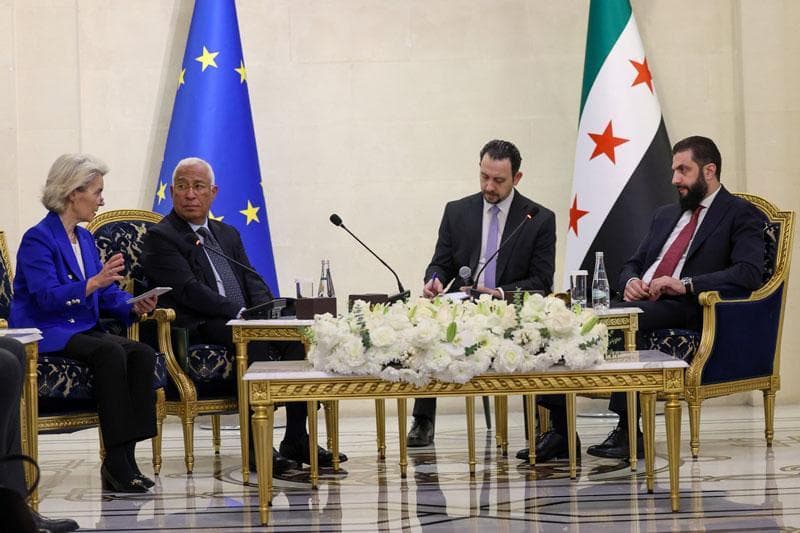
The high-level political dialogue held earlier this month provided the political wrapper. EU representatives sat across the table from Syria’s transitional authorities for the first time in over a decade, with the agenda built around stabilisation, socio-economic recovery and inclusive political transition. The financial envelope being prepared beneath that dialogue tells the story: a 175 million euro package already pledged, a further 180 million euros for 2026-2027, bringing the EU’s bilateral commitment to 455 million euros before factoring in Syria’s share of the broader 5.8 billion euro pledge for 2025-2026 raised at last year’s conference for support to Syria and host communities in Lebanon, Jordan, Iraq and Türkiye.

The de-listings are the operational pivot. By removing the Ministries of Defence and Interior from the asset-freeze and travel-ban list, the Council has unlocked the bureaucratic counterparts that any reconstruction programme needs to engage. Without that step, contractors funded by EU humanitarian instruments could not safely contract with the very ministries responsible for licensing rebuilding, returning displaced populations and securing aid corridors. The legal carve-out is therefore less a political reward to the al-Sharaa government than a precondition for the EU’s own delivery model to function on Syrian soil.

Three forces are driving the speed of the reset. The first is migration. By late January 2026, around 1.12 million Syrians had returned to Syria since December 2024, most of them from Türkiye, Lebanon and Jordan. Member-state interior ministries have read those numbers as a window to begin orderly returns from European territory as well, where Syrian nationals have made up the largest single asylum cohort for more than a decade. The second is reconstruction sequencing. If the EU does not anchor the early phases of recovery — energy, water, basic public administration, civil protection capacity — Gulf capital and Turkish contractors will define the rules of the rebuild, leaving Brussels paying later for outcomes it did not shape. The third is regional spillover containment, with Lebanon’s 1 billion euro EU package for 2024-2027 and an additional 100 million euros in humanitarian aid in 2026 explicitly designed to absorb the demographic and fiscal shocks of any disorderly transition next door.

Analytical caution is warranted. The Council’s renewal of sanctions on Assad-era figures preserves accountability optics but does little operationally, because most of the former command structure has either fled or is dead. The harder test is whether the EU can keep its conditionality framework intact as money begins to flow. Brussels has staked its position on the idea that aid can be sequenced against institutional benchmarks — judicial reform, minority protection, civilian control of the security apparatus — but no Syrian transition since the 1970s has held up under conditionality this granular. The risk is that the first major disbursement is followed by political slippage that the EU finds itself unwilling to publicly punish, having already invested too much credibility in the reset.

There is also a humanitarian arithmetic that the political conversation tends to skip. The 455 million euros earmarked bilaterally is significant but small against UN estimates that put Syria’s reconstruction needs in the hundreds of billions. EU money will only be catalytic if it is sequenced to unlock larger flows from international financial institutions and Gulf partners, and if civil protection and humanitarian access guarantees are written into the disbursement triggers rather than treated as background language. The methodology Brussels has chosen — convert a moment of geopolitical opening into instruments designed to outlast the moment — is the right one. Whether it survives contact with the most exposed of the EU’s southern neighbourhoods will define how seriously the bloc’s broader Mediterranean strategy is taken for the rest of the decade.