Brussels: The European Union and the People’s Republic of China marked fifty years of formal diplomatic relations in 2025, and the institutional choreography surrounding the anniversary obscured an analytical reality that policymakers in both capitals now acknowledge in private. The bilateral relationship has undergone a more profound transformation in the last five years than in the preceding forty-five combined. Yet the architecture connecting Brussels and Beijing has proved remarkably durable, surviving sanctions, counter-sanctions, the indefinite suspension of the Comprehensive Agreement on Investment, and a fundamental reframing of European strategic priorities.
The structural tension is now unmistakable. Economic interdependence has remained substantial. China is among the EU’s largest trading partners, and supply chains across automotive, machinery, electronics and renewable energy remain deeply integrated. Annual bilateral institutional contact spans more than sixty mechanisms — from heads of state summits and ministerial dialogues to technical sectoral working groups — and these have continued to function even during periods of acute political friction. On climate cooperation, both sides have sustained meaningful coordination, recognising that emissions trajectories in two of the world’s three largest economies are inseparable from any credible global mitigation pathway.
Yet the political register has changed irrevocably. The 2019 Strategic Outlook characterised China as a partner, competitor and systemic rival in a single tripartite formulation that, at the time, struck observers as analytically novel and politically courageous. Six years later, that formulation has been operationalised in ways its drafters did not fully anticipate. The de-risking framework articulated by Commission President Ursula von der Leyen in March 2023 represented a definitive break with the assumption that growing economic interdependence would, over time, generate normative convergence. Instead, the EU has assembled an array of defensive policy instruments — the Foreign Subsidies Regulation, the Anti-Coercion Instrument, expanded foreign direct investment screening, and the Critical Raw Materials Act — designed to insulate the Single Market from asymmetric dependencies.
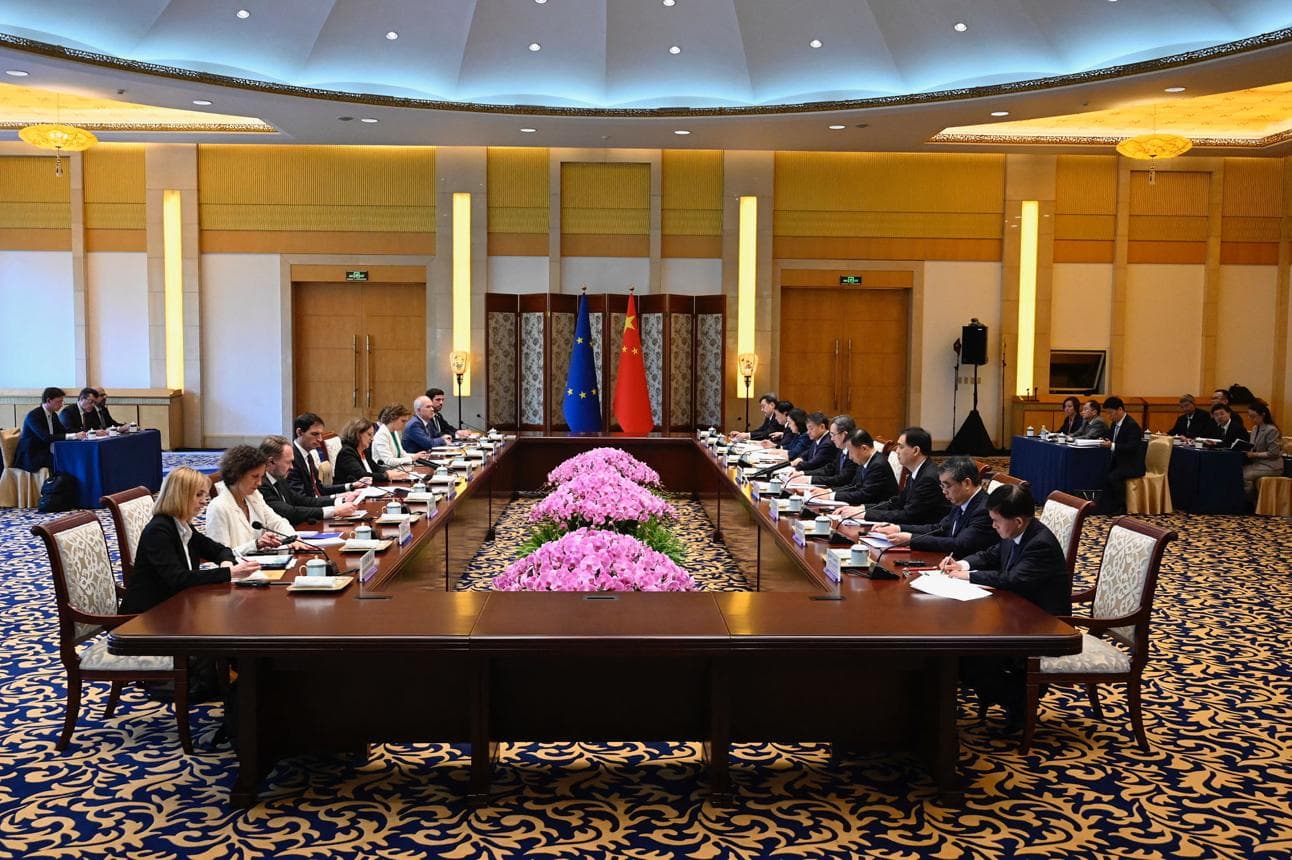
NATO’s 2022 Strategic Concept formally identified China as posing systemic challenges to Euro-Atlantic security, and successive European Council conclusions have echoed that assessment, particularly concerning Beijing’s deepening alignment with Russia. The thirteenth EU–China Strategic Dialogue, held in Brussels in July 2025, was conducted in this transformed strategic atmosphere. High Representative Kaja Kallas met with Wang Yi, the Director of the Central Foreign Affairs Commission Office of the Chinese Communist Party, in a session that produced no breakthroughs but maintained the channel — which is itself a substantive outcome in current conditions.
The economic dimension has proved equally consequential. The European Commission’s anti-subsidy investigation into Chinese electric vehicles, and the subsequent imposition of countervailing duties, has demonstrated that the EU is prepared to deploy trade defence instruments at industrial scale. Beijing has responded with reciprocal investigations and selective export controls on rare earth elements and critical minerals, accelerating European efforts to diversify supply chains across the Indo-Pacific and Africa.
What endures, despite all this, is the institutional infrastructure. The summits continue. The technical exchanges proceed. The compartmentalisation of cooperation and competition has become an art form, and it is one that both Brussels and Beijing have considerable institutional incentive to preserve. The alternative — a comprehensive rupture — would impose costs that neither system is willing to absorb in the current global environment.
What the fiftieth anniversary genuinely marks is not a celebration of past partnership but the establishment of a more candid framework. Both sides now operate within explicit acknowledgement of structural rivalry while maintaining sufficient diplomatic infrastructure to manage that rivalry below the threshold of confrontation. Whether this equilibrium proves stable through the next decade will depend less on declarations than on how each side calibrates its response to the next inevitable point of friction.