August 22, 2026
LATEST
What the EU Taiwan Framework Would Actually Have to DoKorea Signed a Digital Trade Deal That Nobody Has RatifiedCritical Minerals in Mongolia Still Have to Cross Two BordersCan an Indonesia Trade Deal Survive Two Years of RatifyingCross-Border Data Orders Went Live Before the Plumbing DidPlatform Work Rules Take Effect in December and Few Are ReadyCan Europe’s Firefighting Fleet Keep Pace With EU WildfiresThe AI Act Deadline Passed on 2 August and Nothing BitWhy Construction Keeps Shrinking While Confidence ImprovesAccession Talks Stall Again and September 1 Is the TestBrussels Applied a Trade Deal It Cannot Yet RatifyAfrica’s Power Market Now Needs Money More Than BlueprintsLong-Term Budget Talks Enter Autumn Without a Council LineForeign Subsidies Enforcement Now Turns on a Dublin RaidWho Writes Europe’s Telecom Rules Once Copper DisappearsDisability Cards Exist on Paper and Nowhere Else Until 2028Losing Visa-Free Travel Now Takes a Thirty Percent SwingTwenty Flagship Actions Will Test Whether the Culture Compass WorksEurope’s Quality Jobs Act Now Rests on What Unions Do by SeptemberDoes a Three Euro Parcel Duty Change Anything About Cheap ImportsWhat the EU Taiwan Framework Would Actually Have to DoKorea Signed a Digital Trade Deal That Nobody Has RatifiedCritical Minerals in Mongolia Still Have to Cross Two BordersCan an Indonesia Trade Deal Survive Two Years of RatifyingCross-Border Data Orders Went Live Before the Plumbing DidPlatform Work Rules Take Effect in December and Few Are ReadyCan Europe’s Firefighting Fleet Keep Pace With EU WildfiresThe AI Act Deadline Passed on 2 August and Nothing BitWhy Construction Keeps Shrinking While Confidence ImprovesAccession Talks Stall Again and September 1 Is the TestBrussels Applied a Trade Deal It Cannot Yet RatifyAfrica’s Power Market Now Needs Money More Than BlueprintsLong-Term Budget Talks Enter Autumn Without a Council LineForeign Subsidies Enforcement Now Turns on a Dublin RaidWho Writes Europe’s Telecom Rules Once Copper DisappearsDisability Cards Exist on Paper and Nowhere Else Until 2028Losing Visa-Free Travel Now Takes a Thirty Percent SwingTwenty Flagship Actions Will Test Whether the Culture Compass WorksEurope’s Quality Jobs Act Now Rests on What Unions Do by SeptemberDoes a Three Euro Parcel Duty Change Anything About Cheap Imports
August 22, 2026
LATEST
What the EU Taiwan Framework Would Actually Have to DoKorea Signed a Digital Trade Deal That Nobody Has RatifiedCritical Minerals in Mongolia Still Have to Cross Two BordersCan an Indonesia Trade Deal Survive Two Years of RatifyingCross-Border Data Orders Went Live Before the Plumbing DidPlatform Work Rules Take Effect in December and Few Are ReadyCan Europe’s Firefighting Fleet Keep Pace With EU WildfiresThe AI Act Deadline Passed on 2 August and Nothing BitWhy Construction Keeps Shrinking While Confidence ImprovesAccession Talks Stall Again and September 1 Is the TestBrussels Applied a Trade Deal It Cannot Yet RatifyAfrica’s Power Market Now Needs Money More Than BlueprintsLong-Term Budget Talks Enter Autumn Without a Council LineForeign Subsidies Enforcement Now Turns on a Dublin RaidWho Writes Europe’s Telecom Rules Once Copper DisappearsDisability Cards Exist on Paper and Nowhere Else Until 2028Losing Visa-Free Travel Now Takes a Thirty Percent SwingTwenty Flagship Actions Will Test Whether the Culture Compass WorksEurope’s Quality Jobs Act Now Rests on What Unions Do by SeptemberDoes a Three Euro Parcel Duty Change Anything About Cheap ImportsWhat the EU Taiwan Framework Would Actually Have to DoKorea Signed a Digital Trade Deal That Nobody Has RatifiedCritical Minerals in Mongolia Still Have to Cross Two BordersCan an Indonesia Trade Deal Survive Two Years of RatifyingCross-Border Data Orders Went Live Before the Plumbing DidPlatform Work Rules Take Effect in December and Few Are ReadyCan Europe’s Firefighting Fleet Keep Pace With EU WildfiresThe AI Act Deadline Passed on 2 August and Nothing BitWhy Construction Keeps Shrinking While Confidence ImprovesAccession Talks Stall Again and September 1 Is the TestBrussels Applied a Trade Deal It Cannot Yet RatifyAfrica’s Power Market Now Needs Money More Than BlueprintsLong-Term Budget Talks Enter Autumn Without a Council LineForeign Subsidies Enforcement Now Turns on a Dublin RaidWho Writes Europe’s Telecom Rules Once Copper DisappearsDisability Cards Exist on Paper and Nowhere Else Until 2028Losing Visa-Free Travel Now Takes a Thirty Percent SwingTwenty Flagship Actions Will Test Whether the Culture Compass WorksEurope’s Quality Jobs Act Now Rests on What Unions Do by SeptemberDoes a Three Euro Parcel Duty Change Anything About Cheap Imports

Europe and Japan Extend Their Alliance Into Quantum and AI

Yokohama: Europe and Japan have spent years describing each other as natural partners in trade. Their newest project is more ambitious and harder to measure: an attempt to fuse two advanced economies at the level of the technologies that will define the next decade, from quantum machines to the artificial intelligence models now reshaping every industry.

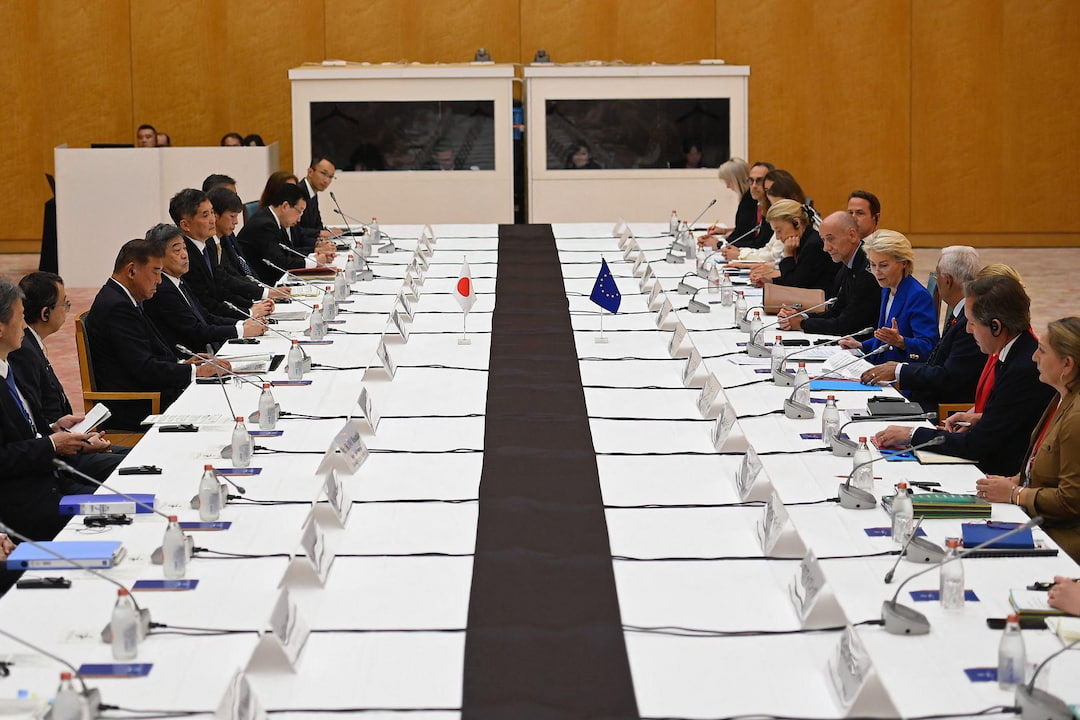
The scaffolding went up at last year’s Tokyo summit, where leaders launched a Competitiveness Alliance that reaches well beyond tariffs. It knits together data flows, cybersecurity, connectivity, quantum research and joint work on artificial intelligence, and it sits alongside a partnership on critical minerals meant to loosen China’s grip on the inputs that all of this hardware needs. The summit statement read less like a communique than a shared industrial strategy.

Politics in Tokyo has since given the effort a harder edge. Prime Minister Sanae Takaichi took power early this year with a commanding majority and a pledge to accelerate spending on defence and technology and to loosen the export controls that once kept Japanese firms cautious abroad. A government willing to move fast on dual-use research is exactly the partner Brussels has been looking for as it tries to turn strategy papers into working laboratories.

The logic is defensive as much as commercial. Both economies watched the pandemic and the rare-earth squeeze expose how thoroughly a single supplier could hold their factories hostage. Neither can match the scale of the United States or China alone. Pooled research budgets, shared standards and interoperable networks let a mid-sized bloc and a mid-sized power behave, on the questions that matter most, like something closer to a great power.

Quantum computing is the clearest test. The field rewards deep pockets, patient capital and access to rare talent, and no European or Japanese champion can outspend the American giants on its own. By agreeing to align research programmes and let their scientists move between labs, Brussels and Tokyo are betting that combination beats duplication. The same instinct drives their work on artificial intelligence, where the two sides want to prove that democracies can build powerful models without copying either Silicon Valley’s light-touch rules or Beijing’s surveillance defaults.

None of this comes cheaply, and the obstacles are real. Europe’s twenty-seven members guard their research money jealously, Japanese firms move at their own careful pace, and export-control regimes on both sides can still smother a joint venture in paperwork. Data-transfer rules that look aligned on paper often diverge the moment a regulator gets involved. Grand alliances have a habit of shrinking to a handful of pilot projects once the budgets are drawn.

What separates this attempt from earlier declarations is the sense of a closing window. Both governments believe the architecture of the digital age is being poured now, and that latecomers will inherit rules written by others. Whether Europe and Japan can pour fast enough to matter is unproven. But by choosing to build the foundations together, they have at least decided not to hand the job to anyone else.