August 22, 2026
LATEST
Critical Minerals in Mongolia Still Have to Cross Two BordersCan an Indonesia Trade Deal Survive Two Years of RatifyingCross-Border Data Orders Went Live Before the Plumbing DidPlatform Work Rules Take Effect in December and Few Are ReadyCan Europe’s Firefighting Fleet Keep Pace With EU WildfiresThe AI Act Deadline Passed on 2 August and Nothing BitWhy Construction Keeps Shrinking While Confidence ImprovesAccession Talks Stall Again and September 1 Is the TestBrussels Applied a Trade Deal It Cannot Yet RatifyAfrica’s Power Market Now Needs Money More Than BlueprintsLong-Term Budget Talks Enter Autumn Without a Council LineForeign Subsidies Enforcement Now Turns on a Dublin RaidWho Writes Europe’s Telecom Rules Once Copper DisappearsDisability Cards Exist on Paper and Nowhere Else Until 2028Losing Visa-Free Travel Now Takes a Thirty Percent SwingTwenty Flagship Actions Will Test Whether the Culture Compass WorksEurope’s Quality Jobs Act Now Rests on What Unions Do by SeptemberDoes a Three Euro Parcel Duty Change Anything About Cheap ImportsEurope’s Satellite Constellation Grew by 66 Before a Single LaunchCan Europe’s Defence Industry Absorb 1.5 Billion by FebruaryCritical Minerals in Mongolia Still Have to Cross Two BordersCan an Indonesia Trade Deal Survive Two Years of RatifyingCross-Border Data Orders Went Live Before the Plumbing DidPlatform Work Rules Take Effect in December and Few Are ReadyCan Europe’s Firefighting Fleet Keep Pace With EU WildfiresThe AI Act Deadline Passed on 2 August and Nothing BitWhy Construction Keeps Shrinking While Confidence ImprovesAccession Talks Stall Again and September 1 Is the TestBrussels Applied a Trade Deal It Cannot Yet RatifyAfrica’s Power Market Now Needs Money More Than BlueprintsLong-Term Budget Talks Enter Autumn Without a Council LineForeign Subsidies Enforcement Now Turns on a Dublin RaidWho Writes Europe’s Telecom Rules Once Copper DisappearsDisability Cards Exist on Paper and Nowhere Else Until 2028Losing Visa-Free Travel Now Takes a Thirty Percent SwingTwenty Flagship Actions Will Test Whether the Culture Compass WorksEurope’s Quality Jobs Act Now Rests on What Unions Do by SeptemberDoes a Three Euro Parcel Duty Change Anything About Cheap ImportsEurope’s Satellite Constellation Grew by 66 Before a Single LaunchCan Europe’s Defence Industry Absorb 1.5 Billion by February
August 22, 2026
LATEST
Critical Minerals in Mongolia Still Have to Cross Two BordersCan an Indonesia Trade Deal Survive Two Years of RatifyingCross-Border Data Orders Went Live Before the Plumbing DidPlatform Work Rules Take Effect in December and Few Are ReadyCan Europe’s Firefighting Fleet Keep Pace With EU WildfiresThe AI Act Deadline Passed on 2 August and Nothing BitWhy Construction Keeps Shrinking While Confidence ImprovesAccession Talks Stall Again and September 1 Is the TestBrussels Applied a Trade Deal It Cannot Yet RatifyAfrica’s Power Market Now Needs Money More Than BlueprintsLong-Term Budget Talks Enter Autumn Without a Council LineForeign Subsidies Enforcement Now Turns on a Dublin RaidWho Writes Europe’s Telecom Rules Once Copper DisappearsDisability Cards Exist on Paper and Nowhere Else Until 2028Losing Visa-Free Travel Now Takes a Thirty Percent SwingTwenty Flagship Actions Will Test Whether the Culture Compass WorksEurope’s Quality Jobs Act Now Rests on What Unions Do by SeptemberDoes a Three Euro Parcel Duty Change Anything About Cheap ImportsEurope’s Satellite Constellation Grew by 66 Before a Single LaunchCan Europe’s Defence Industry Absorb 1.5 Billion by FebruaryCritical Minerals in Mongolia Still Have to Cross Two BordersCan an Indonesia Trade Deal Survive Two Years of RatifyingCross-Border Data Orders Went Live Before the Plumbing DidPlatform Work Rules Take Effect in December and Few Are ReadyCan Europe’s Firefighting Fleet Keep Pace With EU WildfiresThe AI Act Deadline Passed on 2 August and Nothing BitWhy Construction Keeps Shrinking While Confidence ImprovesAccession Talks Stall Again and September 1 Is the TestBrussels Applied a Trade Deal It Cannot Yet RatifyAfrica’s Power Market Now Needs Money More Than BlueprintsLong-Term Budget Talks Enter Autumn Without a Council LineForeign Subsidies Enforcement Now Turns on a Dublin RaidWho Writes Europe’s Telecom Rules Once Copper DisappearsDisability Cards Exist on Paper and Nowhere Else Until 2028Losing Visa-Free Travel Now Takes a Thirty Percent SwingTwenty Flagship Actions Will Test Whether the Culture Compass WorksEurope’s Quality Jobs Act Now Rests on What Unions Do by SeptemberDoes a Three Euro Parcel Duty Change Anything About Cheap ImportsEurope’s Satellite Constellation Grew by 66 Before a Single LaunchCan Europe’s Defence Industry Absorb 1.5 Billion by February

Europe and Korea’s Defence Partnership Reached the Paperwork Stage

Changwon: The industrial city that builds much of South Korea’s armour and artillery has watched European delegations arrive with growing frequency, and it still holds no European contract signed under the framework those visitors keep citing.

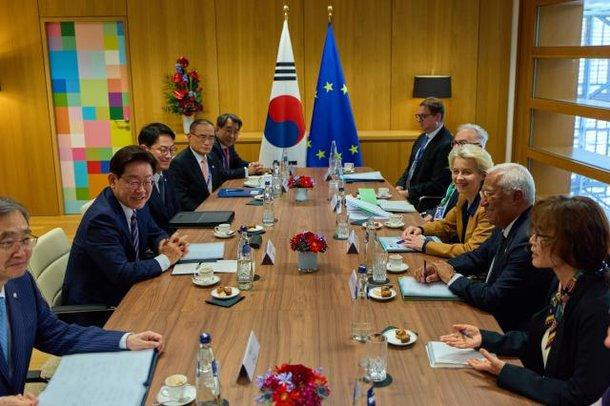
The European Union and the Republic of Korea signed a Security and Defence Partnership on 4 November 2024, making Seoul one of the first two Asian capitals to hold one, alongside Tokyo. Leaders reviewed implementation at their summit in Brussels on 10 June 2026 and agreed to widen the arrangement, listing maritime security, cyber defence, counter-hybrid work, space and developments on the Korean Peninsula. The European External Action Service publishes the text of the partnership, and the Council set out the summit outcome in its own record.

The defence partnership reads well and commits little. It creates a political framework, not a procurement channel. It obliges neither side to buy anything, fund anything or certify anything, and its deliverables live in dialogues rather than in dates. Two years after signature, that gap has started to show.

Korea’s relevance to European rearmament rests on evidence rather than rhetoric. Warsaw’s orders for K2 tanks, K9 howitzers and Chunmoo rocket artillery demonstrated the one thing European primes struggled to offer, which was delivery measured in months rather than in budget cycles. Korean industry then went further and moved assembly into Poland, converting a supply contract into an industrial relationship.

European instruments push the other way. The bloc’s defence industrial programmes weight eligibility toward European content and European supply chains, which makes a Korean-origin platform harder to fund from Brussels than from a national treasury. Seoul has read that rule correctly and localises production instead of arguing about it. The result is a partnership whose most substantial output happens bilaterally, between Korean firms and individual member states, while the EU-level channel handles the language.

The intelligence strand carries more weight than the industrial one. Korea watches North Korean force generation continuously, and Pyongyang’s deployment of troops and munitions in support of Russia turned that watch into information Europe needs for its own war assessment. Reciprocity runs the other way too, because European services track Russian technology transfers that end up on the Peninsula. Neither capital advertises this exchange, which is usually a sign that it works.

Implementation would look concrete if anyone wanted it to. A standing staff-to-staff channel with a named counterpart. Korean participation in a specific European maritime or space project rather than in a category. An export control conversation that reconciles Seoul’s licensing with European end-use rules before a deal rather than after one. Each of those carries a cost, which is why the summit language avoided all three.

Europe has now signed security and defence partnerships with more than a dozen states. The instrument has spread faster than the machinery behind it, and Korea is the case where the shortfall is easiest to measure, because the alternative relationship already exists and already delivers. Brussels has the signature. Changwon has the order book.