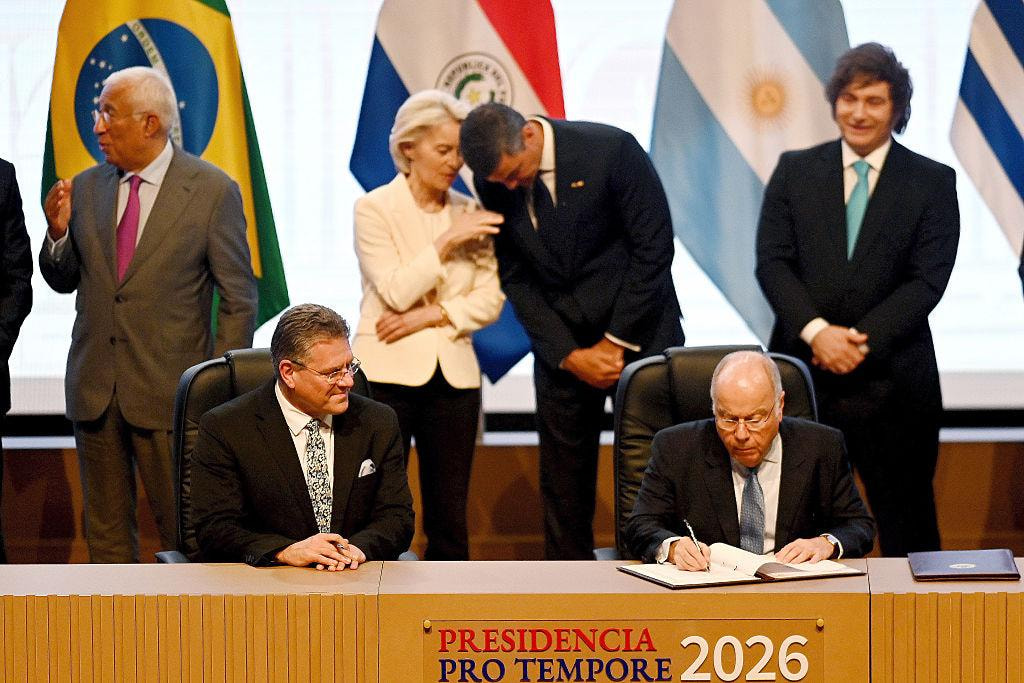
Montevideo: For twenty-five years the trade agreement between the European Union and Mercosur existed mainly as a cautionary tale about how long a negotiation can run before it collapses under its own weight. That changed quietly on 1 May, when the interim trade agreement began to apply provisionally, lowering tariffs on a vast range of goods flowing between Europe and the four founding members of the South American bloc. After a political breakthrough in December 2024 and a formal signature in January, European exporters of cars, machinery and wine can finally trade into Argentina, Brazil, Paraguay and Uruguay on preferential terms, while South American farmers gain wider access to the world’s largest single market.
The provisional start is a genuine milestone, but it is worth being precise about what has and has not happened. Mercosur has done its part with striking speed. Argentina ratified in late February, Uruguay a day later, Brazil in early March and Paraguay by the middle of the month, completing the bloc’s approval in a matter of weeks. The European side is messier. When member states endorsed the deal in January, the vote was a qualified majority of twenty-one to five, with Austria, France, Hungary, Ireland and Poland opposed and Belgium abstaining. Days later the European Parliament referred the agreement to the Court of Justice for a legal opinion that could take up to two years to deliver. The interim text applies now; the full partnership agreement remains hostage to litigation and to the ratification of every national parliament.
That split structure is the most revealing feature of the whole exercise. Brussels has learned to carve trade agreements into pieces it can implement on its own authority and pieces that require unanimous national consent, precisely because the second category has become a graveyard for ambitious deals. By splitting off the interim trade chapter, the Commission delivered tangible benefits to exporters while quarantining the politically toxic questions about investment, agriculture and environmental enforcement. It is clever procedure, but it also concentrates resentment. Farmers in France and Poland, who see South American beef and poultry as an existential threat, now confront a deal that is operating before their governments have formally agreed to it.
The economic logic for Europe is hard to dispute. The bloc has spent the past two years preaching the gospel of diversification, of reducing dependence on any single supplier or market after the shocks of recent years. A preferential corridor to a region rich in food, critical minerals and clean-energy potential fits that doctrine almost perfectly, and it lands at a moment when transatlantic trade with the United States has grown unpredictable. For Mercosur, Europe offers a counterweight to the Chinese demand that has come to dominate South American exports, and a standard-setting partner whose rules, however demanding, open doors elsewhere.
The unresolved questions are environmental and democratic rather than commercial. Critics argue the deal rewards agricultural expansion into sensitive ecosystems and that its sustainability commitments lack teeth. Supporters counter that engagement gives Europe more leverage over South American practices than walking away ever could. Both cases will be litigated in the most literal sense over the coming two years, in the Luxembourg courtroom where the Court of Justice will decide whether the Union even had the authority to structure the deal as it did.
What the provisional application proves is that Europe can still close a deal of historic scale when the strategic stakes are high enough. What the pending court case proves is that closing the deal and securing it are no longer the same thing. The agreement is alive, tariffs are falling, and ships are already moving under new terms. Whether it survives to become permanent now rests less with negotiators in Brussels and Montevideo than with judges in Luxembourg and parliaments scattered across the continent.