August 9, 2026
LATEST
New EU Gas Market Rules Take Effect With Consumer SafeguardsDeforestation Regulation Holds Its December Deadline Despite CutsDigital Omnibus Delays Europe’s High-Risk AI Deadline to 2027Europe’s Schools Confront a Widening Basic Skills GapRule of Law Report Finds Progress but Trust Still LagsIRIS2 Gains 66 Satellites as Brussels Signs the Rollout DealNature Restoration Plans Come Due as Member States Race a DeadlineECB Rates Hold at 2.25 Percent as Frankfurt Waits on the DataEU Budget Talks Turn to Cohesion as Ireland Takes OverWildfire Response Stretches Europe’s Emergency Fleet ThinCan Europe’s Quantum Plan Match Its Big Ambitions?Armenia Edges West as Moscow’s Grip Slips AwayEurope Inherits the World’s Aid Bill It Cannot Fully PayAir Passenger Rights Get Their First Overhaul in Two DecadesErasmus Opens a 5 Billion Euro Round for Skills and MobilityCeuta Crisis Pushes the EU Toward Faster Migrant ReturnsBulky Parcels Face a Packaging Crackdown From August 12Can Europe Build Its Drone Wall Before 2030 Arrives?Indonesia’s Trade Deal With Europe Nears Its Final SignatureEurope Leans on Beijing to Keep Climate Talks Alive Before AntalyaNew EU Gas Market Rules Take Effect With Consumer SafeguardsDeforestation Regulation Holds Its December Deadline Despite CutsDigital Omnibus Delays Europe’s High-Risk AI Deadline to 2027Europe’s Schools Confront a Widening Basic Skills GapRule of Law Report Finds Progress but Trust Still LagsIRIS2 Gains 66 Satellites as Brussels Signs the Rollout DealNature Restoration Plans Come Due as Member States Race a DeadlineECB Rates Hold at 2.25 Percent as Frankfurt Waits on the DataEU Budget Talks Turn to Cohesion as Ireland Takes OverWildfire Response Stretches Europe’s Emergency Fleet ThinCan Europe’s Quantum Plan Match Its Big Ambitions?Armenia Edges West as Moscow’s Grip Slips AwayEurope Inherits the World’s Aid Bill It Cannot Fully PayAir Passenger Rights Get Their First Overhaul in Two DecadesErasmus Opens a 5 Billion Euro Round for Skills and MobilityCeuta Crisis Pushes the EU Toward Faster Migrant ReturnsBulky Parcels Face a Packaging Crackdown From August 12Can Europe Build Its Drone Wall Before 2030 Arrives?Indonesia’s Trade Deal With Europe Nears Its Final SignatureEurope Leans on Beijing to Keep Climate Talks Alive Before Antalya
August 9, 2026
LATEST
New EU Gas Market Rules Take Effect With Consumer SafeguardsDeforestation Regulation Holds Its December Deadline Despite CutsDigital Omnibus Delays Europe’s High-Risk AI Deadline to 2027Europe’s Schools Confront a Widening Basic Skills GapRule of Law Report Finds Progress but Trust Still LagsIRIS2 Gains 66 Satellites as Brussels Signs the Rollout DealNature Restoration Plans Come Due as Member States Race a DeadlineECB Rates Hold at 2.25 Percent as Frankfurt Waits on the DataEU Budget Talks Turn to Cohesion as Ireland Takes OverWildfire Response Stretches Europe’s Emergency Fleet ThinCan Europe’s Quantum Plan Match Its Big Ambitions?Armenia Edges West as Moscow’s Grip Slips AwayEurope Inherits the World’s Aid Bill It Cannot Fully PayAir Passenger Rights Get Their First Overhaul in Two DecadesErasmus Opens a 5 Billion Euro Round for Skills and MobilityCeuta Crisis Pushes the EU Toward Faster Migrant ReturnsBulky Parcels Face a Packaging Crackdown From August 12Can Europe Build Its Drone Wall Before 2030 Arrives?Indonesia’s Trade Deal With Europe Nears Its Final SignatureEurope Leans on Beijing to Keep Climate Talks Alive Before AntalyaNew EU Gas Market Rules Take Effect With Consumer SafeguardsDeforestation Regulation Holds Its December Deadline Despite CutsDigital Omnibus Delays Europe’s High-Risk AI Deadline to 2027Europe’s Schools Confront a Widening Basic Skills GapRule of Law Report Finds Progress but Trust Still LagsIRIS2 Gains 66 Satellites as Brussels Signs the Rollout DealNature Restoration Plans Come Due as Member States Race a DeadlineECB Rates Hold at 2.25 Percent as Frankfurt Waits on the DataEU Budget Talks Turn to Cohesion as Ireland Takes OverWildfire Response Stretches Europe’s Emergency Fleet ThinCan Europe’s Quantum Plan Match Its Big Ambitions?Armenia Edges West as Moscow’s Grip Slips AwayEurope Inherits the World’s Aid Bill It Cannot Fully PayAir Passenger Rights Get Their First Overhaul in Two DecadesErasmus Opens a 5 Billion Euro Round for Skills and MobilityCeuta Crisis Pushes the EU Toward Faster Migrant ReturnsBulky Parcels Face a Packaging Crackdown From August 12Can Europe Build Its Drone Wall Before 2030 Arrives?Indonesia’s Trade Deal With Europe Nears Its Final SignatureEurope Leans on Beijing to Keep Climate Talks Alive Before Antalya

For New Zealand, Europe Is Now A Security Partner Too

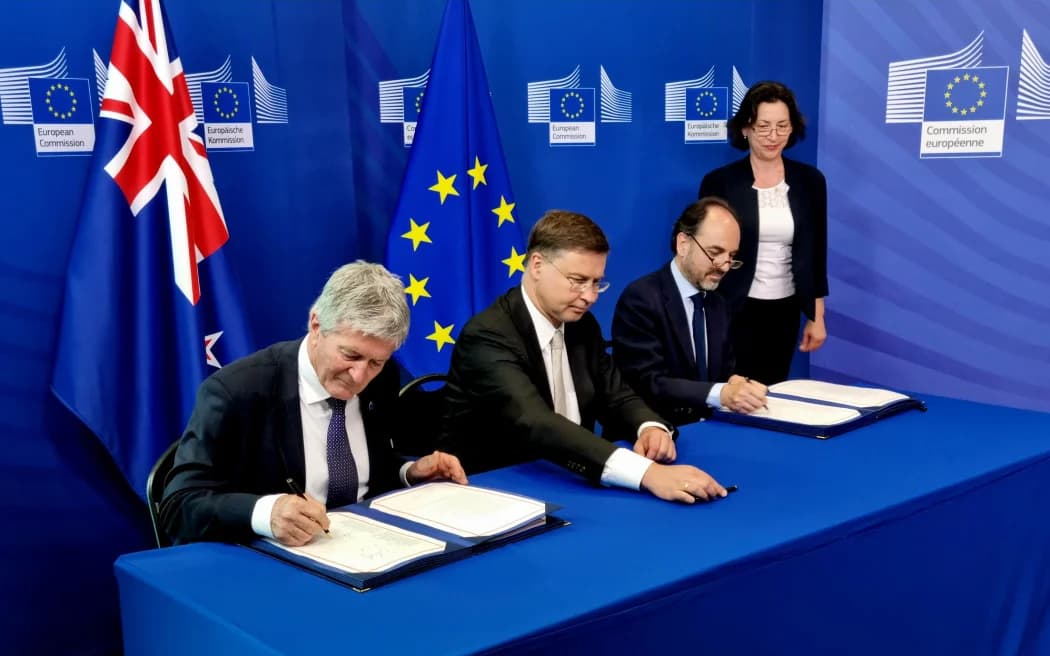
Wellington: It is tempting to file the European Union and New Zealand under trade and move on. The two signed a free trade agreement that took effect in May 2024, the EU is now New Zealand’s second-largest trading partner, and bilateral goods trade reached €8.4 billion last year. But the more revealing development is not commercial at all. At their Joint Committee in Wellington last September, held under the Partnership Agreement on Relations and Cooperation, the two sides agreed to deepen engagement on security and defence, explicitly including in the Indo-Pacific. A small Pacific democracy and a continental bloc on the other side of the planet are quietly deciding they are strategic partners, not just counterparties.

The architecture for this has been building for a decade. The Partnership Agreement, signed in 2016, was always meant to carry the non-trade weight of the relationship, spanning foreign policy, climate, justice and research. New Zealand was the first non-European country to associate with Horizon Europe, the world’s largest science funding programme, and more than half of its researchers already collaborate with European partners. What is new is the willingness to name maritime security, the fight against information manipulation and cooperation in multilateral forums as shared business. These are the vocabulary of alignment, not merely of friendship.

Why would Wellington bother? Geography offers no obvious reason for a country of five million to invest diplomatic capital in Brussels. The answer lies in hedging. New Zealand has watched its region militarise and its largest trading partner grow more coercive, and it prizes any relationship that widens its options without forcing it into a bloc. Europe is attractive precisely because it is distant, wealthy and uninterested in demanding that Wellington choose sides. For the EU, a credible Indo-Pacific footprint requires local partners who lend legitimacy, and few come with New Zealand’s reputation for principled independence.

The limits are equally clear and worth stating plainly. New Zealand’s nuclear-free law and its instinct for non-alignment mean it will never become a forward operating partner in the way some European planners might wish. Its defence budget is modest, its forces small, and its public deeply allergic to entanglement in distant wars. Any European official who reads the warm communiques as a prelude to basing rights or joint deployments will be disappointed. The cooperation that is plausible is narrower and quieter: shared maritime domain awareness, coordinated positions in the United Nations and regional bodies, joint resistance to disinformation, and the slow knitting together of research and standards.

That modesty is the point, not a flaw. The EU has a habit of announcing partnerships grander than it can sustain, then losing interest when the cameras leave. New Zealand offers a chance to do the opposite: to build something small, durable and genuinely two-way, where each side gives the other reach it lacks. If Brussels treats Wellington as a serious interlocutor rather than a photo opportunity on the way to bigger capitals, the relationship could become a quiet model for how a European bloc and a Pacific democracy operate together. The test, as ever, is whether the follow-through outlasts the headline.