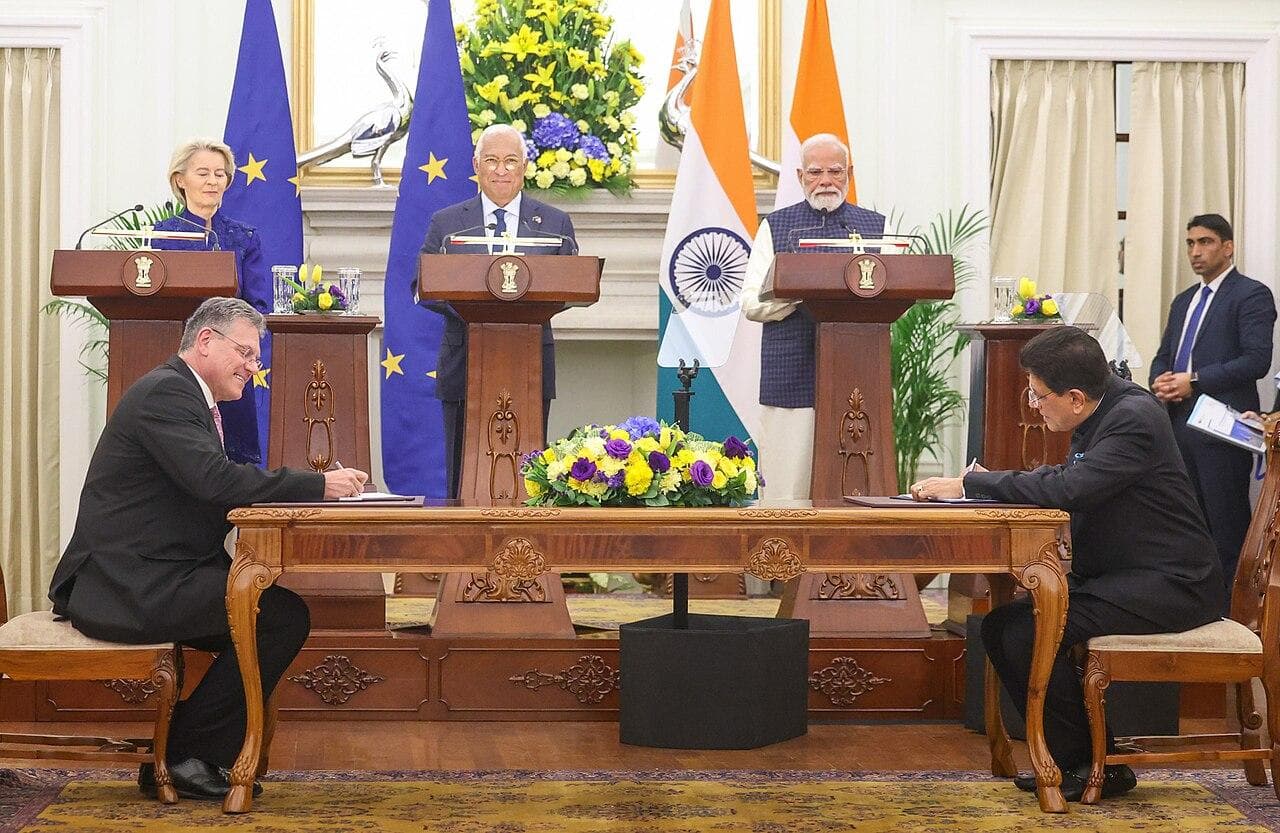
New Delhi: The signatures are the easy part. When the European Union and India concluded negotiations for a free trade agreement on 27 January 2026, they closed a file opened nearly two decades earlier, in 2007, and abandoned in 2013 amid mutual frustration. The agreement Brussels calls the largest it has ever struck is real. Whether it survives the journey from political declaration to enforceable law is a separate question, and one that will consume the coming year.
The commercial logic is straightforward enough to explain the persistence. India is among the fastest-growing large economies on the planet, and European exporters have watched from behind a tariff wall that reaches well above 100 percent on some goods. The deal removes or reduces duties on more than 96 percent of EU goods exports and, on the Commission’s own projection, could double those exports by 2032. For carmakers, machinery producers and drinks exporters long shut out of the Indian market, the numbers are difficult to ignore.
Yet the harder test lies in ratification, where the interests that were papered over in negotiation reassert themselves. The agreement must clear the Council of the European Union, secure the consent of the European Parliament, and win approval in New Delhi. Each stage invites a different objection. The most pointed comes from the Parliament’s Green group and from environmental campaigners, who note that the deal’s chapter on trade and sustainable development is markedly weaker than the strong commitments the EU has demanded in comparable agreements. For an institution that has made climate conditionality a signature of its trade policy, that dilution is awkward to defend.
Not every worry that shadowed earlier EU trade fights applies here. Analysts point out that the investor-state dispute mechanisms and the acute agricultural competition that inflamed the Mercosur debate are far less prominent in the India text. That should smooth the path. But smoothness is relative in a process that requires unanimity in some respects and a fragile parliamentary majority in others, and where any member state can turn a technical reservation into a bargaining chip.
There is also a strategic reading that European officials are careful not to overstate in public. A trade agreement with India is, among other things, a hedge. As Brussels works to reduce its exposure to a single dominant supplier in Asia, deeper commercial ties with the world’s most populous democracy offer both an alternative market and a diplomatic counterweight. That framing is attractive, though it risks loading a commercial instrument with geopolitical expectations it was not designed to carry.
The sceptic’s case deserves a hearing too. Two decades of stalled talks bred a habit of announcing breakthroughs that later dissolved, and phased tariff commitments stretched over years leave ample room for backsliding once domestic pressures mount. Indian farmers and small manufacturers have their own anxieties about European competition, and ratification in New Delhi is no formality.
For now, the agreement sits in the gap between signature and force, which is where trade deals reveal their true resilience. If Brussels and New Delhi can hold their coalitions together through the ratification grind, they will have built something substantial. If they cannot, the deal will join a long list of promising texts that never quite became law.