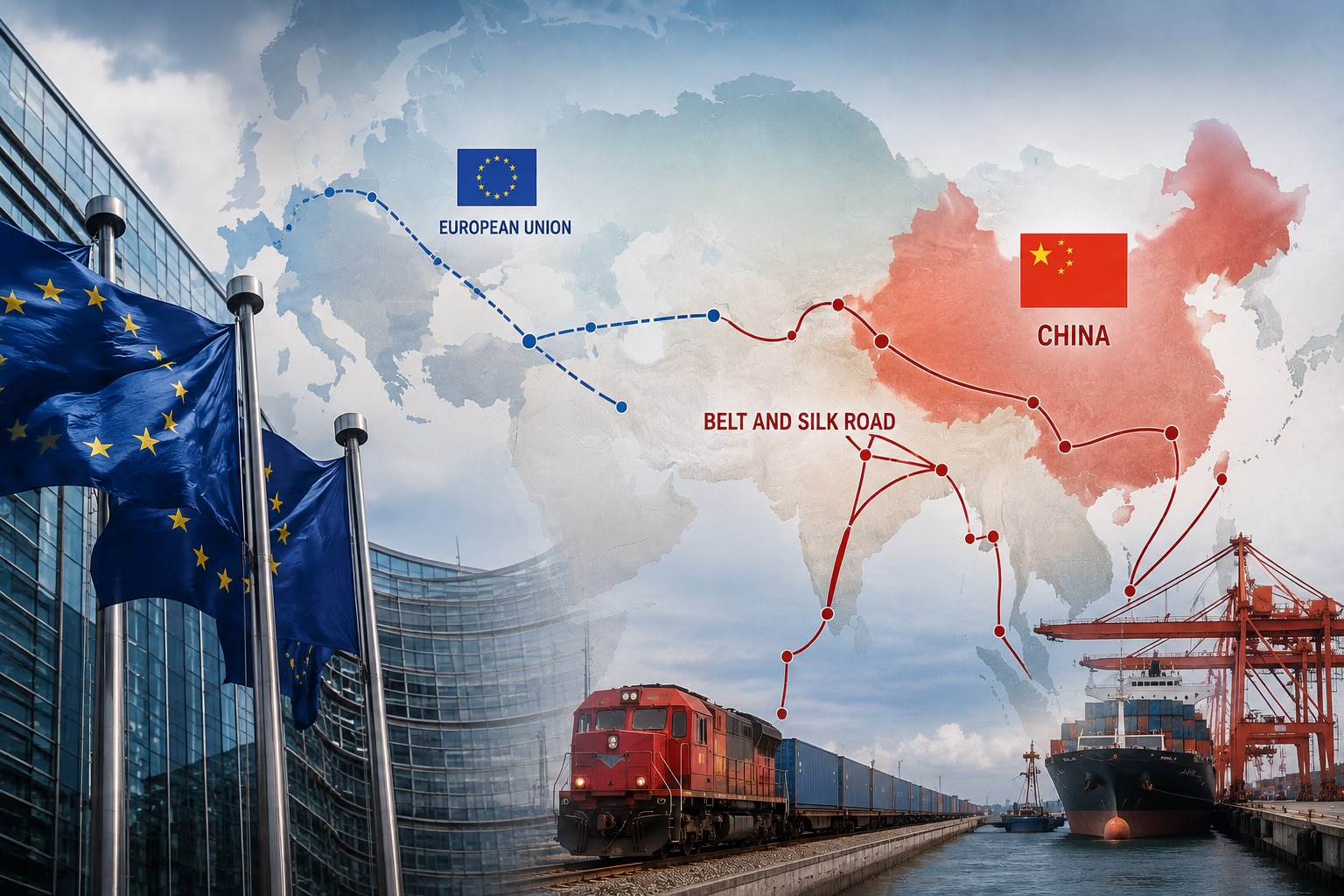
Strasbourg: The European Parliament’s adoption on 26 March of a sweeping evaluation of the Global Gateway – 371 votes in favour, 146 against, eighty abstentions – has detonated under the Commission’s flagship connectivity strategy at a moment when it can least afford institutional turbulence. The report’s headline demand, an immediate investigation into the involvement of Chinese companies in projects ostensibly designed as a European alternative to the Belt and Road Initiative, exposes a contradiction that has shadowed the initiative since its 2021 launch and that the Commission’s communications strategy has struggled to dispel.
The empirical record is unflattering. Of the EUR 300 billion that the Commission committed to mobilise by 2027, roughly half is earmarked for African projects, and a meaningful share of those projects has been executed by Chinese contractors operating through subcontracting arrangements with European prime contractors or through joint ventures with African parastatals. The Lobito Corridor, the showcase rail and logistics project connecting the Democratic Republic of Congo and Zambia to the Atlantic via Angola, became the proximate trigger for parliamentary attention after disclosures that Chinese state-linked firms had won procurement tranches that the strategy was rhetorically designed to displace.
The Commission’s reply, articulated by officials within the international partnerships directorate, rests on a defensible if uncomfortable point. Open procurement rules under EU law do not permit exclusion of bidders on the basis of nationality alone, and reciprocity mechanisms have only patchy reach where third-country procurement is involved. The argument has the merit of legal consistency. It has the demerit of confirming the geopolitical critique. If the Global Gateway’s distinguishing feature was supposed to be its character as a values-based, rules-based, and strategically autonomous infrastructure offer, the inability to keep the Belt and Road’s principal operators out of its own pipeline reads as a structural admission of European weakness.
That perception matters in three theatres. In African capitals, where the Commission needs governments to choose European partners on the basis of comparative advantage, the optics undermine the case. In Brussels, where the Parliament’s vote landed against a backdrop of an emerging legislative push for stricter local content rules and tighter foreign subsidies enforcement, the report puts the executive on notice that the next multiannual financial framework’s external action allocations will face hostile scrutiny. In member state capitals, where finance ministers are increasingly impatient about the disjunction between mobilisation figures and actual project closure, the audit demand provides political cover for trimming contributions.
The 18 May Foreign Affairs Council in Development configuration, chaired by High Representative Kaja Kallas, attempted to reframe the debate. Council conclusions emphasised the Global Gateway as a central pillar of the Union’s external action and acknowledged that the strategy must adapt to a landscape of reduced official development assistance globally and increasing pressure on the multilateral system. The implicit concession was that the initiative cannot continue to be marketed primarily as a counter-China instrument; its long-term legitimacy depends on whether African counterparts perceive genuine alignment with their own industrialisation agendas.
There is a more uncomfortable diagnosis available. The Global Gateway was conceived during a moment of European strategic optimism about the Union’s capacity to project influence through infrastructure finance. That moment has passed. The combination of fiscal constraints in member states, the diversion of external action resources toward Ukraine, and the demonstrated nimbleness of Chinese contractors in adapting to European procurement norms has narrowed what the initiative can plausibly achieve. Parliament’s investigation will likely confirm what officials privately concede – that the architecture needs not cosmetic adjustments but a candid reset, including new local content rules, sharper foreign subsidies enforcement, and a willingness to accept fewer headline projects in exchange for credibly European delivery.
The strategic question, then, is whether the Commission can absorb the Parliament’s verdict and rebuild a leaner Global Gateway around delivery rather than spectacle, or whether the initiative will continue to be marketed at the scale at which it was launched while quietly underperforming the comparator it was designed to challenge.