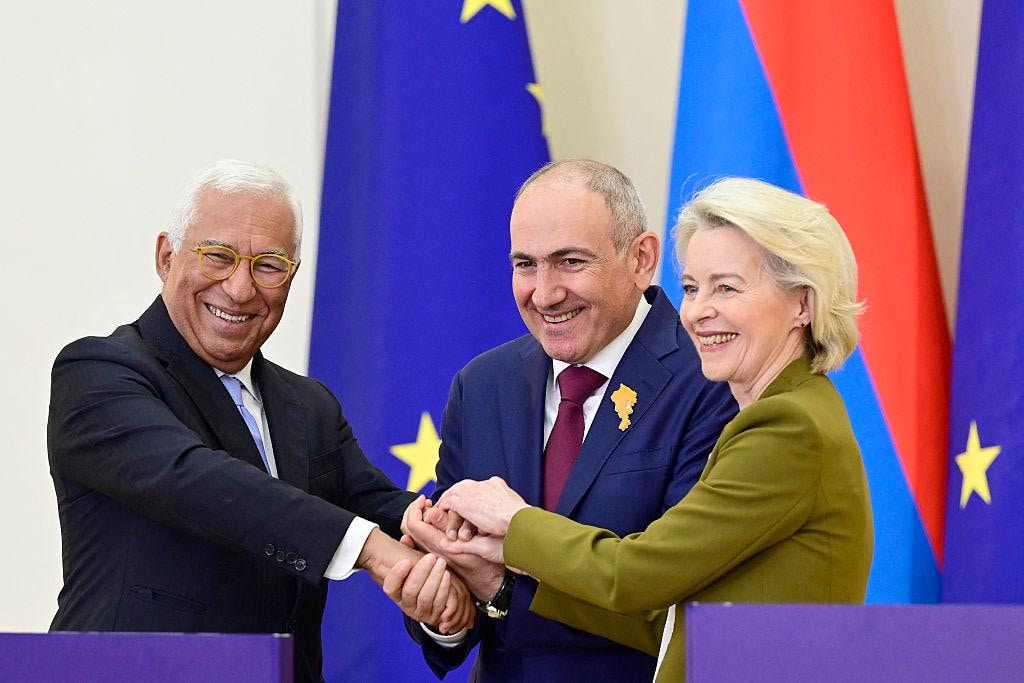
Mexico City: The signature ceremony at the National Palace on 22 May placed a stamp on the modernised EU-Mexico Global Agreement and on the parallel Interim Trade Agreement that the two sides had been negotiating since the in-principle deal of January 2025. President Claudia Sheinbaum hosted Ursula von der Leyen and Trade Commissioner Maroš Šefčovič in a setting that was deliberately framed as more than a trade ceremony. The framework that takes effect with the interim text removes tariffs on around 99 percent of bilateral trade and is built around a strategic partnership architecture that brings political dialogue, security cooperation, and digital governance under a single legal roof.
For the Commission, the timing matters as much as the substance. The original 2000 framework had been overtaken by Mexico’s nearshoring boom and by a North American trading environment that has grown more transactional. Brussels has spent two years arguing that the modernisation was less about market access growth, already substantial under the legacy text, and more about embedding Mexico into a rules-based architecture that the United States no longer guarantees. The case is not abstract. Around sixty percent of Mexico’s manufacturing exports are inputs into supply chains anchored further north, and Mexican policymakers have read the Inflation Reduction Act, the recurring steel and aluminium duties, and the periodic threats over migration enforcement as evidence that any single-market dependency carries political risk.
The provisions on procurement carry the strongest political signal. The interim text opens federal and state procurement well beyond the WTO Government Procurement Agreement reservations Mexico has historically maintained, and European bidders gain treatment broadly equivalent to USMCA partners on most procurement lines. For European defence and infrastructure firms that had previously been priced out by the local content rules under USMCA Chapter 13, the new floor changes the bidding economics on Pemex tenders, on the Yucatán rail project, and on the Mayan port expansion. The Commission’s services have been quietly modelling the procurement opening at around four billion euros of accessible contracts annually once the agreement reaches steady state.
The agricultural chapter contains the most contested ground. Spanish and Portuguese producers have argued through the consent phase that the duty elimination on virtually all agri lines, including a meaningful slice of horticulture, would test the Mediterranean farm bloc’s price floor. The Commission’s mitigation is procedural rather than financial. Specific safeguards in the text allow for tariff reintroduction when import surges exceed defined thresholds, and the geographical indications register protects more than three hundred and fifty European names against generic use in Mexican markets. Whether those safeguards survive the ratification phase in member-state parliaments is the test that will absorb DG Trade through the autumn.
Three signals will indicate whether the deal converts political momentum into operational reality. The first is whether Berlin and Paris coordinate their ratification timetables to land before the European Parliament’s summer recess in 2027. The second is whether Mexican secondary legislation transposes the digital trade chapter before the November 2026 federal budget cycle in Mexico City. The third is whether the joint council established under the strategic partnership uses its first session in early 2027 to publish concrete benchmarks for the political dialogue strand. None of those signals is guaranteed. The interim trade application gives the deal momentum but does not insulate it from the slower work of ratification across twenty-seven capitals.