August 9, 2026
LATEST
New EU Gas Market Rules Take Effect With Consumer SafeguardsDeforestation Regulation Holds Its December Deadline Despite CutsDigital Omnibus Delays Europe’s High-Risk AI Deadline to 2027Europe’s Schools Confront a Widening Basic Skills GapRule of Law Report Finds Progress but Trust Still LagsIRIS2 Gains 66 Satellites as Brussels Signs the Rollout DealNature Restoration Plans Come Due as Member States Race a DeadlineECB Rates Hold at 2.25 Percent as Frankfurt Waits on the DataEU Budget Talks Turn to Cohesion as Ireland Takes OverWildfire Response Stretches Europe’s Emergency Fleet ThinCan Europe’s Quantum Plan Match Its Big Ambitions?Armenia Edges West as Moscow’s Grip Slips AwayEurope Inherits the World’s Aid Bill It Cannot Fully PayAir Passenger Rights Get Their First Overhaul in Two DecadesErasmus Opens a 5 Billion Euro Round for Skills and MobilityCeuta Crisis Pushes the EU Toward Faster Migrant ReturnsBulky Parcels Face a Packaging Crackdown From August 12Can Europe Build Its Drone Wall Before 2030 Arrives?Indonesia’s Trade Deal With Europe Nears Its Final SignatureEurope Leans on Beijing to Keep Climate Talks Alive Before AntalyaNew EU Gas Market Rules Take Effect With Consumer SafeguardsDeforestation Regulation Holds Its December Deadline Despite CutsDigital Omnibus Delays Europe’s High-Risk AI Deadline to 2027Europe’s Schools Confront a Widening Basic Skills GapRule of Law Report Finds Progress but Trust Still LagsIRIS2 Gains 66 Satellites as Brussels Signs the Rollout DealNature Restoration Plans Come Due as Member States Race a DeadlineECB Rates Hold at 2.25 Percent as Frankfurt Waits on the DataEU Budget Talks Turn to Cohesion as Ireland Takes OverWildfire Response Stretches Europe’s Emergency Fleet ThinCan Europe’s Quantum Plan Match Its Big Ambitions?Armenia Edges West as Moscow’s Grip Slips AwayEurope Inherits the World’s Aid Bill It Cannot Fully PayAir Passenger Rights Get Their First Overhaul in Two DecadesErasmus Opens a 5 Billion Euro Round for Skills and MobilityCeuta Crisis Pushes the EU Toward Faster Migrant ReturnsBulky Parcels Face a Packaging Crackdown From August 12Can Europe Build Its Drone Wall Before 2030 Arrives?Indonesia’s Trade Deal With Europe Nears Its Final SignatureEurope Leans on Beijing to Keep Climate Talks Alive Before Antalya
August 9, 2026
LATEST
New EU Gas Market Rules Take Effect With Consumer SafeguardsDeforestation Regulation Holds Its December Deadline Despite CutsDigital Omnibus Delays Europe’s High-Risk AI Deadline to 2027Europe’s Schools Confront a Widening Basic Skills GapRule of Law Report Finds Progress but Trust Still LagsIRIS2 Gains 66 Satellites as Brussels Signs the Rollout DealNature Restoration Plans Come Due as Member States Race a DeadlineECB Rates Hold at 2.25 Percent as Frankfurt Waits on the DataEU Budget Talks Turn to Cohesion as Ireland Takes OverWildfire Response Stretches Europe’s Emergency Fleet ThinCan Europe’s Quantum Plan Match Its Big Ambitions?Armenia Edges West as Moscow’s Grip Slips AwayEurope Inherits the World’s Aid Bill It Cannot Fully PayAir Passenger Rights Get Their First Overhaul in Two DecadesErasmus Opens a 5 Billion Euro Round for Skills and MobilityCeuta Crisis Pushes the EU Toward Faster Migrant ReturnsBulky Parcels Face a Packaging Crackdown From August 12Can Europe Build Its Drone Wall Before 2030 Arrives?Indonesia’s Trade Deal With Europe Nears Its Final SignatureEurope Leans on Beijing to Keep Climate Talks Alive Before AntalyaNew EU Gas Market Rules Take Effect With Consumer SafeguardsDeforestation Regulation Holds Its December Deadline Despite CutsDigital Omnibus Delays Europe’s High-Risk AI Deadline to 2027Europe’s Schools Confront a Widening Basic Skills GapRule of Law Report Finds Progress but Trust Still LagsIRIS2 Gains 66 Satellites as Brussels Signs the Rollout DealNature Restoration Plans Come Due as Member States Race a DeadlineECB Rates Hold at 2.25 Percent as Frankfurt Waits on the DataEU Budget Talks Turn to Cohesion as Ireland Takes OverWildfire Response Stretches Europe’s Emergency Fleet ThinCan Europe’s Quantum Plan Match Its Big Ambitions?Armenia Edges West as Moscow’s Grip Slips AwayEurope Inherits the World’s Aid Bill It Cannot Fully PayAir Passenger Rights Get Their First Overhaul in Two DecadesErasmus Opens a 5 Billion Euro Round for Skills and MobilityCeuta Crisis Pushes the EU Toward Faster Migrant ReturnsBulky Parcels Face a Packaging Crackdown From August 12Can Europe Build Its Drone Wall Before 2030 Arrives?Indonesia’s Trade Deal With Europe Nears Its Final SignatureEurope Leans on Beijing to Keep Climate Talks Alive Before Antalya

New Zealand Quietly Becomes Europe’s Steadiest Pacific Partner

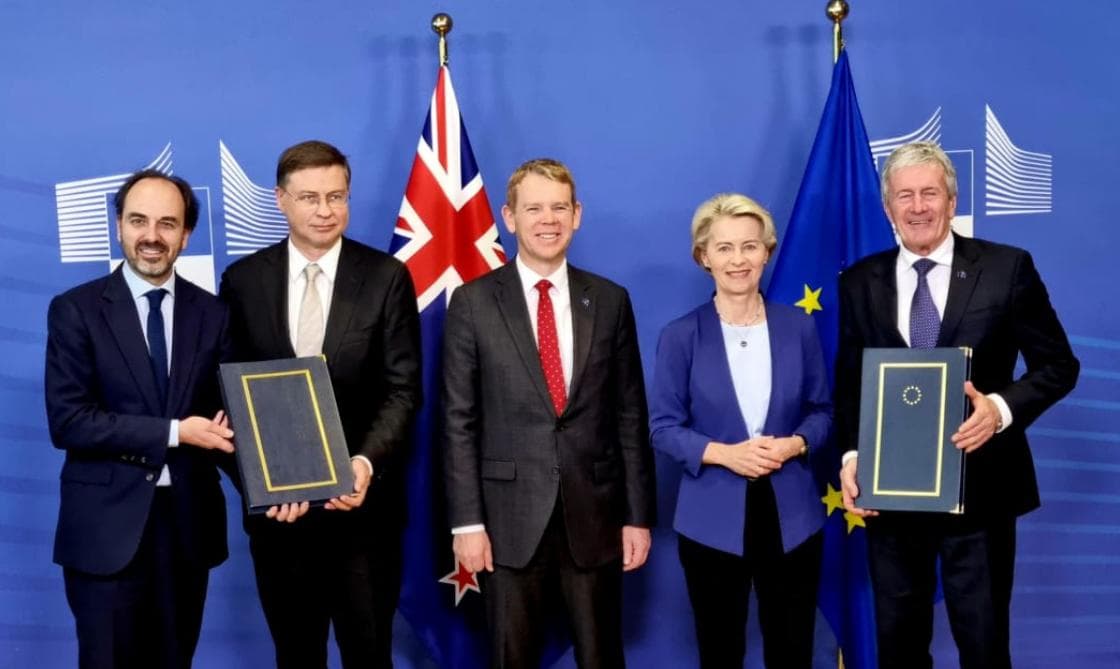
Wellington: Two years after the European Union and New Zealand switched on their free trade agreement, the partnership has done something rare in current trade politics. It has worked, and it has done so without drama. Bilateral trade in goods and services has climbed roughly eight percent to a record figure above twenty billion dollars since the deal entered into force on 1 May 2024, and the first formal Trade Committee, held in October 2025, produced little more than mutual satisfaction. The next session is scheduled for Brussels in the second half of this year. In a season dominated by tariff threats and supply shocks, an uneventful trade relationship is itself a kind of achievement.

That calm is worth examining, because it reflects a deliberate European strategy rather than luck. The agreement removes tariffs on all EU exports to New Zealand and phases out 98.5 percent of EU duties on New Zealand goods over seven years, saving European exporters an estimated one hundred and forty million euros a year. Those are real numbers for European wine, machinery and pharmaceutical firms. Yet the deeper value to Brussels is structural. New Zealand is a small, rule-following, democratic economy that shares the Union’s instincts on climate, labour standards and the rule of law. The agreement was the first EU trade deal to attach the prospect of sanctions to its sustainability chapter, including commitments under the Paris accord. For a bloc trying to prove that values-based trade can still deliver, Wellington is an almost ideal test case.

The geopolitics matter more than the modest commercial volumes suggest. New Zealand sits inside the Comprehensive and Progressive Agreement for Trans-Pacific Partnership and maintains close ties across the Indo-Pacific, the region Brussels has identified as decisive for its economic future. By binding itself to a like-minded Pacific democracy, the EU gains a reliable node in a part of the world where its presence is thin and its leverage limited. The relationship offers something the bloc badly wants as it tries to reduce exposure to a single dominant supplier in Asia, namely partners who are predictable precisely because they are not great powers with their own coercive ambitions.

There are limits to how far this model travels. New Zealand’s economy is roughly the size of a mid-sized European region, so the agreement will never reshape the Union’s external balance the way a deal with a continental market might. Agricultural access remains politically sensitive in Europe, and New Zealand’s farmers had hoped for more generous dairy and beef quotas than they secured. The two sides also sit on opposite ends of the planet, which caps the logistical intimacy that proximity gives the EU’s neighbourhood deals. None of this is fatal, but it explains why the partnership will remain a complement to Europe’s strategy rather than its centrepiece.

Still, the quiet success carries a lesson that Brussels should not waste. Much of the Union’s recent external energy has gone into difficult, high-stakes negotiations with large and often reluctant partners. The New Zealand experience suggests an underused alternative, namely deepening ties with smaller, value-aligned states that are eager to deal and easy to trust. The upcoming Brussels Trade Committee is unlikely to generate headlines. That may be the point. In a world where economic relationships are increasingly weaponised, a partner that simply does what it promised is becoming Europe’s scarcest and most valuable asset.