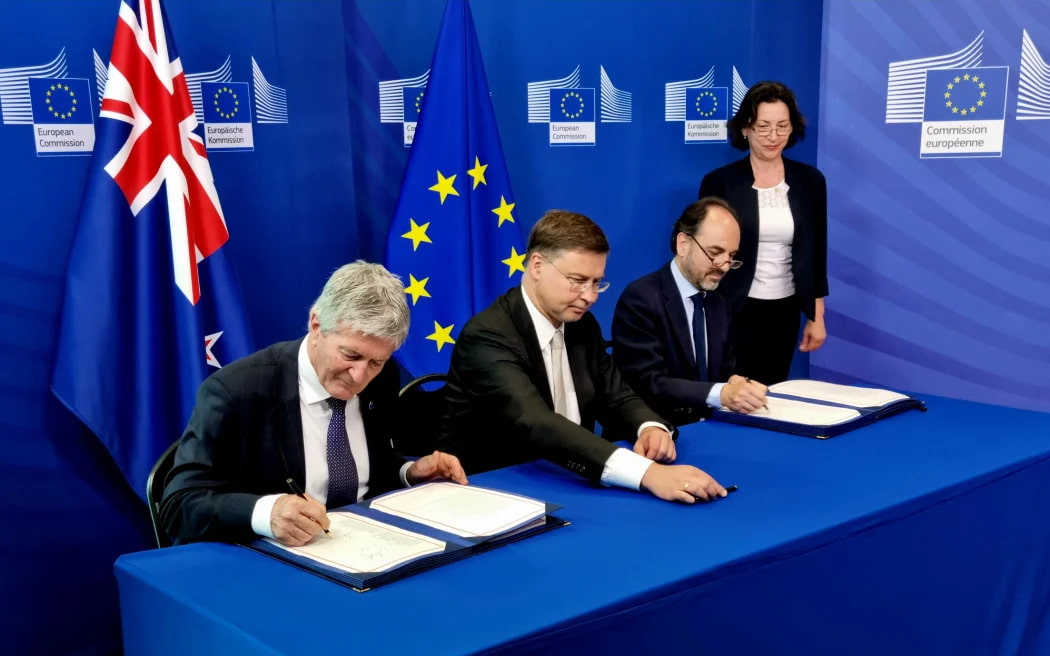
Wellington: There are few trade relationships the European Union likes to talk about less and worry about less than the one it built with New Zealand. The two economies sit roughly eighteen thousand kilometres apart, trade in goods that rarely compete head to head, and concluded a free trade agreement in 2023 that drew none of the street protests that have shadowed Brussels’ deals elsewhere. Two years into that agreement, which entered into force on 1 May 2024, the quiet partnership is turning into one of the more convincing arguments for the bloc’s diversification strategy.
The headline numbers are modest by the standards of the EU’s giant trading partners, but the direction of travel is what matters. Bilateral trade in goods and services rose about 8 percent in the first year of the agreement, reaching a record of roughly 21.6 billion dollars in the year to June 2025. The deal eliminates an estimated 140 million euro a year in duties for European exporters from its first year, and the Commission projects EU exports to New Zealand could climb by up to 47 percent over time. The first meeting of the joint Trade Committee took place in October 2025, and a second is due in Brussels in the second half of 2026.
What makes the agreement instructive is less the volume of trade than the template it sets. Brussels managed the politically explosive question of agriculture, New Zealand’s competitive dairy, beef and sheep meat, through tariff rate quotas rather than open access, the same mechanism now fought over in the Mercosur debate. It paired market opening with a sustainability chapter that, for the first time in an EU trade deal, makes core climate and labour commitments enforceable through the agreement’s dispute settlement and potential sanctions. For a Union trying to prove that open trade and the Green Deal can coexist, New Zealand became a low-risk laboratory.
The strategic subtext is the Indo-Pacific. As Washington leans further into tariffs and economic nationalism, and as Beijing’s export controls remind Europe how exposed its supply chains are, agreements with reliable, rule-of-law democracies acquire a value beyond their balance sheets. New Zealand is small, but it is a stable food and services partner in a region where the EU has struggled to convert strategy documents into signed treaties. Each working deal strengthens Brussels’ claim to be a credible economic presence east of Suez.
None of this makes the relationship transformative. New Zealand will not move the needle on European growth, and the agriculture quotas still irritate farmers in both directions. But in a year when the bloc’s headline trade files are mired in litigation and political revolt, a deal that simply works, generating record flows and a calendar of routine committee meetings, is its own kind of achievement. The lesson Brussels is quietly drawing is that durable trade policy may depend less on landing the biggest partners than on accumulating dependable ones.