
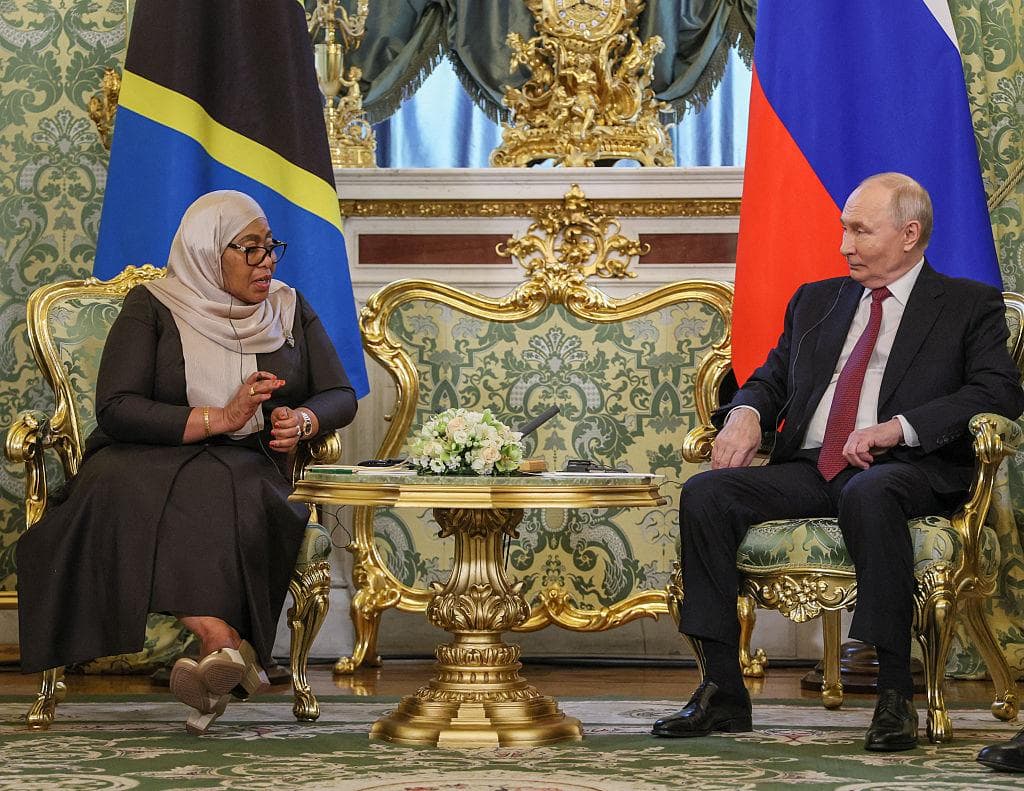

President Samia Suluhu Hassan addressed the St. Petersburg International Economic Forum between 5 and 7 June, with Russian investment in Tanzanian critical minerals, uranium, and offshore gas now projected at two billion dollars over three to five years. The European Parliament suspended one hundred and fifty-six million euro in support to Dodoma last November and has been refused entry by the same government since. The arithmetic is the argument.
President Samia Suluhu Hassan addressed the twenty-ninth St. Petersburg International Economic Forum between 5 and 7 June 2026, the most senior East African engagement Russia has staged since the start of the war in Ukraine, and the Tanzanian foreign ministry has since projected two billion dollars in Russian investment over three to five years across critical minerals, uranium, and offshore gas, in a forecast drawn from official post-visit announcements rather than from independent assessment.
Six months earlier, on 27 November 2025, the European Parliament voted to suspend approximately one hundred and fifty-six million euro of direct support to the Tanzanian government, to call for an international commission of inquiry into the events that followed the 29 October 2025 election, and to recommend consideration of sanctions against those responsible². In May, the Subcommittee on Human Rights was prevented by Dodoma from conducting the parliamentary mission its own resolution had instructed.
The European response has not been wrong on its own terms. It has, however, been alone in its category, and the consequence of that solitude is now visible on the calendar.
Tanzania holds, on the public geological record, the Ngualla rare earth deposit, among the largest and highest-grade undeveloped concentrations of neodymium and praseodymium on the world map, approximately six per cent of global graphite supply, the Panda Hill niobium project that would establish a fourth significant producer outside Brazil and Canada, the Tembo nickel programme, uranium reserves of strategic significance, helium discoveries in the Rukwa Basin, and one of the largest undeveloped offshore liquefied natural gas projects on the Indian Ocean seaboard. The medium-term investment pipeline associated with these resources, by the Tanzanian government’s own estimate, exceeds sixty billion United States dollars. A nickel and copper smelting plant in Bahi District, commissioning its first production line in February 2026, has begun the value-addition step that determines whether African mineral wealth leaves the continent as ore or as processed input to global supply chains.
The country is not a side desk of the European critical raw materials agenda. It is, on the published list of dependencies the bloc has been writing strategy around since 2023, one of the substantive answers.
The geography reinforces the geology. Dar es Salaam is the principal maritime gateway for the landlocked economies of the Democratic Republic of the Congo, Burundi, Rwanda, Uganda, Zambia, and Malawi, and the Central Corridor running west from the port is the only operational alternative to the Mombasa route through Kenya and a structural counterweight to the United States-and-European-backed Lobito Corridor through Angola 4. The Standard Gauge Railway under construction extends the corridor’s logistical reach inland.
The Indian Ocean coastline places Tanzania at the convergence point of three trading systems Brussels has been writing strategy papers about for a decade: the Gulf-to-Africa capital flow, the Indo-Pacific maritime architecture the European External Action Service formally committed to in 2021, and the East African Community single market the bloc has co-financed since 2014. The country sits squarely in the position European strategy documents describe. It is not, in European policy practice, treated as the position would suggest.
The European Parliament’s November resolution was a formal exercise of the conditionality framework the bloc applies, with varying intensity, to partner states whose post-election political environments draw international institutional scrutiny. The text called for an international commission of inquiry under African leadership and recommended the suspension of direct fiscal support pending its findings. The African Union’s own Election Observation Mission, led by former Botswana President Mokgweetsi Masisi, conducted a parallel assessment and published its Preliminary Statement on 5 November with its own set of recommendations for constitutional and electoral reform³.
Each of those institutional responses sits within the architecture of multilateral post-election engagement that has operated across the African continent for two decades. On its own terms, the European response was the kind of statement a parliament that takes its monitoring instruments seriously will issue when those instruments report concerns. What follows from the response, however, is the question this piece concerns itself with.
The European case for maintaining the conditionality framework, on its own terms, is not trivial and deserves more weight than the strategic critique of the bloc’s choices usually allows it. The European Union’s distinctive value proposition to its partners since the Cotonou Agreement of 2000 has been rules-based engagement underwritten by transparent benchmarks, and the architecture of conditional support has been the institutional expression of that proposition for a quarter-century. Brussels reasoners will argue, with considerable force, that the cost of relaxing the framework where the strategic price is high is the higher cost of the framework itself becoming a coalition of convenience rather than of principle. If the European response to documented post-election concerns can be calibrated by the size of the partner’s mineral pipeline, the response loses the distinctive character that has been the bloc’s argument to its own publics for two generations, and the political legitimacy of the conditionality regime collapses in the constituencies that elected the Parliament that voted it.
That is the strongest version of the European position, and it is the starting point this piece accepts before raising the question of whether the framework can hold its principle and its presence on the same map.
What Brussels said in November was a record. What’s not being said in similar occasions is setting a new doctrine. Is European human rights policy different and region-specific?
What the resolution did not include, and what no subsequent European action has constructed, is a strategic engagement framework operating alongside the conditionality. There is no Critical Raw Materials Strategic Partnership with Tanzania of the kind the bloc has concluded with the Democratic Republic of the Congo, Zambia, Rwanda, and Kazakhstan, despite the size of the dependencies a Tanzanian partnership would address. There is no Central Corridor financing package parallel to the European Investment Bank’s role in Lobito. There is no Mediterranean-to-Indian Ocean trade corridor that would link European markets to the gas and minerals Tanzania is preparing to export. There is no minister-level engagement structure that would allow Brussels to keep the human rights file open and the strategic file moving in the same calendar quarter. The doctrine, on the operational record, is conditionality without presence, and conditionality without presence is, in practical effect, the choice not to engage at all.
The space the European framework has left has been filled in real time. The United States advanced negotiations on a forty-two billion dollar LNG development, the nine hundred and forty-two million dollar Tembo nickel project, and the three hundred million dollar Mahenge graphite mine in talks concluded at Chamwino State House in December 2025. China has continued financing the Standard Gauge Railway, the modernisation of the TAZARA line that connects Tanzania to the Zambian copperbelt, and the expansion of Dar es Salaam port capacity. India and the Gulf states have moved capital into agriculture, hospitality, and the diaspora-anchored trade architecture that has historically connected the East African coast to the Arabian peninsula. Russia, after the St. Petersburg visit, has positioned itself to enter the critical minerals sector and has expressed interest, through Gazprom, in hydrocarbon exploration.
The Tanzanian state has substantive engagement with four major external partners on energy, infrastructure, and minerals. The European Union has acquired a procedural impasse over a parliamentary visit.
The case for engaging Tanzania is not the case for softening the European position on the 2025 election. The case is that human rights conditionality without strategic engagement is, on the empirical record now available, not producing reform. The Tanzanian government has not released Tundu Lissu in response to European pressure, has not opened the constitutional reform process the African Union mission called for, and has not invited the international commission of inquiry that the Parliament’s resolution requested. It has instead accelerated alignment with partners that do not apply the conditionality.
Whatever one believes about the moral content of the European position, the early operational record on its effectiveness is now visible, and that record suggests a doctrine producing resolution language, fiscal suspension, blocked visits, and a counterparty Russia summit has been outflanked rather than enforced.
There is, in addition, a question of consistency the Tanzanian government has been making in private and increasingly in public, and which Brussels cannot indefinitely refuse to engage. The European Union has maintained its Association Agreement with Israel through an active International Court of Justice proceeding on the conduct of the Gaza campaign, has continued its Strategic Partnership with Egypt despite a documented prisoner-of-conscience record numbered in the tens of thousands, has held the commercial framework with Saudi Arabia steady through the Yemen war and the Khashoggi assassination, and has expanded its customs and migration arrangements with Türkiye through repeated press and judicial restrictions.
Each of those decisions can be defended on its own strategic terms. The cumulative effect, read from Dodoma, is that European principle has historically tracked European interest, and that conditionality has been applied where the geopolitical cost was lowest. The events of the post-election period warranted a serious European response. The Tanzanian question now is whether the response Brussels chose would have been the response Brussels would have chosen for a state with greater leverage over European supply chains, European security architecture, or European migration management. The pattern on the available record suggests it would not have been, and that perception is now structural in the relationship.
The pattern is not new, and it is not unique to Tanzania. A scholarly tradition associated with figures including Adekeye Adebajo, Carlos Lopes, and W. Gyude Moore has argued for two decades that European governance conditionality, however principled in its formulations, operates in African political space as a form of strategic engagement that selects winners and losers in domestic political competition, and that the framework’s claim to neutrality has been historically harder to sustain than its European architects acknowledge. The 2025 moment in Tanzania, on this reading, did not produce the perception of European partisanship. It activated it.
Whether one accepts the full force of that scholarship or only its weaker formulations, the bloc now operates in an African political environment in which the assumption of European neutrality is no longer the baseline, and the next Tanzania move will be read against that absence.
What Brussels could still build is a framework in which the human rights file and the strategic file run on separate but linked tracks. A Critical Raw Materials partnership could be opened with verification clauses and labour standards that preserve conditionality on the practices that matter. A Central Corridor investment package could be structured through the European Investment Bank rather than through the ministerial budget support the parliamentary resolution rightly suspended. The diplomatic channel between the European External Action Service and Dodoma could be maintained at the level of strategic dialogue while the inquiry the Parliament called for proceeds.
None of this requires that the bloc set aside the concerns its November resolution set out. All of it requires that the bloc behave as if its principles and its interests are both real, that Tanzania is a country it intends to be present in, and that the resolution it wrote in November was not the last sentence in its Tanzania policy but the first one.
The bloc’s African strategy has been shrinking on its western edge through the Sahel withdrawal, on its northern edge through the rolling Libya and Sudan crises, and on its central reach through the limited penetration of the Lobito Corridor beyond the Congolese hinterland. East Africa, anchored on Tanzania, is the seaboard on which the European position has not yet collapsed. The minerals on which the next decade of the global economy will be built sit in geographies the bloc has been engaging through resolution language rather than through partnership architecture, and the framework that produced suspended support and a blocked parliamentary visit will not be the framework that recovers the mineral race the next decade will be decided by. This is the moment, on the evidence the present trajectory provides, when Brussels has to revise its policy and rephrase its diplomatic core.
The question facing the bloc is not whether it can recover Tanzania quickly, because that work would take a decade. The question is whether the bloc can afford to lose the East African coast at the same moment its other African positions are eroding, and the trajectory the present month is producing suggests that it cannot.
NOTES:
- The twenty-ninth St. Petersburg International Economic Forum was held between 5 and 7 June 2026 and drew, by the Russian organisers’ figures, more than twenty-four thousand participants from over one hundred and forty countries. The forum is Russia’s principal annual platform for commercial diplomacy and has anchored Moscow’s outreach to non-aligned states since 1997. President Samia Suluhu Hassan’s participation included a state programme in addition to the forum sessions.
- European Parliament resolution of 27 November 2025 on the situation in Tanzania following the general election of 29 October 2025 (2025/2933(RSP)). The text called for the suspension of direct fiscal support to the Tanzanian government, the establishment of an international commission of inquiry into post-election violence under African leadership, consideration of targeted sanctions, and a redirection of European Union financial instruments toward civil society, human rights defenders, and independent media. The associated funding suspension is estimated at approximately one hundred and fifty-six million euro.
- The African Union Election Observation Mission to Tanzania, led by former Botswana President Mokgweetsi Masisi, issued a Preliminary Statement on 5 November 2025 concluding that the conduct of the 29 October general election failed to comply with African Union principles, normative frameworks, and international standards for democratic elections. The Mission identified the presidential appointment of electoral commissioners, the constitutional prohibition on judicial challenge to presidential results, the prohibition on independent candidates, and unequal media access as structural shortcomings.
- The Lobito Corridor, supported jointly by the United States Development Finance Corporation, the European Investment Bank, and the African Finance Corporation, runs from the Angolan port of Lobito through the Democratic Republic of the Congo to the Zambian copperbelt. The Central Corridor, anchored on the port of Dar es Salaam, serves the same hinterland of landlocked African economies but has not received a comparable European financing instrument. The Standard Gauge Railway being built across Tanzania extends the corridor’s reach toward the Great Lakes.
- The scholarly tradition referenced engages questions of post-colonial European engagement with African political space. Representative works include Adekeye Adebajo’s The Curse of Berlin: Africa After the Cold War (Wits University Press, 2010), Carlos Lopes’s Africa in Transformation: Economic Development in the Age of Doubt (Palgrave Macmillan, 2019), and the policy writings of W. Gyude Moore at the Center for Global Development on comparative development partnership architectures.
ABOUT THE AUTHOR
Lukas Weber is a Brussels-based senior analyst and the international editor of The European Post, and writes on European external relations and geopolitics.