


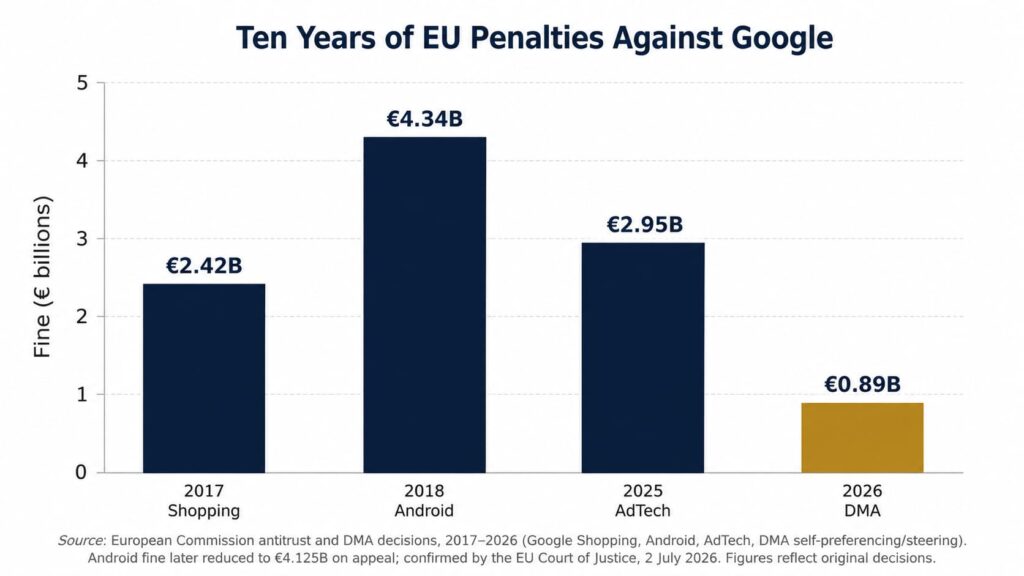
The past twenty-four hours offer a compact illustration of a condition the European Union has been reluctant to name plainly. Washington confirmed additional Section 301 tariffs of 10 percent on European goods, part of a package ranging up to 12.5 percent applied to sixty trading partners over forced labour enforcement findings, according to the Office of the United States Trade Representative. Eurostat’s own trade figures show the Union’s goods deficit with China reached nearly 360 billion euros in 2025, a gap that has widened rather than narrowed. And in the middle of both relationships, the European Commission fined Google a combined 890 million euros for breaching the Digital Markets Act, drawing immediate objections from Washington. Commentary written around these three developments converges on a single metaphor: the Union walking a tightrope between two hegemons, tugged by Washington on one side and Beijing on the other.
The metaphor is not wrong, so far as it goes. It is, however, incomplete, and the incompleteness matters, because it lets Brussels avoid a harder admission about where its remaining external power actually sits.
The steelman
There is a genuine case for the tightrope framing, and it deserves stating in full before it is contested. The Union’s trade negotiator, Bernd Lange, called the new American tariffs “crazy” in an interview this week on Euronews’s Europe Today, and he had grounds: the duties rest on forced labour findings that sit awkwardly beside EU legislation on the same subject that most trade lawyers regard as stricter than its American counterpart. The China relationship is separately delicate. A delegation of MEPs led by David McAllister concluded a three-day mission to Beijing and Shanghai on 23 July, the Foreign Affairs Committee’s first visit since direct parliamentary contact resumed last year following an eight-year freeze, even as the Union’s own sanctions lists target Chinese nationals accused of supplying dual-use components to Russia’s war effort. Vice President Javier López was careful this week to rule out invoking the anti-coercion instrument, the so-called trade bazooka, preferring negotiation to escalation. That caution reflects a structural fact rather than a failure of nerve: the Union cannot match Washington’s tariff schedule or Beijing’s industrial subsidy capacity without inflicting comparable damage on its own exporters.
Nor is regulation the only place Brussels still acts with independent weight, and the case for that is stronger than a passing mention allows. High Representative Kaja Kallas spent this week in Manila, where she signed an EU-Philippines Enhanced Partnership on the sidelines of the ASEAN Regional Forum, entirely on the Union’s own initiative and independent of either Washington or Beijing. The Commission’s civil protection mechanism has, since late June, coordinated roughly 750 responders from 18 member states and released 20 million euros in humanitarian funding for Venezuela’s earthquake response, a deployment that owes nothing to either great power. And this month’s 2026 Rule of Law Report extended its monitoring, as in prior years, to the four enlargement candidates of Albania, Montenegro, North Macedonia and Serbia, using accession conditionality that is entirely the Union’s own instrument. Development assistance, humanitarian response and accession diplomacy are not marginal footnotes to European external power; they are its most autonomous expressions, and a fair account of that power has to weigh them properly rather than concede them in a single sentence.
The turn
Even granting all of that, look at where the Union acted with visible confidence this week, as distinct from where it merely responded or, in the Philippines and Venezuela cases, acted where no great power was contesting the field. It was not on tariffs: Commission spokesperson Olof Gill told reporters at Friday’s midday briefing that Brussels “notes positively” that the outcome matched the EU-US Joint Statement, a notably accommodating register for a tariff Brussels had called unjustified only two days earlier. It was not on China, where the response to a widening deficit was a further round of dialogue. It was the Google fine, where the written record carries more weight than any summary of it. In the Commission’s own statement announcing the decision, Executive Vice-President Teresa Ribera argued that “the best products should succeed because they’re better,” not because of who owns the search engine ranking them, while her colleague Henna Virkkunen, Executive Vice-President for Tech Sovereignty, Security and Democracy, added that the Commission would not hesitate to use its tools to protect the market openings the DMA was designed to create. Neither statement hedges, and both were issued the same day Washington’s tariffs took effect, which makes the contrast in register a data point rather than an impression.
The gap between those two registers, one accommodating and one assertive, on the same day, is worth pausing on before moving to what it implies. A spokesperson framing a tariff outcome as welcome is diplomatic language for an outcome Brussels did not choose. Two Executive Vice-Presidents declaring, in a formal decision document with their names attached, that they would not hesitate to use their enforcement tools is language chosen by people who expect to win the argument. That difference in confidence, expressed on the same Thursday and Friday, is closer to primary evidence for this piece’s thesis than any inference drawn from the fine’s size alone.
That contrast is the more useful story, if the pattern holds beyond this single week, and it should be read as a contrast rather than a verdict. On trade and hard security, where power is measured in tariff schedules and industrial capacity, the Union has generally been a price-taker in recent months. On market regulation, where power is measured in access and the willingness to enforce rules against firms that need the European market more than they resent European law, it has more often set the terms. Alphabet’s own fourth-quarter results put full-year 2025 revenue at roughly 402.8 billion dollars; against that figure, the 890 million euro fine amounts to a small fraction of one percent, and the company’s public response was to challenge the law’s legitimacy rather than the facts. That response is consistent with, though it does not by itself prove, an actor that finds regulation to be the one lever where its weight still counts.
The pattern also has a longer history than this week suggests, though the claim should be stated as an interpretation rather than an established fact. The General Data Protection Regulation gave Brussels a template that neither Washington nor Beijing replicated at comparable scale: a rulebook that reaches beyond the Union’s borders because any company seeking access to roughly five hundred million consumers must comply wherever it is headquartered. Meta, Apple and Amazon have each absorbed DMA or antitrust penalties in recent years without triggering the kind of retaliatory tariff threat a comparable trade restriction typically invites, plausibly because companies can adjust their conduct and remain in the market, while states cannot make an equivalent adjustment when Brussels tries the same move in agriculture or steel. That asymmetry is one plausible explanation, rather than the only one, for why regulatory action and trade or security action have produced such different postures from Brussels this week.
The Commission’s own recent history offers a further, more tentative data point. As reported by Euronews’s Luca Bertuzzi in the same newsletter dispatch, Trade Commissioner Maroš Šefčovič argued a year ago for delaying antitrust action against Google, reportedly out of concern that it could derail the negotiations culminating in last summer’s Turnberry framework. That the fine proceeded now, with the tariff relationship already strained, is consistent with a shift inside the Berlaymont toward treating regulatory assertiveness as compensation for a trade and security relationship the Union cannot otherwise control, though a single decision a year apart cannot confirm a change in institutional calculation on its own.
EXHIBIT: THIS WEEK’S ACTIONS, BY DOMAIN AND POSTURE
| Domain | Brussels’s Action | Posture |
| Trade – US tariffs | Absorbed Section 301 tariffs; welcomed preserved exemptions | Reactive |
| Trade – China deficit | Ruled out the anti-coercion instrument; pledged further dialogue | Reactive |
| Security – Russia sanctions | Adopted the 21st package, weakened by exemptions and a paused price cap mechanism | Reactive-consensus |
| Regulation – DMA fine | Fined Google €890 million; EVPs stated they would not hesitate to act further | Assertive |
| Diplomacy – Philippines | Signed an Enhanced Partnership on its own initiative | Autonomous |
| Development – Venezuela | Deployed 750 responders and €20 million in aid | Autonomous |
| Enlargement – Rule of Law | Extended the 2026 monitoring cycle to four candidates | Autonomous |
Reactive: outcome set by another party, Brussels responds. Autonomous: action taken on the Union’s own initiative, independent of Washington or Beijing. Assertive: Brussels sets the terms in a contest with another major power. Categorization is this publication’s own reading of the sourced actions above, not an official EU classification.
Why this matters more than the metaphor
The tightrope image implies balance, and balance implies that Brussels retains agency over both sides of the beam. What this week suggests instead, at least provisionally, is closer to triage. The Union’s twenty-first sanctions package against Russia, adopted by the Council on 23 July, tells a related story in miniature. Unanimity secured Greece an exemption to keep shipping Russian liquefied natural gas to non-EU buyers, and the automatic adjustment mechanism on the Russian oil price cap was paused rather than tightened, even as the package added, per the Council’s own statement, a record 218 individual and entity listings, extended sanctions to over a hundred banks and crypto operators, and targeted more than forty vessels in Russia’s shadow fleet. Consensus among twenty-seven governments increasingly produces the strongest measure all can sign, which is not always the strongest measure available. Where the Union still moves as one and moves with evident force is where a single Commission directorate can act without first securing twenty-seven finance ministries’ agreement on a number, a structural asymmetry rather than a difference in political will.
None of this means Brussels should abandon dialogue with Washington and Beijing in favour of regulatory combat, nor that its diplomatic and development instruments are negligible, and the Manila partnership and the Venezuela deployment stand as evidence against that stronger claim. A trading bloc that depends on both great powers for growth cannot conduct its entire external relations through fines, and enlargement policy and humanitarian response will remain genuine, autonomous sources of influence regardless of how the trade relationship evolves. But commentary would serve readers better by treating the tightrope metaphor as a partial description rather than a complete one. A more precise account, offered here as a reading of one consequential week rather than a settled judgment, is a Union that has leaned most heavily, in matters directly contested with Washington and Beijing, on the one domain where its internal machinery still functions without requiring a national veto: the enforcement of its own market rules.
The view from outside the tightrope
Partners in Islamabad, Riyadh or Brasília have reason to read this shift for what it may signal about future negotiating posture, not only about Google’s case specifically. The Carbon Border Adjustment Mechanism already applies a comparable logic to trade in physical goods: it entered its definitive regime on 1 January 2026, requiring non-EU exporters of covered goods to account for embedded carbon or face a charge at the border, with first declarations due in September 2027. A comparable dynamic is arriving in digital governance: the AI Act’s rules for high-risk systems and transparency obligations become applicable on 2 August 2026, days from this writing, and will apply to any provider placing AI systems on the European market regardless of where that provider is headquartered. Neither instrument is a prediction so much as a fact already in force; what remains genuinely speculative is whether Brussels extends the same logic to data governance and green finance taxonomies as deliberately as it has to carbon and digital markets. If the Google decision is read as one data point in an emerging pattern rather than an isolated case, governments negotiating with Brussels in the coming year would be well advised to treat CBAM and the AI Act as the clearer precedents, and to watch for similar instruments before assuming any new proposal is merely technical.
The question for the autumn, when the China trade deadline arrives and the tariff truce with Washington is inevitably retested, is whether the Union treats this concentration of regulatory confidence as a temporary expedient or builds a deliberate strategy around it, alongside the diplomatic and development instruments it continues to deploy on its own terms. This week’s evidence points, cautiously and without certainty, toward the former becoming more central than either Brussels or its partners currently acknowledge.
ABOUT THE AUTHOR
Daniel Fischer is a senior analyst specialising in geopolitics, public diplomacy, migration, international trade, and investment. He is a contributor to The European Post.
