
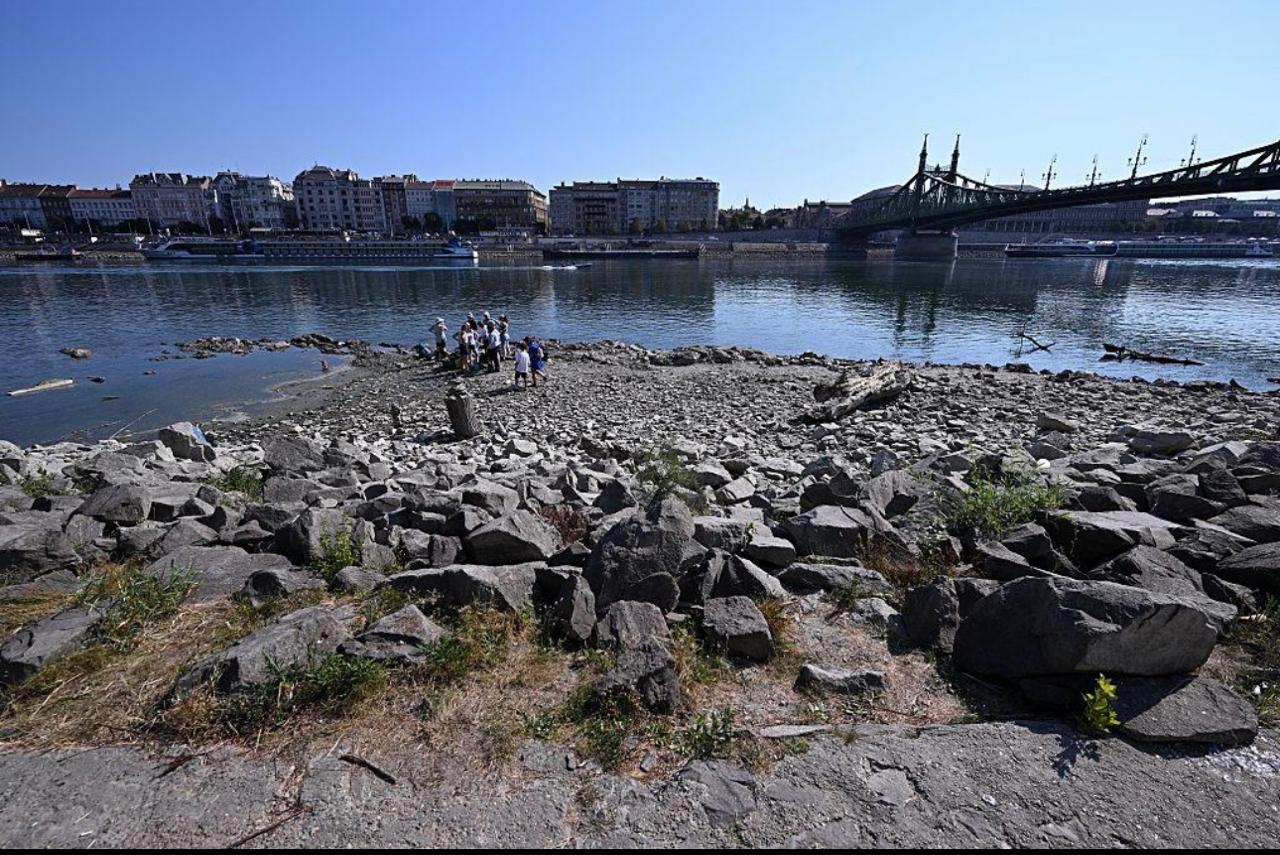

France convenes a drought crisis meeting on Wednesday. Romania has sent its navy to reshape the Danube. Brussels is monitoring. Scarcity of this kind is a distributive decision before it is anything else, and the Union has never built the instrument that makes one.
On 31 July the Romanian government ordered emergency measures to keep Unit 2 of the Cernavoda nuclear plant running. Within hours, communique 229 records, the Romanian Naval Forces began hydrographic and bathymetric survey work between kilometres 345 and 346 of the Danube, at the junction of the Bala arm with the Dunarea Veche, to establish the technical parameters for a submerged sill. Two days later, in communique 230, the defence ministry put the operation at 102 soldiers and sixteen pieces of technical equipment, drawn from the 39th Divers Centre, the River Flotilla, and the Maritime Hydrographic Directorate, working with the 10th Engineer Brigade. Combat divers carried out a controlled detonation to dislodge a rock formation from the bed of the Bala arm, so that part of the flow could be redistributed toward the Dunarea Veche and on to the plant.
The first attempt failed. Rear Admiral Marcel Neculae, deputy chief of the naval staff, told reporters that the Parjoaia rock had proved harder than expected and had not shifted, and the divers returned the next morning. Strip away the drama and what the two communiques describe is a member state building a hydraulic structure inside an international river, with its armed forces, under national emergency powers, in order to keep a reactor cooled.
Europe’s water crisis ceases to be a weather report at exactly that point. It becomes a question of priority. The question is no longer how Europe saves water, but who gets the water that remains when saving is no longer enough.
The Transmission of a Local Scarcity
In France, the ministry for ecological transition said on Monday that close to seventy per cent of the territory now sits under water-use restriction, and the ecology minister convenes a crisis meeting on Wednesday. July was the hottest month the country has ever recorded, with a national rainfall deficit approaching seventy per cent. By 6 August, forty-seven departments held at least one commune at the highest tier of restriction, which bans all non-essential tap water use.
A thousand kilometres east, the arithmetic turns starker. Romania declared a nationwide alert in the energy sector for the whole of August after the Danube’s flow fell to less than half its seasonal norm. Operators took Unit 1 at Cernavoda offline as a precaution. Ilie Bolojan, the acting prime minister, warned that losing Unit 2 as well would remove roughly a fifth of national generation. Dacia and Ford suspended production runs, the panel manufacturer Kronospan cut electricity use by up to half, and Bucharest asked Ukraine, a country at war and outside the Union, for evening supply, with parallel conversations in Sofia and Athens.
So a hydrological event in one basin arrived, inside a fortnight, as an industrial shutdown, a cross-border import request, and a call on a non-member’s nuclear fleet. Europe’s water crisis is not a national inconvenience replicated twenty-seven times. It is one shortage travelling through a coupled system, and it picks winners as it goes.
What Europe’s Water Crisis Encounters in Brussels
The Commission does not lack a water policy. It adopted the European Water Resilience Strategy in June 2025, organised around a Water Efficiency First principle and more than fifty actions running to 2030. The document is a serious one and it addresses the right decade. What it does not do is answer a Thursday in August. Efficiency governs how much a continent draws over years. It says nothing about the order of service once the river has fallen below what everyone needs.
The energy side comes better equipped than critics usually allow. Regulation (EU) 2019/941 on risk-preparedness in the electricity sector obliges each member state to build a national plan on regional crisis scenarios identified by ENTSO-E, and it requires states to act in a spirit of solidarity, offering assistance through regional or bilateral measures agreed in advance. That machinery is real, and Romania’s import discussions run along its grain. But an electricity crisis triggers the regulation. It therefore engages downstream of the apportioning, never during it.
Between the strategy and the regulation lies a decision nobody owns. When flow falls below what all users need, someone settles the order of service: reactor cooling, inland shipping, or irrigation. On the present record, whichever national authority moves first settles that ranking, and on the Bala arm a defence ministry settled it. The Danube’s own institutions do not close the gap. They handle shipping and water protection. Rationing a falling river between rival users under emergency conditions sits outside the mandates they publish, and neither presents itself as performing that function.
A Precedent the Union Set for Itself in 2022
The Union has already shown it can do the thing it is not doing. On 5 August 2022, facing a fuel it could no longer source, the Council adopted Regulation (EU) 2022/1369 on coordinated demand-reduction measures for gas, setting a voluntary fifteen per cent reduction target that becomes binding once the Council declares a Union alert, layered on the solidarity obligations of the 2017 security of gas supply regulation. Ministers designed, negotiated, and legislated a rationing scheme inside a single summer. Four years later, to the week, Europe’s water crisis has produced no comparable text.
The case for treating water differently is not weak, and it deserves stating at full strength. Gas is fungible and travels through pipes that operators can reverse. Water sits in basins, and abstraction rights rank among the most lo cal entitlements a state grants, entangled with land tenure, farming, and municipal supply. Article 192(2) of the Treaty on the Functioning of the European Union reserves to unanimity, under a special legislative procedure in which Parliament is merely consulted, measures affecting the quantitative management of water resources or affecting, directly or indirectly, the availability of those resources. That is a deliberate reservation rather than a drafting accident. And in most instances the reactor, the barge, and the field sit inside one jurisdiction, which is a real argument that the allocation belongs at home.
That last premise is the one this summer breaks. The users may be domestic; the consequences are not. Romania’s shortfall became Ukraine’s export and an evening problem in Bulgaria and Greece. Curtailed shifts at Dacia and Ford feed assembly lines that finish in Germany and France. The Rhine and the Danube served as international waterways long before anyone counted them as national assets. Unanimity constrains the instrument, not the interdependence, and an absent instrument does not hand the decision back to the member state. On my reading it hands the decision instead to whoever acts first. Two points cut against the objection on its own terms. The Treaty supplies its own exit: the second subparagraph of Article 192(2) lets the Council, acting unanimously on a Commission proposal, make the ordinary legislative procedure applicable, so the unanimity lock can be opened without amending anything. And the gas instrument did not go through that door at all. Regulation (EU) 2022/1369 rests on Article 122(1), the solidarity clause the Union reaches for when severe difficulties arise in the supply of a product. Whether Article 122 stretches to a hydrological allocation is arguable, and I put it no higher than arguable, but the objection assumes an environmental legal base the Union has already shown itself willing to bypass.
Water Entered as an Input Cost
In its July bulletin the Commission’s Joint Research Centre cut EU yield forecasts for grain maize and sunflowers by six to seven per cent, put total cereals one per cent below the five-year average, and warned that persistent heat in western Europe makes further reductions likely. On 4 August the gauge at Kaub, which sets the loading draft for every barge between the North Sea ports and the industrial interior, fell to twenty-one centimetres against a seasonal norm above two metres. No lower reading exists since German measurement began in 1880. Vessels load at a fraction of capacity, freight shifts to rail and road, and the cargoes affected include coal, chemicals, and grain. Europe’s water crisis now surfaces in yield tables, freight rates, and evening power prices, which is to say it has become an input cost and not a season.
Four Measures Short of Treaty Amendment
The argument here is not for a Brussels water ministry, and no agency will solve Europe’s water crisis. It is for four modest measures, none of which disturbs the unanimity reserved by Article 192(2).
- A written order of service, basin by basin, agreed in normal years. Each shared basin should carry a published sequence, negotiated when nothing is at stake, setting out how cooling water, inland shipping, and irrigation rank against one another as flow declines. The Union need not choose the ranking. It should require that a ranking exist before anyone needs it. The drafting belongs to the riparian states inside the basin commissions they already fund, the adoption to the national competent authorities each member state has designated under Regulation 2019/941, and the deposit to the Commission, so that the sequence is on a Union record rather than in a national drawer. No new body is needed, and none of those steps requires unanimity.
- A duty to notify and consult before physical works on a shared watercourse. Neither MApN communique refers to any basin-level notification or consultation; both describe an interinstitutional effort within Romania. I have found no published record of consultation with the other riparian states, and I would welcome a correction. The criticism is not that Romania acted wrongly, since a government facing the loss of a fifth of its generation will act. It is that nobody outside Bucharest can readily establish what process applied, and a river with eight riparian states deserves better than that.
- Hydrological triggers written into the risk-preparedness scenarios. Regulation 2019/941 already demands scenario identification at regional and national level. A Danube flow threshold and a Rhine gauge reading belong inside those scenarios, so that a plan anticipates a reactor derating instead of a press conference announcing one.
- A water column in seasonal adequacy assessment. ENTSO-E assesses generation adequacy season by season. On a continent where thermal output, hydro output, and freight all turn on river conditions, water availability belongs in that assessment as a stated variable, not an implied one.
The Honest Limit of the Argument
None of this would have made it rain. I concede that plainly instead of burying it at the foot of a policy wish list. A rule would not have raised the Danube by a centimetre, kept Cernavoda Unit 1 online, or spared a single French commune its tanker deliveries. What it would have changed is the character of the decision. When a government sent soldiers to reshape a river this month, it acted alone, under national emergency powers, on a waterway that other states depend upon, and it acted because the alternative meant watching a fifth of its electricity disappear. Improvisation of that order deserves respect. Repetition of it does not.
The next dry summer will arrive, and on current form it will find the same continent holding the same efficiency strategy, the same electricity regulation, and the same empty space between them. Commentary has treated Europe’s water crisis all summer as a climate story. It is also, and more usefully, an institutional one: the Union has learned to ration a fuel and has not yet learned to ration a river. That is now a choice, not an oversight, which is the only encouraging thing about it.
A NOTE ON THE RECORD:
This is an opinion piece. Factual claims are attributed in the text and listed in the Source Register below. Where the argument rests on the author’s inference and not on a published fact, the text says so. Reporting used to corroborate an institutional act carries the mark CORROBORATION.
| Claim | Source | Date |
|---|---|---|
| After the government’s emergency measures of 31 July 2026, the Naval Forces surveyed Danube km 345 to 346 at the Bala arm junction with the Dunarea Veche to set parameters for a submerged sill. |
Ministry of National Defence of Romania, press communique no. 229 View Communique PRIMARY |
31 July 2026 |
| 102 soldiers and 16 pieces of equipment from the 39th Divers Centre, River Flotilla and Maritime Hydrographic Directorate, with the 10th Engineer Brigade, built the submerged sill on the Bala arm; EOD divers detonated a rock formation to redistribute flow to Reactor 2. |
Ministry of National Defence of Romania, press communique no. 230 View Communique PRIMARY |
2 August 2026 |
| The first detonation did not dislodge the Parjoaia rock; Rear Admiral Marcel Neculae, deputy chief of the naval staff, said it had proved harder than expected and the operation would resume the following day. |
Remarks to reporters on 2 August 2026, reported by News.ro Read Report CORROBORATION |
2 August 2026 |
| Nearly 70% of French territory under water-use restriction; ministerial crisis meeting on Wednesday; July 2026 the hottest month on record in France, with a rainfall deficit near 70%. |
French ministry for ecological transition and Meteo-France, as reported by Euronews Read Article CORROBORATION |
10 August 2026 |
| By 6 August, 47 French departments held at least one commune at crise level, the highest tier of restriction. |
The Connexion, citing French departmental restriction data Read Article |
8 August 2026 |
| Romania declared a nationwide alert in the energy sector for August 2026; Danube flow below half its seasonal norm; risk of losing roughly 20% of national generation if Cernavoda Unit 2 shut down. |
Statement by acting Prime Minister Ilie Bolojan following the National Committee for Emergency Situations, reported by BTA Read Report CORROBORATION |
31 July 2026 |
| Dacia and Ford suspended production runs and Kronospan cut electricity use by up to half; industrial consumers asked to shift or reduce evening load. |
Balkan Insight Read Article |
4 August 2026 |
| Romania sought emergency evening electricity imports from Ukraine, with parallel discussions with Bulgaria and Greece; a national operational centre for the energy sector established. |
Radio Romania International Read Update |
6 August 2026 |
| The European Commission stated it is monitoring the effects of the Danube drought and has identified no electricity supply problem, while plants in Romania and Hungary run at minimum capacity. |
Radio Romania International Read News CORROBORATION |
8 August 2026 |
| The Rhine at Kaub fell to 21 centimetres on 4 August 2026, the lowest since records began in 1880, against a seasonal norm above two metres. |
German federal waterway data compiled by ETH Zurich, reported by Bloomberg Read Report CORROBORATION |
4 August 2026 |
| Barges loading at a fraction of normal capacity, freight diverted to rail and road; cargoes affected include coal, chemicals, and grain. |
Society of Chemical Industry Read Article |
August 2026 |
| EU yield forecasts cut by 6-7% for grain maize and sunflowers; total cereals 1% below the five-year average; further reductions considered likely. |
JRC MARS Bulletin, Crop monitoring in Europe, Volume 34 No 6, Joint Research Centre View Bulletin PRIMARY |
27 July 2026 |
| The European Water Resilience Strategy, adopted 4 June 2025, is organised around a Water Efficiency First principle with over 50 actions running to 2030. |
European Commission, Directorate-General for Environment View Strategy Overview PRIMARY (COM(2025) 280 final) |
4 June 2025 |
| Regulation (EU) 2019/941 requires national risk-preparedness plans built on ENTSO-E regional crisis scenarios and obliges member states to act in a spirit of solidarity, offering assistance through agreed regional or bilateral measures. |
Official Journal of the European Union, L 158, 14 June 2019 View Regulation PDF PRIMARY |
5 June 2019 |
| Council Regulation (EU) 2022/1369 set a voluntary 15% gas demand-reduction target, binding on declaration of a Union alert, alongside the solidarity framework of Regulation (EU) 2017/1938. |
Official Journal of the European Union, L 206, 8 August 2022 View Regulation PRIMARY |
5 August 2022 |
| Article 192(2) TFEU reserves to Council unanimity, under a special legislative procedure with Parliament consulted, measures affecting the quantitative management of water resources or, directly or indirectly, the availability of those resources; the second subparagraph permits the Council, acting unanimously on a Commission proposal, to make the ordinary legislative procedure applicable. |
Consolidated Treaty on the Functioning of the European Union, Article 192 View Treaty PDF PRIMARY |
Consolidated 2016 |
| Regulation (EU) 2022/1369 was adopted on the legal basis of Article 122(1) TFEU, not on an environmental legal basis. |
European Commission, COM(2024) 101 final, explanatory memorandum View Explanatory Memorandum PRIMARY |
27 February 2024 |
| No published record of basin-level consultation with other Danube riparian states; neither MApN communique refers to one. |
Author’s search of the public record, 11 August 2026 AUTHOR’S FINDING (Open to correction) |
11 August 2026 |
ABOUT THE AUTHOR
Clara Weiss is a Senior Analyst and Policy Specialist specialising in energy and climate. She writes on the green transition, European energy security, and international climate policy for The European Post.