

Israel was admitted to the United Nations under the international legal order, and Europe did more than any state to build it. On the gravest test of that order in a generation, the Union has chosen the comfort of silence over the cost of enforcement.
AUTHOR’S NOTE:
This article is offered as criticism in good faith, an assessment of the bloc’s own policies and their implementation, written in the interest of the rule of law Europe helped establish. Its argument rests on public documentation, including the findings of United Nations bodies and the International Court of Justice, the European Commission’s review of the Association Agreement, and the published record of the European Parliament and the Council. It examines the conduct of states and institutions, not the character of any nation or people. The analysis is grounded in established fact and figures, and the views expressed are honestly held.
The State of Israel exists because an international order willed it into being. In November 1947 the United Nations General Assembly recommended the partition of Mandatory Palestine, and in May 1949 Israel was admitted to the United Nations as a member state, its sovereignty underwritten by the same charter and the same body of law the post-war world had only just finished drafting. That origin is worth recalling, because it carries an obligation often left unspoken. A state created under international law is bound by international law. Nothing in the order admits a country to its privileges while exempting it from its constraints.
Those constraints have been clear for a long time. Since 1967 Israel has held the Gaza Strip, the West Bank, and East Jerusalem under military occupation, and the Fourth Geneva Convention, drafted in 1949 to protect civilians in precisely such circumstances, governs that territory. The International Court of Justice has affirmed as much repeatedly, most recently in July 2024, when it found Israel’s continued presence in the occupied Palestinian land unlawful and called for it to end. Gaza did not cease to be occupied when Israeli settlers withdrew in 2005, because command of its borders, airspace, population registry, and economy remained. The legal status of the territory has never been genuinely in dispute. What has been in dispute is whether anyone with the power to enforce the law would choose to use it.
The present catastrophe has a starting date that honest accounting cannot omit. On 7 October 2023, Hamas led an assault on southern Israel that killed roughly 1,200 people, most of them civilians, and seized some 240 hostages. Many of those captives, or their remains, are still held, and the anguish of their families is its own standing indictment of Hamas. The crime was real, and the right of a state to defend its population is not in question. What is in question is everything a state may lawfully do in the exercise of that right, because the laws of war do not lapse the moment the cause is grief.
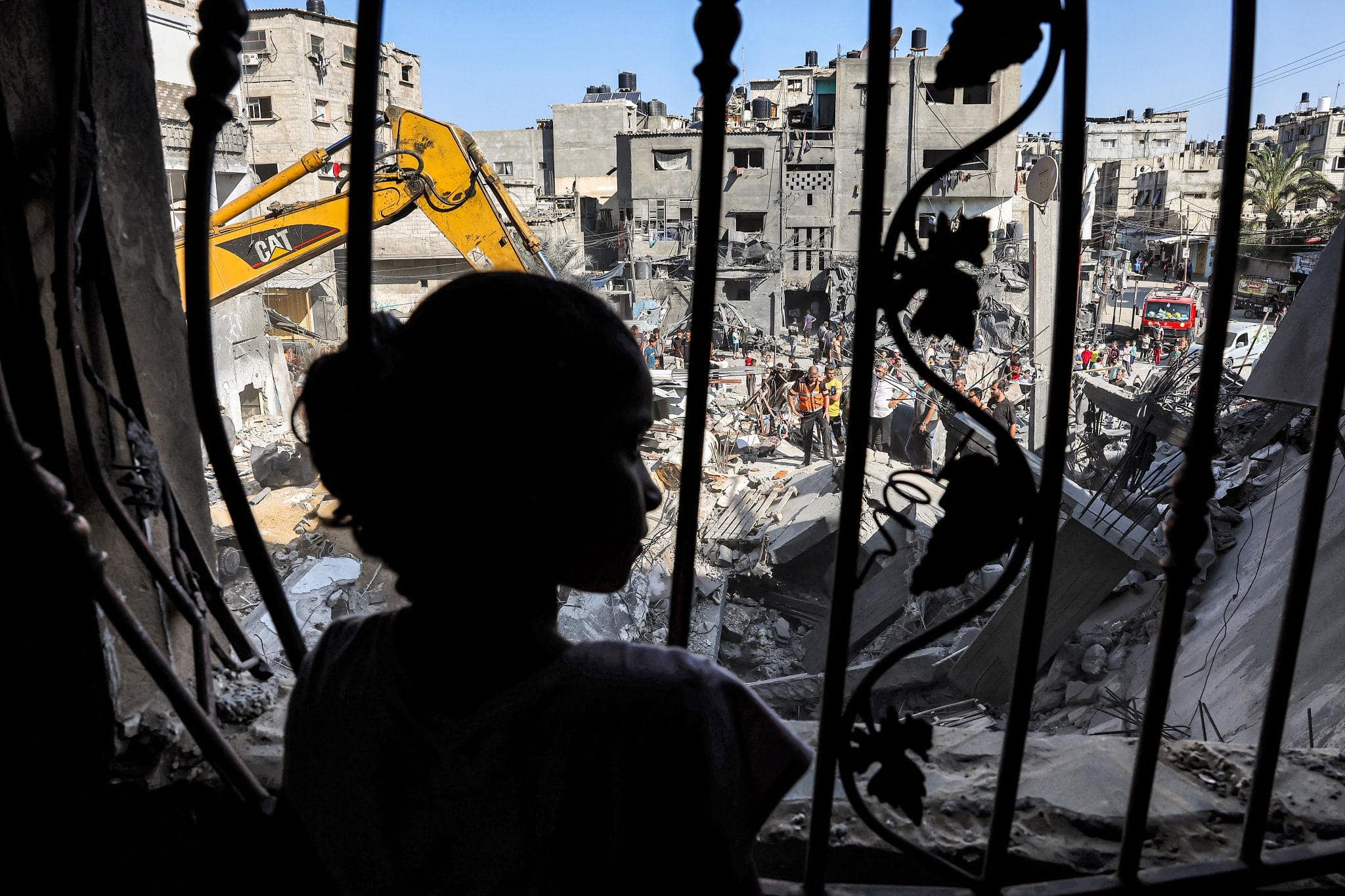
The conduct of the response is now documented in detail, much of it by the institutions Europe itself funds and ordinarily trusts. More than seventy thousand Palestinians have been killed in Gaza, the majority of them women and children, by counts the United Nations treats as broadly reliable. Most of the territory’s population, well over two million people, has been displaced, a great many ordered from one district to another and then bombarded in the place they were sent. Hospitals, universities, water systems, and the bakeries that fed the living have been reduced to rubble. Famine, the engineered kind that follows a blockade rather than a drought, has been recorded by the same international monitors whose judgements the EU cites without hesitation everywhere else.
“The laws of war do not lapse the moment the cause is grief. A state created under international law is bound by it.”
In September 2025 the United Nations Independent International Commission of Inquiry concluded that Israel had committed genocide against Palestinians in Gaza, finding that four of the five acts defined by the 1948 Genocide Convention had been carried out, and citing the recorded statements of senior Israeli officials as evidence of intent. Israel rejected the report as false. A separate case brought by South Africa remains before the International Court of Justice, which has already ordered Israel to take measures to prevent genocidal acts and to permit aid to enter. A reader is entitled to weigh a contested legal term with care. No reader is entitled to pretend that a finding of such gravity, from a body of such standing, can be answered by a continent with nothing sturdier than concern.
This is the point at which Europe’s conduct must be examined, and examined without indulgence. European states did more than any other actor to build the modern architecture of human rights. They supplied the jurists who drafted the Universal Declaration, hosted the conventions that wrote the laws of war, and answered their own continent’s century of atrocity with the conviction that law must stand above sovereign power. The Union bound itself to a Charter of Fundamental Rights that opens on the inviolable dignity of the person. That inheritance is the source of whatever moral authority Europe carries beyond its borders, and it is now being spent on a silence.
The silence is not the product of helplessness. Article 2 of the EU-Israel Association Agreement makes respect for human rights an essential element of the entire relationship, a clause written so that Brussels would hold a lawful instrument when a partner’s conduct crossed a threshold. The Commission’s own review concluded there were indications Israel had breached those obligations. In September Ursula von der Leyen, for years among Israel’s most reliable defenders in Brussels, told the European Parliament that man-made famine can never be a weapon of war, and proposed sanctions on extremist ministers and settlers, a freeze on bilateral payments, and a partial suspension of the trade provisions at the heart of the agreement. The legal finding was in place, the mechanism was in place, and the proposal was in place. Only the resolve to complete the sequence was absent.
What followed is instructive. In May 2026, after a change of government in Hungary lifted a long-standing veto, EU foreign ministers agreed to sanction a handful of violent settlers and a list of Hamas figures, and the bloc’s chief diplomat called it a move from deadlock to delivery. The settler measures were overdue. They were also action on the periphery. The structural step, suspension of the trade provisions, needs only a qualified majority rather than unanimity, and that threshold has never been assembled. A coalition of capitals led by Germany and Italy has held the line against any measure touching the economic core of the relationship, and a citizens’ initiative carrying more than a million signatures has not moved them. Into the vacuum, five member states have stepped, legislating their own bans on settlement goods, national conscience standing in for a common policy.
That this is choice rather than incapacity is settled by a single comparison. When Russia invaded Ukraine in 2022, the Union assembled sweeping sanctions and a unified front within days, and it absorbed real economic pain to do so. The machinery is plainly capable of speed and sacrifice once the political will is present. Set beside Gaza, the contrast yields the conclusion European institutions have laboured to keep unspoken. The difference is not what Europe can do. It is what Europe is willing to do, and the willingness has tracked the cost of acting rather than the gravity of the cause.
The price of the silence is not confined to Gaza. Governments across the Global South were asked to stand on principle against the violation of Ukrainian sovereignty, and have watched the same Europe decline to apply that principle when the victims are Palestinian and the partner is a Western friend. They have drawn the obvious inference. A human rights framework enforced against adversaries and suspended for allies is not a framework. It is a hierarchy of human worth conducted in legal language, and the audience for European instruction on the rules-based order has read it as exactly that.
None of this is beyond remedy, which is what makes the dormancy so difficult to forgive. Article 2 can still be invoked. The trade provisions can still be suspended by a majority willing to assemble itself. The Council meets again in June, and the choice before it is not between action and impossibility but between action and comfort. Europe helped write the law that admitted Israel to the community of nations, and the law that governs how a nation may wage war, and a continent cannot claim authorship of a moral order while reserving the right to ignore it whenever enforcement proves expensive. Children are being killed beneath a body of law that carries Europe’s signature, and Europe will not enforce it. The question is no longer what the Union believes, but whether the bloc still means it. In June that belief will be tested against a vote, and a vote unlike a statement cannot be qualified.
ABOUT THE AUTHOR
Azfar Bukhari is a senior analyst specialising in geopolitics, public diplomacy, migration, international trade, and investment. He is a regular contributor to The European Post.