
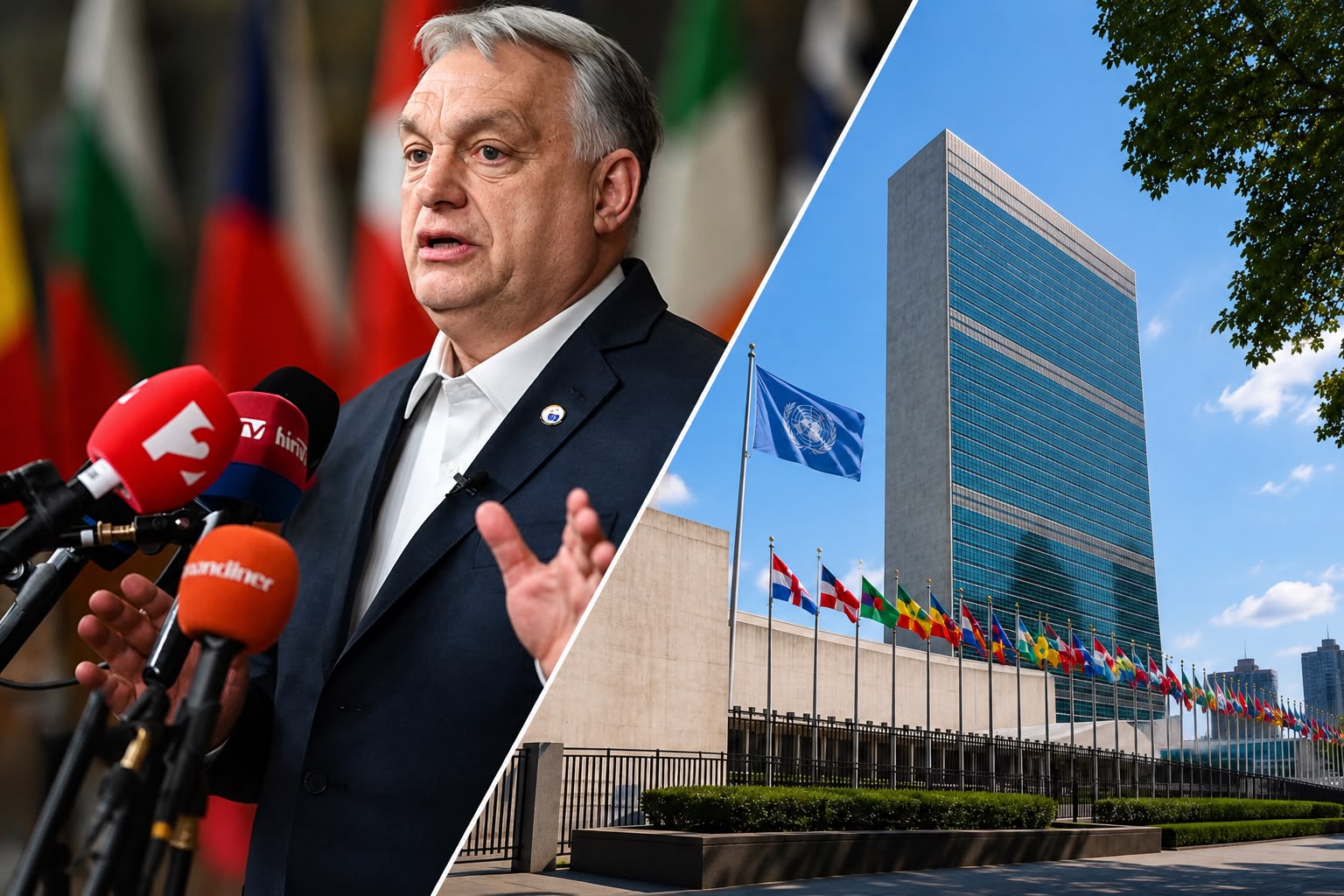

Washington is reportedly weighing Viktor Orbán as the next UN Secretary-General, with Russian and Chinese support. Europe’s leaders have laughed the idea off. They would do better to agree what they want from the post, and the treaties already give them a channel to act on it. The final rounds of voting are weeks away.
Donald Tusk had the quickest answer. Asked on Monday about claims that Trump administration officials are promoting Viktor Orbán as the next UN Secretary-General, the Polish prime minister recalled an earlier rumour that Orbán would run the European Commission. “This seems to me just as funny as that first rumor,” he said. Ukraine’s foreign minister, Andrii Sybiha, was sharper. Orbán, he wrote, would “put to good use the masterful veto and blackmail skills” he had developed in the Union, and Kyiv could share its “great experience of taking him out for coffee at the right moment.”
The laughter is understandable. The complacency behind it is not. The claim comes from an unsigned editorial by the Wall Street Journal’s editorial board, published on Sunday and citing sources in three countries. It says US officials encouraged Orbán to consider running and that Russia and China appeared open to a joint candidacy. The board itself opposed the idea, warning that Orbán “would act as an apologist for Vladimir Putin and other dictators.” No government has confirmed the account, Orbán declined to comment, and any announcement would reportedly wait until after the American midterm elections on 3 November. The story may come to nothing. What it exposes will not go away: the Union has never said who it wants to lead the United Nations, and the selection is entering its final stretch.
A Selection Further Along Than Europe Admits
Guterres’s second term ends on 31 December. The Security Council began formal straw polls on 30 July and has held at least six since. According to Security Council Report, seven candidates were in the race by early October, most of them from Latin America and the Caribbean, the region widely seen as next in line. The Council does not publish straw-poll results, but figures leaked from the 16 October round, the first to show how the five permanent members vote, indicate that every candidate drew at least two discouraging votes from them. Rebeca Grynspan of Costa Rica reportedly led with nine encouraging votes, the number needed for a recommendation, but still faced two potential vetoes. When the permanent members have aligned, the Council has moved fast: in 2016, it recommended António Guterres the day after its final colour-coded poll.
The field is still open. The United Arab Emirates nominated its Minister of State, Lana Nusseibeh, last week, and any member state can present a candidate who is not its own national. Burundi nominated Senegal’s Macky Sall, and Tonga nominated Ecuador’s Ivonne A-Baki. Orbán would not need Budapest’s endorsement to enter. That matters, because the government of Péter Magyar, which ended his sixteen years in power in April, would be unlikely to offer it.
The Secretary-General Europe Described but Never Chose
The Union has not been silent about the UN Secretary-General it wants. In April, during the General Assembly’s dialogues with candidates, the EU statement asked for a leader who could “build trust, reduce polarization, bridge divides,” with “a clear appreciation of the EU’s role in the UN system,” and who would defend peace and security, development, and human rights “with equal vigour.”
Those are sound criteria, and they sit uneasily with Orbán’s record. His government spent years in conflict with the Union over the rule of law, which led the European Parliament to trigger the Article 7 procedure against Hungary in 2018 and the Council, on the Commission’s proposal, to freeze EU funds under the conditionality regulation in 2022. In June 2025, it notified Hungary’s withdrawal from the Rome Statute of the International Criminal Court, a decision the Magyar government reversed only days before it would have taken effect. Washington has since sanctioned the Court itself, and the Commission has issued a notice to EU operators on continuing to serve it. A UN Secretary-General chosen partly for his scepticism of such institutions would lead the system those institutions belong to.
Yet the April statement named no one and drew no lines. It described a candidate and stopped there. That restraint was defensible while the race was crowded and slow. It is harder to defend when three permanent members may be assembling a candidate of their own. By Monday evening, neither the Commission nor the High Representative had commented in public.
The post matters to Europe in practical ways. Article 99 of the Charter lets the Secretary-General bring any threat to peace before the Security Council on his own initiative. The office’s good offices helped produce the 2022 Black Sea Grain Initiative, brokered with Türkiye, which reopened Ukrainian grain exports for a year. A Secretary-General who saw the war in Ukraine as a quarrel to be settled on Moscow’s terms would use the same tools in a different direction. EU member states, taken together, are also among the largest funders of the UN’s regular budget. They would be paying for an institution whose leadership they had left to others.
The Case for Staying Out
There is a serious argument for leaving the matter alone. The Union is not a member of the United Nations, and the appointment belongs to the Security Council and the General Assembly under Article 97 of the Charter. France’s veto is France’s, not Brussels’. A common EU line against a European former head of government would look like the Union policing its own politics on a global stage, and it would hand Orbán the story he prefers: Brussels against the sovereign nations.
There is also a timing objection. Reacting to an unconfirmed claim in a newspaper editorial risks giving it weight it may not deserve. If Orbán never declares, a European statement would have answered a question nobody formally asked.
Why Article 34 Makes Silence a Choice
Both objections underrate the machinery the treaties already provide. Article 34 of the Treaty on European Union states that member states on the Security Council “will concert and keep the other Member States and the High Representative fully informed,” and that they will “defend the positions and the interests of the Union, without prejudice to their responsibilities” under the Charter. The article obliges coordination; it does not create a common position, which the Council would first have to agree. The selection of the UN Secretary-General is Council business. Article 34 does not ask capitals to pretend it is not.
The arithmetic makes the point sharper. Four EU member states sit on the Council this year: France as a permanent member, and Denmark, Greece, and Latvia as elected members. The United Kingdom holds the second European veto. A recommendation needs nine votes and no permanent-member veto. An unnamed State Department official, according to accounts of the Journal’s editorial, counted eight votes as secure and more within reach. Whether that count is right depends partly on four EU governments that have not, on the public record, coordinated anything.
Nor does a European position require naming or blocking a person. It requires deciding, before the final ballots, which commitments a UN Secretary-General must hold. That approach answers the sovereignty objection, because it applies to every candidate equally. It answers the timing objection too, because the criteria matter whoever enters the race.
What a European Position on the UN Secretary-General Would Require
The Foreign Affairs Council could agree, in its next meeting, a short set of conditions drawn from the Union’s own April statement: full support for the Charter, including the territorial integrity of member states; equal defence of all three pillars of the UN system; and cooperation with international courts, the ICC among them. If the Council agreed such conditions, Article 34 would oblige France, Denmark, Greece, and Latvia to defend them in the remaining straw polls and keep the High Representative informed. That obligation is political rather than judicial, since the Court of Justice has almost no jurisdiction over foreign policy, and how each votes on a given candidate would remain a national decision. A parallel understanding with London would cover the second European veto.
Such a position would need unanimity, and that is not guaranteed. Some EU governments have their own sympathies in Washington and Moscow. But the attempt would show where each capital stands, and a public record of disagreement is more useful than a private assumption of consensus.
The cost of doing nothing is easy to state. If the next UN Secretary-General is agreed among Washington, Moscow, and Beijing, Europe will have spent a decade defending multilateralism and then watched its main institution chosen without it. Tusk may well be right that the Orbán rumour is a joke. The Union’s lack of a position is not.
ABOUT THE AUTHOR
Ivana Stojanović is a Senior Policy Analyst specialising in external relations and diplomacy. She writes on European foreign policy, diplomatic strategy, multilateral alliances, and international security cooperation for The European Post.