

Every country inside the GSP+ tier held all twenty-seven required conventions through 2023 to 2025. The joint report covering those years sets torture, curtailed expression, and impunity beside that fact, and records a single preference withdrawn, granted on behalf of European ethanol producers. The reapplication window closing in 2028 is the last occasion on which the arrangement can be made to mean what it says.
The fifth joint report on the Generalised Scheme of Preferences, published on 16 July by the European Commission and the High Representative, states that all eight countries in the GSP+ tier held ratification of the twenty-seven listed international conventions throughout 2023 to 2025 and lodged no new reservations.
Several pages later the same text catalogues torture, narrowed civic space, impunity for gender-based violence, curtailed freedom of association, and judiciaries without independence across those same countries. Each account is accurate. Read alongside one another, they describe an arrangement that measures conduct with great care and answers it with almost nothing.
GSP+ is the demanding tier of the European Union’s unilateral tariff scheme. It opens duty-free entry on two thirds of tariff lines to vulnerable low and lower middle income economies, in return for applying twenty-seven international conventions covering human rights, labour standards, environmental protection, and good governance. Eight countries currently hold the status: Bolivia, Cabo Verde, Kyrgyzstan, Mongolia, Pakistan, the Philippines, Sri Lanka, and Uzbekistan.
One benefit did come off during the reporting period. In June 2025 the Commission suspended GSP+ treatment for ethanol originating in Pakistan, invoking the special agricultural safeguard that exists to shield European producers from import surges. That was the only preference removed from a GSP+ country in three years. It had no connection whatever to the twenty-seven conventions.
The Case for the Instrument as It Stands
Brussels has a reasonable reply, and it deserves stating at full strength before anyone tests it.
GSP+ conditionality was never designed as a sanctions mechanism. It was designed as a permanent conversation underwritten by market access, and the report shows that conversation yielding returns.
Pakistan narrowed the reach of the death penalty, issued implementing rules under its Anti-Torture Act, passed Child Marriage Restraint Acts in Balochistan and Islamabad, and ratified the ILO Protocol to the Forced Labour Convention.
Uzbekistan carried on dismantling forced labour. The Philippines produced a roadmap on freedom of association together with a child labour strategy. Kyrgyzstan and Sri Lanka reinforced domestic violence legislation. Every beneficiary in the tier ratified the Convention on the Rights of Persons with Disabilities and joined the Paris Agreement well before either text entered the scheme’s own list.
Money follows the dialogue. Aid for Trade commitments to the eight beneficiaries reached EUR 1.4 billion between 2021 and 2023, directed at production capacity, standards compliance, and trade facilitation.
Removing preferences, on this account, would fall hardest on garment workers who had no say in the conduct being punished, and would surrender the access that keeps ministries in the room at all. Patience is not weakness. It is how slow institutional change gets bought.
Monitoring Without Enforcement
That defence survives only while removal remains believable, and the record has now made it otherwise.
Across the entire life of the 2012 Regulation, no GSP+ withdrawal procedure was carried through against any beneficiary. Preferences shifted for commercial reasons alone: product graduation touching India, Indonesia, and Kenya, rice safeguards restored against Cambodia and Myanmar, and the Pakistani ethanol case. The credibility of GSP+ conditionality rests on a consequence that has never once arrived.
The Signal Received by Beneficiary Governments
A beneficiary government reading three years of findings learns something precise from that pattern. Ratification buys entry. Reporting buys continuation. Implementation, the part the conventions actually concern, carries no price at all.
The report is candid about the resulting gap: legislative frameworks improve while enforcement stays uneven, labour inspectorates lack capacity, and the data needed to verify progress on gender-based violence, torture investigations, child labour, and trafficking prosecutions is simply missing.
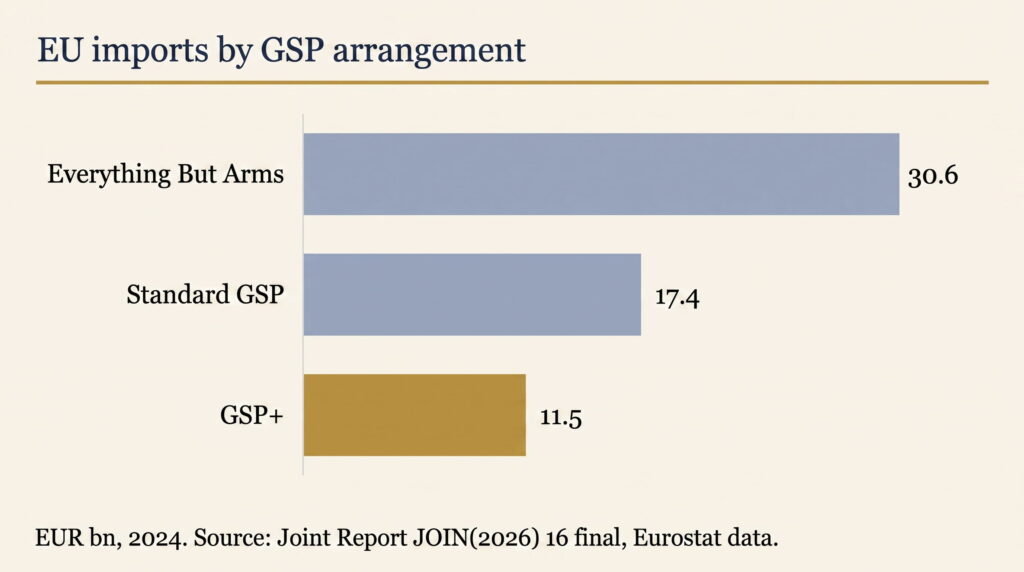
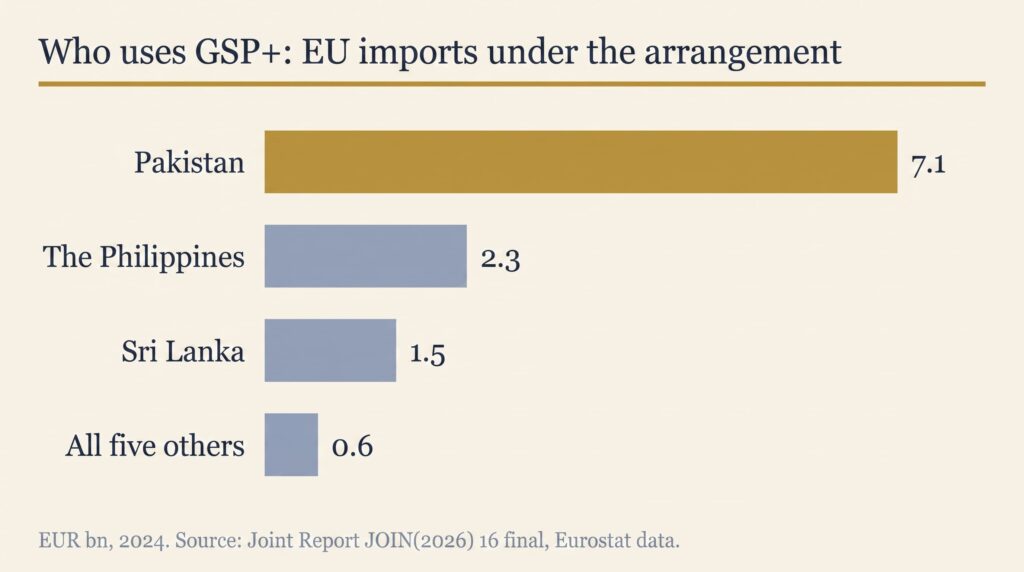
Pakistan remains the largest user of the arrangement, with EUR 7.1 billion of exports entering the EU under GSP+ in 2024 at a preference utilisation rate of 95.1 per cent. The Philippines followed at roughly EUR 2.3 billion, Sri Lanka at EUR 1.5 billion. Nearly a fifth of all EU imports under the scheme originate in the GSP+ tier.
The Withdrawal Procedure Never Opened
The European Parliament has already tested the point. In April 2021 it asked the Commission and the External Action Service to examine Pakistan’s eligibility at once and to say whether grounds existed for beginning a temporary withdrawal, restating a complaint about the blasphemy statutes it had first lodged in 2014. Nothing was opened. Access held.
One precedent maps the outer boundary of what Brussels will do. In 2020 the Commission stripped part of Cambodia’s duty-free entitlement over rights violations, using the Everything But Arms arrangement rather than the GSP+ tier. That remains the only occasion on which the European Union has withdrawn preferences from anyone on rights grounds under the 2012 rules.
The years since have moved the other way in Pakistan. In 2023, inside the window this assessment examines, parliament raised the minimum sentence for insulting the family and companions of the Prophet from three years to ten and made the offence non-bailable, widening a body of law that European institutions had spent a decade urging Islamabad to narrow. The July document logs progress on the death penalty, torture rules, and child marriage next to continuing failure on expression, disappearances, and judicial independence. That ledger has two columns, and only one of them has ever carried a cost.
Bangladesh shows the same reflex from another angle. It sits under Everything But Arms rather than the GSP+ tier, inside the enhanced engagement track the Commission keeps for its largest and most troubled duty-free partners, and it is due to leave least developed country status in November 2026 with three further years of protected entry after that. Whatever conditions eventually attach to Dhaka’s access arrive late in the decade, by which point a decade of practice will have established engagement, rather than removal, as the answer to findings of this kind.
A Scheme Contracting Through Its Own Success
What gives this cycle urgency is that the constituency for the instrument is shrinking fast.
India is expected to leave standard preferences once the bilateral agreement concluded in February 2026 enters application and its two-year transition expires. Indonesia departs on 1 January 2027 after three consecutive years above the income threshold, and Kenya’s economic partnership agreement displaces its preferences on the same date.
The Commission anticipates the Philippines upgrading to a treaty relationship. Cabo Verde and Mongolia both sit close to income graduation. Bangladesh, Laos, and Nepal are scheduled to leave least developed country status, though Dhaka asked the United Nations in February for a three-year deferral.
The pattern matters more than any single exit. Unilateral preference is giving way to negotiated treaty, and the sustainability chapters inside those treaties cannot be switched off the way a tariff line can. Whatever GSP+ conditionality achieves in the coming decade, it will achieve with a smaller and poorer set of partners than the one Brussels has grown used to addressing.
Enforcement Grounds Under the 2027 Framework
Regulation (EU) 2026/1395, adopted on 17 June and applicable from 1 January 2027, does strengthen the architecture on paper. Five conventions join the list, the Paris Agreement replaces the Kyoto Protocol, civil society acquires a defined role, transparency requirements tighten, and an urgent procedure permits faster action in grave cases.Grounds for withdrawal widen to reach environmental and good governance violations.
They widen to reach something else as well. A beneficiary that fails to take back its own nationals in irregular migration cases may now lose its preferences. Consider where the sharpest new blade points.
The monitoring identifies torture, civic space, and violence against women as the deepest and most stubborn failures in the tier. The enforcement ground that arrived carrying real political weight behind it concerns returns. GSP+ conditionality gained force in the area European domestic politics demanded, rather than in the areas European monitoring documented.
Reapplication as the Final Test of GSP+ Conditionality
Every current beneficiary must now reapply for the arrangement and submit a Plan of Action, with a transition running to the end of 2028. The report treats this as an administrative passage, and offers Commission and External Action Service support through the paperwork.
Treated differently, it is the only occasion in a decade when eight governments will sit down and ask Europe for something it can withhold.
The Substance of a Credible Plan of Action
Three tests would make GSP+ conditionality legible to the governments it addresses. The Plans of Action should carry dated benchmarks drawn directly from the country staff working documents, so that a baseline exists against which 2030 can be judged.
The missing statistics the report identifies should become reporting obligations with fixed deadlines, because a commitment nobody can measure is a commitment nobody need keep.
The response to failure requires calibration below the level of total removal, through sectoral or partial suspension, so that the choice is no longer between a diplomatic complaint and an economic rupture nobody in Brussels intends to cause.
None of that demands new legislation. It demands that the Commission write terms it intends to apply, and say so in the application file rather than in the report that follows four years later.
The Weight of the Pakistani Case
Islamabad sits at the centre of this argument for reasons of arithmetic. Pakistan accounts for close to two thirds of everything the GSP+ tier ships into the European Union under preference, EUR 7.1 billion out of EUR 11.5 billion in 2024, and it claims the benefit on 95.1 per cent of eligible trade.
Clothing and textiles carry most of that value, which puts the scheme inside the country’s largest export sector and much of its urban employment. No other beneficiary combines dependence on that scale with a monitoring file as thick, and none has more riding on an application due before the end of 2028.
Pakistan is where this will be decided, because Pakistan has the most to lose and therefore the most reason to move. A preference worth that much to one exporter has genuine purchase, which is exactly why the present settlement is so hard to defend
.
A scheme that has removed one preference in three years, and that one for the benefit of European distilleries, is not conditionality. It is a discount with a monitoring report attached.
ABOUT THE AUTHOR
Azfar Bukhari is a senior analyst specialising in geopolitics, public diplomacy, migration, international trade, and investment. He is the Vice President (External Relations & Diplomacy) and a regular contributor to The European Post.