
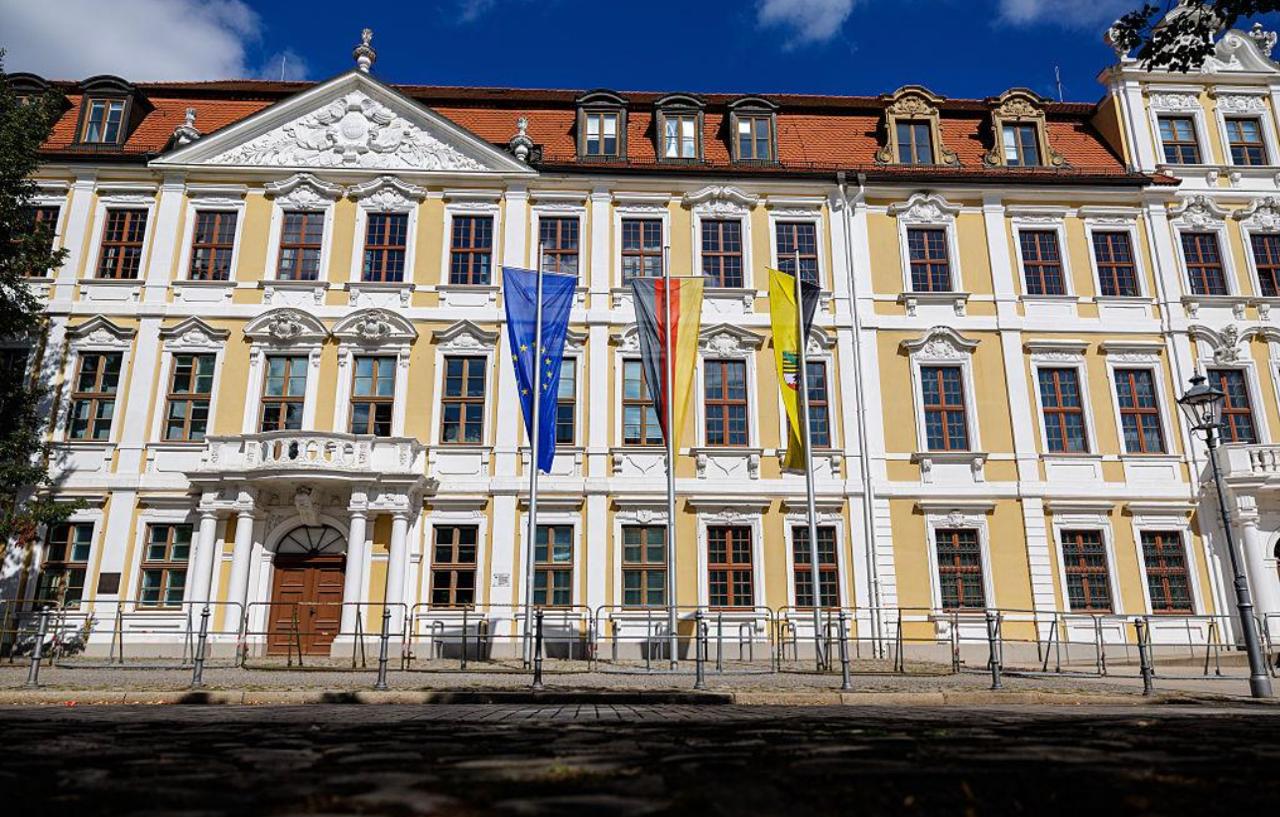

The instinct in Brussels this week has been to file the Saxony-Anhalt result under German domestic politics: a CDU that misjudged its own base, a firewall debate that belongs to Berlin, a state government that will now spend weeks negotiating a coalition nobody particularly wants. That instinct is not unreasonable. State elections in a federal republic are, by design, local affairs, and the Bundestag is where German governing majorities are actually built.
It is also the wrong frame. What happened in Magdeburg on 6 September is not primarily a story about German party arithmetic. It is a stress test of the European Union’s own machinery for defending the values it lists in Article 2 of its founding treaty, and the machinery did not so much fail the test as reveal that it was never built to sit it in the first place.
The Saxony-Anhalt Election Result, By the Numbers
The Alternative für Deutschland took 43.8 percent of the vote in Saxony-Anhalt, on record turnout of 77.8 percent, winning 39 of the Landtag’s 83 seats and falling three short of an outright majority it had openly campaigned to secure. The governing Christian Democrats collapsed to 17.2 percent, less than half their 2021 result, while the FDP was eliminated from the chamber entirely. It was the AfD’s best result in its thirteen-year history, and, as the Associated Press reported, the closest any far-right party has come to forming a German state government since the Second World War.
Precision matters here, because the party’s own defenders have made a habit of disputing loose language. The federal AfD’s classification as a “gesichert rechtsextremistisch,” or confirmed right-wing extremist, organisation by the Federal Office for the Protection of the Constitution has been suspended since February 2026, when the Cologne Administrative Court barred the agency from applying or publicising that designation while the AfD’s underlying legal challenge proceeds. No such ambiguity attaches to Saxony-Anhalt itself. The state’s own domestic intelligence service classified the regional AfD branch as confirmed right-wing extremist well before the vote, a classification the Bundeszentrale für politische Bildung, Germany’s federal agency for civic education, cited as context for the election itself. Voters in Magdeburg went to the polls knowing exactly what a state authority had already concluded about the party they were about to reward.
Article 7 TEU: A Toolkit Built for Governments, Not Electorates
The European Union does have an instrument for precisely this kind of alarm. Article 7 of the Treaty on European Union allows the Council, acting on a proposal from a third of member states, the Parliament or the Commission, to determine that a “clear risk of a serious breach” of the Union’s founding values exists in a member state, and, in the most severe cases, to suspend that state’s voting rights in the Council altogether. The Commission itself describes Article 7 as the “last resort” in a broader rule of law framework, reserved for cases where dialogue with national authorities has already failed.
That description contains the whole problem. Article 7 is addressed to states, meaning to governments that have already taken office and acted. It has no register for an electorate that has merely voted a confirmed extremist party to the edge of power, because a government does not yet exist to summon, warn or sanction. The procedure requires a four-fifths majority of the Council even to record a risk, and unanimity among the remaining members to impose any actual penalty, a bar so high that the Commission’s own Article 7 case against Poland ran for more than six years before being closed in 2024 on the strength of a change of government in Warsaw rather than any sanction ever applied. Brussels has a genuine mechanism for governments that break the rules. It has nothing at all for a party that has not yet formed one, no matter how close the arithmetic runs or how openly its state chapter has already been designated a threat to the constitutional order by the country’s own authorities.
Hungary, Poland and the Double Standard Brussels Cannot Avoid
This asymmetry would be an abstract curiosity if Brussels had not spent the past decade treating Hungary and, for years, Poland as the Union’s standing cautionary tale. Budapest has sat under Article 7 scrutiny since 2018, and every General Affairs Council session on judicial independence or media freedom in Hungary has doubled as a reminder that the EU claims to police its members’ democratic health as a condition of membership, not merely of good manners. Warsaw’s own case shows the mechanism working exactly as designed, slowly, and only once voters replaced the government under scrutiny.
Saxony-Anhalt is not Hungary, and a state Landtag is not a national government subject to Article 7 in the first place. But the reaction it drew sharpens the structural point rather than softening it. Spanish prime minister Pedro Sánchez called the result a warning that the far right is advancing “thanks largely to the surrender of the traditional right,” French MEP Valérie Hayer said the result should serve as a wake-up call for a more assertively pro-European response, and France’s Europe minister Benjamin Haddad called it a grave moment for the continent. None of those statements came from a Commission spokesperson, and none pointed toward the rule of law framework, Article 7, or any procedural step the Union’s own institutions could actually take. The political reaction was immediate and unambiguous. The institutional one, the only kind Article 7 recognises, had nowhere to go, because Saxony-Anhalt has not yet produced a government for Brussels’ toolkit to address.
The Economic Case Against the AfD That Voters Still Rejected
Merz made the sharpest version of the institutional case himself, two days too late to affect the result. Confronting AfD leader Alice Weidel in the Bundestag, he said the party’s “remigration” platform amounted to ethnic cleansing by another name, warning that stripping migrant labour from the country would leave, in his words, not a single care home, hospital or restaurant able to keep operating, since roughly one in six of Germany’s skilled workers already comes from a migrant background. The DIW, Germany’s leading economic research institute, had modelled a version of the same warning weeks before the vote: an AfD platform of leaving the euro and the EU, sealing the border and halting migration would cost the average Saxony-Anhalt resident roughly 1,600 euros a year in income and put some 10,000 jobs at risk in the very state that went on to vote for it.
None of that arithmetic is a Brussels argument, and it should not be read as one. It is evidence that the substantive case against the result already existed inside Germany’s own institutions before the ballots were cast, made loudly and with real numbers, and that the electorate returned its verdict anyway on record turnout. That outcome says nothing about what the European Union could or should have added, because the economic argument was never the Union’s to make. It confirms instead that the gap identified above is structural rather than rhetorical: a case can be made in full, in public, by a sitting chancellor and a national research institute, and still leave no opening for Brussels to act, because no EU mechanism has ever been built to weigh in on what happens once a domestic warning fails to change a domestic vote.
The CDU’s Firewall Against the AfD Is Showing Cracks
The domestic response has not offered much reassurance either. On election night, Union parliamentary group leader Thorsten Frei stated plainly that the CDU would not negotiate with right-wing extremists. Days earlier, his own deputy, Sepp Müller, had argued that a clear AfD victory should carry a mandate to attempt government formation regardless. Minister President Sven Schulze has said he does not intend to cooperate with the AfD while declining, for a period, to rule out flexibility on the so-called firewall altogether. None of this suggests collapse. It does suggest that the mainstream party Brussels has traditionally relied upon to hold the line in eastern Germany is arguing with itself about where the line actually sits, in public, while the AfD’s own leadership calls the result a mandate to govern.
There is also a specific procedural detail worth stating precisely, because it is the one part of this story that could move faster than a normal coalition timeline. Saxony-Anhalt’s constitution requires an absolute majority to elect a Minister-President in the first two ballots, but only a majority of the votes actually cast in a third, a threshold abstentions do not count against. BSW list leader Claudia Wittig has said her five-seat bloc would abstain in a third ballot if other parties reject a governing arrangement with her party, a path reporting has suggested could put Siegmund in office without a formal coalition ever being signed. Siegmund has publicly rejected being installed that way, insisting he wants his own governing majority, and German reporting still expects the process to take several weeks before any of the three ballots is even held. The mechanism is real. Whether anyone uses it is not yet decided.
Berlin and Mecklenburg-Vorpommern vote on 20 September, and neither state offers the CDU obvious comfort. Saxony-Anhalt was not a one-off shock. It was the first data point in a six-week sequence, and one European leaders have already met with forceful individual statements. What is missing is not comment but capacity: no Commission process, rule of law dialogue or Article 7 step has attached to any of it, because none of the Union’s instruments switch on before a government exists for them to name.
What the EU’s Rule-of-Law Framework Still Needs to Say
None of this argues for inventing new sanctions against voters, which would be both unworkable and self-defeating for a Union that stakes its legitimacy on the ballot box. It argues for something more modest and more difficult: that Brussels state plainly what Article 7 actually is, a narrow tool for disciplining governments after the fact, and what it is not, a general shield against democratic backsliding, rather than leaving that distinction to be inferred from a decade of statements about Hungary. The gap is not a failure of the mechanism on its own terms. It is a gap between what the mechanism was built to do and what a decade of unclarified Article 7 rhetoric has left open to interpretation.
Saxony-Anhalt’s coalition talks will resolve one way or another in the coming weeks, and Germany’s federal institutions retain tools of their own, including a functioning constitutional court system, that the state level does not. But the European question does not close with Magdeburg’s government formation. It reopens on 20 September, and again whenever a founding member state’s electorate hands a confirmed extremist party the largest share of the vote it has ever won. Brussels can continue treating each instance as a national curiosity, or it can say plainly that the instruments built to defend Article 2 were designed for a threat model that this month’s results have already outgrown.
ABOUT THE AUTHOR
Jean Cluzet is a Senior Analyst and Policy Analyst specialising in democratic governance and rule of law. He writes on European constitutional standards, judicial independence, institutional accountability, and democratic resilience for The European Post.
