
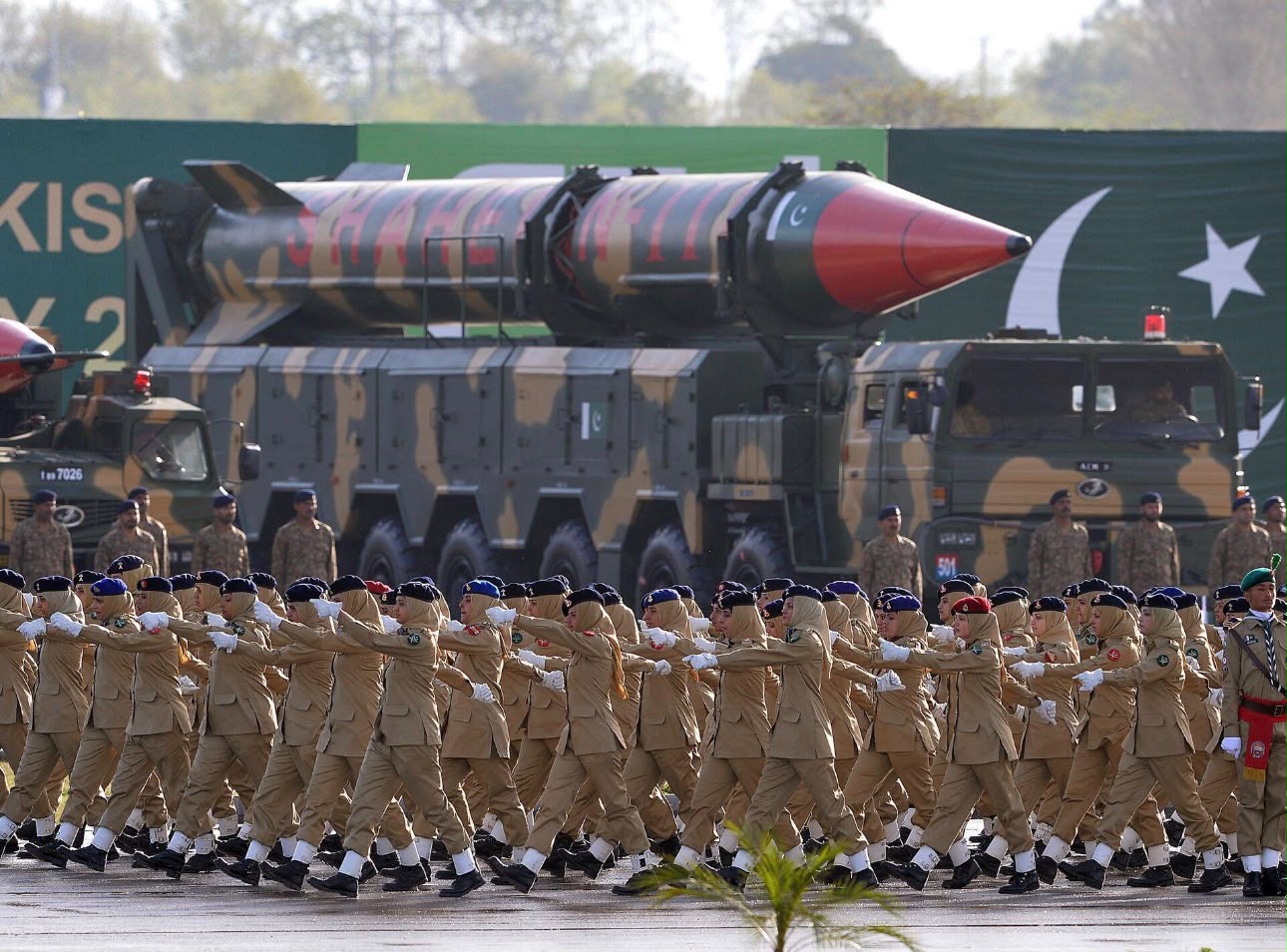

A fifty-minute film released on 25 July by Deutsche Welle, Germany’s state-funded international broadcaster, revives a question European policy circles prefer to raise obliquely: whether Pakistan should hold nuclear weapons at all. The documentary gathers familiar material, extremism, governance failure, economic fragility, and military dominance of civilian life, then arranges it toward a conclusion about the safety of the country’s arsenal.
Fifty-four days earlier, the European Union’s High Representative for Foreign Affairs had stood in Islamabad and called Pakistan a “major regional power” and an important partner for the bloc, in remarks published by the European External Action Service. Kaja Kallas credited Pakistan with acting as principal mediator between Washington and Tehran, said its diplomacy had prevented a return to full-scale war on more than one occasion, and observed that the work was recognised and appreciated across Europe. The joint communiqué from the eighth EU-Pakistan Strategic Dialogue commended Islamabad for its constructive role in bringing the two adversaries into contact.
Both positions came from Europe. Only one of them was thought through. The film merits engagement rather than indignation. The proper response, however, is not to claim that Pakistan’s nuclear programme lies beyond criticism, but to recognize that Europe has been asking the wrong question for the past twenty-eight years. The right question has only become more urgent as the guarantor architecture that once gave coherence to the old one has steadily unraveled.
The Devolution Of Nuclear Power As Condition, Not Prescription
The argument that follows needs clarifying at once, because a careless reading of the term inverts its meaning.
This is not an appeal for more arsenals. Uncontrolled proliferation would leave the world less governable, not safer. The devolution of nuclear power describes a distribution that already exists. Nine states possess these weapons. That occurred across 1945, 1949, 1952, 1960, 1964, 1974, 1998, and after. No European policy will reverse it within any timeframe relevant to present decisions.
From a settled distribution follows an issue of consequences. If strategic capability sits in more capitals than it once did, order gets produced differently: by additional actors, in additional places, under conditions no single guarantor commands. Such is the substance of the devolution of nuclear power, a claim about the way the present works instead of a preference about how it should have been arranged.
The term is imperfect, and the imperfection is worth naming rather than hiding. Devolution ordinarily implies a grantor: authority passing from a centre to a subordinate body, on terms the centre sets and could revoke. Nothing of the kind occurred here. Pakistan built its capability under the Symington and Pressler amendments, against export controls, interdiction, and the sustained opposition of several governments now debating whether it should hold what it holds. The West spent three decades trying to prevent the capability that produced the mediator it thanked in June.
So what has devolved is not capability. Responsibility devolved, shed rather than conferred. The guarantor powers never delegated the burden of regional order; they proved unable to carry it, and it settled where carrying it was possible. Read that way the coinage holds, describing something no member of the original nuclear club arranged or approved.
Europe’s reflex treats each discussion of the subject as a re-litigation of whether it ought to have happened. That conversation closed some time ago. What remains open is what Europe does inside the result, and the answer at present is that it does two contradictory things in the same summer without noticing.
Conceding The Strongest Objections
A rebuttal conceding nothing persuades nobody, so begin with the concessions.
Pakistan’s political order places extraordinary weight on an institution standing outside electoral accountability. Extremism has cost Pakistan tens of thousands of lives and continues to threaten its internal cohesion. Economic fragility has proved chronic, not cyclical. Pakistani commentators write about all three more harshly than any foreign network manages.
The proliferation record is equally real. The A. Q. Khan network was the gravest breach of the nonproliferation regime committed through any state’s territory, and a case that skirts it forfeits its audience in Brussels and Berlin. That operation was dismantled, custody architecture around fissile material rebuilt, and Islamabad has since worked with the International Atomic Energy Agency on security standards. The burden of proof created in 2004 has been reduced without being discharged.
Nor is the current ledger clean. Pakistan has blocked the opening of Fissile Material Cut-off Treaty negotiations at the Conference on Disarmament for well over a decade, on the stated grounds that a production freeze would fix an existing asymmetry in place. It has not concluded an Additional Protocol. SIPRI places the stockpile at roughly 170 warheads and records continuing accumulation of fissile material and new delivery systems, with expansion likely over the coming decade. These are choices, made now, by the state asking to be assessed on its conduct, and an argument built on conduct has to carry them.
The sharpest technical objection concerns battlefield-range systems, which shorten decision time and lower the threshold at which release might be contemplated. That criticism is legitimate. It bears with equal force on Russian and American doctrine, and belongs in any candid assessment.
The Inference The Evidence Does Not Carry
Having granted all of that, consider what the production does with it, because the difficulty is not bias in the ordinary sense. Bias would be a matter of emphasis. The trouble lies in material that appears to point somewhere other than the conclusion drawn from it, and in a method that leaves the gap unaddressed.
What follows rests on Pakistani accounts of the broadcast rather than on the broadcast itself, and should be read accordingly. Those accounts record interviewees describing a centralised command structure, layered physical security, and a dedicated force assigned to protect strategic assets, with none of it rebutted on screen. They report no documented breach of the command system, no presented failure of custody, and no evidence of penetration by any armed group. If that is a fair summary, then the production establishes the architecture and then returns to the proposition that extremists might one day seize the weapons, a claim its own witnesses had already answered. Deutsche Welle is welcome to correct the record, and the correction would be easy to make if the accounts are wrong.
An asymmetry runs alongside it. India’s capability features as a strategic condition to be accounted for. Pakistan’s features as the residue of deception. Yet the opening minutes describe the programme as illegally developed, when no state outside the five recognised under the Non-Proliferation Treaty ever had a lawful route to nuclear status, including several partners of the government that funds this broadcaster. The account then presents 1998 as the moment of disclosure while omitting what prompted it, which was New Delhi’s tests weeks earlier.
Provenance deserves a mention as well. The end credits name an outside company, Vincent Productions, and indicate that the production was completed in 2025, with the broadcast carrying a 2026 label. Pakistani journalists, among them Fakhar Durrani, have alleged that it circulated on a video-sharing platform a year before a European public broadcaster attached its name to it. That allegation awaits an answer. The question it raises concerns editorial process rather than geopolitics, and a publicly funded institution owes its licence-payers a reply.
Facilitation, Guarantee, And Non-Coercibility
Now the turn, resting on a distinction the documentary never reaches.
On the evening of 17 June, at a Versailles dinner marking the two hundred and fiftieth anniversary of American independence, the President of the United States signed the memorandum ending his country’s war with Iran. Emmanuel Macron shook his hand, posted the video, and welcomed the agreement as opening a path to lasting peace. France supplied the table. Islamabad had brokered the text, alongside Qatar, Saudi Arabia, Turkey, and Egypt.
Four of those five facilitators hold no nuclear weapons, which appears at first to undercut any link between capability and diplomatic standing. Separate the roles and the opposite emerges.
Facilitation means venues, channels, and the passing of messages. Many governments manage it, and Doha manages it exceptionally well. Guarantee is a different function. A guarantor places itself between two adversaries and holds a settlement in position, which requires that neither party be able to discipline it into abandoning that position. Client states cannot perform the role, since their patrons may withdraw the support on which they depend.
An arsenal confers something narrower than the usual claims made for it. Not the ability to mediate, widely held. Not moral authority, which no weapon has ever produced. What it delivers is non-coercibility. Washington could not mediate a war where it was itself a belligerent. No European government appears among the mediators named in the memorandum. The contention here is that what qualified the broker was not proximity alone but a position on which neither belligerent could bring decisive pressure to bear.
Read the devolution of nuclear power through that lens and advocacy disappears from it. You hear an observation about who can now do the work of settlement, and why the list is short.
Riyadh, Paris, And The Selective Application Of Doubt
Consider how the same subject gets handled when a different country is involved.
On 22 July, the United States Department of Energy announced a peaceful nuclear cooperation agreement with Saudi Arabia under Section 123 of the Atomic Energy Act, alongside a bilateral safeguards instrument, described as the legal basis of a thirty-year partnership. As the Congressional Research Service sets out, such accords require congressional review before entry into force.
The terms did not stay still. Within a day, as the Stimson Center records, the President posted that enrichment was excluded, that the arrangement covered non-military use only, and that it now depended on Saudi normalisation with Israel, a condition absent at signature and one Riyadh has said it cannot meet without a credible path to Palestinian statehood. Objections followed from Washington. The Nuclear Threat Initiative noted that Riyadh will not implement the IAEA Additional Protocol, long a condition of American nuclear supply. Analysts at the Carnegie Endowment observed that the gold standard set by the United Arab Emirates accord is depreciating.
Note what that sequence establishes. For a Muslim-majority state where religion is constitutive of law, the criteria are negotiable, revisable in public, and tradable against unrelated diplomatic objectives. Nobody proposed that Saudi society was unfit for the technology. The conversation stayed on safeguards, verification, and terms, which is where it belongs.
Pakistan receives a different conversation entirely.
Nor is Europe a bystander to the trend it laments. SIPRI records that in March 2026 the French President ordered an increase in his country’s warhead numbers and announced that Paris would no longer disclose the size of its arsenal. An expanding and newly opaque European deterrent attracted no documentary.
Confessional Categories And The Institutional Test
For forty years the phrase “Islamic bomb” has fastened onto Pakistan and onto nobody else. India’s weapons are not described as Hindu. Israel’s are not called Jewish. The only devices ever used against a civilian population went unlabelled by any faith. A weapon has no confession.
That asymmetry exposes the work the category performs, which is not measurement. Custody is an institutional property, composed of command authority, personnel reliability screening, permissive action links, physical protection, and the rules governing delegation of release. French, British, and Israeli systems get assessed on precisely these criteria. Nobody proposes reading Paris through Catholic doctrine.
Apply the institutional test to Pakistan and something examinable appears: a National Command Authority with civilian participation, a Strategic Plans Division numbering roughly twenty thousand personnel, and a custody framework built and audited across twenty years. That record may be judged insufficient. It may not be replaced with an adjective.
Applying that standard honestly also means accepting whatever it turns up. Pakistan reorganised its senior command in November 2025. The Twenty-Seventh Amendment rewrote Article 243, as Dawn set out clause by clause, creating a Chief of Defence Forces and providing for a Commander of the National Strategic Command appointed by the prime minister on the army chief’s recommendation. Pakistani commentators have debated the reorganisation at length, which is worth noticing in itself: the argument is under way in Islamabad, in public, among people entitled to have it. For custody purposes the operative matter is narrower and more technical, namely whether screening, protection, and release authority carried across the change unaltered. That has an answer, available to anyone prepared to ask instead of assume.
Which is why such scrutiny is no trap. It is the only measure under which Pakistan can be weighed fairly, and a state confident in its own architecture gains from inviting the examination rather than resenting it.
From Verdict To Instrument
Two hundred and fifty million people are not knowable through their loudest extremists, any more than European societies are knowable through their far right, their ethnonationalists, or their own religious militants. Each population carries constituencies that misrepresent it. Mistaking a fringe for a national disposition is unjust, and produces poor policy besides, because it forecloses options serving European interests.
Europe need not endorse proliferation, and no part of this asks it to. Nor must it retire disarmament as an objective. What it owes itself is the distinction between the world it would have designed and the one where its choices land. The devolution of nuclear power is no doctrine awaiting adoption or refusal. It is the terrain.
The devolution of nuclear power is that second world. Inside it, the productive question is not whether Islamabad should have crossed the threshold in 1998, after New Delhi had already settled the arithmetic of the subcontinent in 1974. It is how a nuclear regional power capable of guaranteeing settlements gets drawn further into responsible stewardship, crisis management, and regional security architecture.
Europe is not without means here. GSP+ preferences give Brussels standing that few partners command, and Kallas used the Islamabad visit to press on those obligations, which is precisely how a serious relationship works. The instruments exist. What has been missing is a single view of what they are for.
Because the alternative is what happened this summer. In June the European Union’s chief diplomat named Pakistan a major regional power and thanked it for helping avert a war. In July a European public broadcaster asked whether that state could be trusted with the capability that made it worth thanking. A continent that cannot hold one position for eight weeks will not shape the settlement of anything, and it will keep arriving at Versailles in time for dinner and too late for the signing.
ABOUT THE AUTHOR
Azfar Bukhari is a senior analyst specialising in geopolitics, public diplomacy, migration, international trade, and investment. He is a regular contributor to The European Post.