
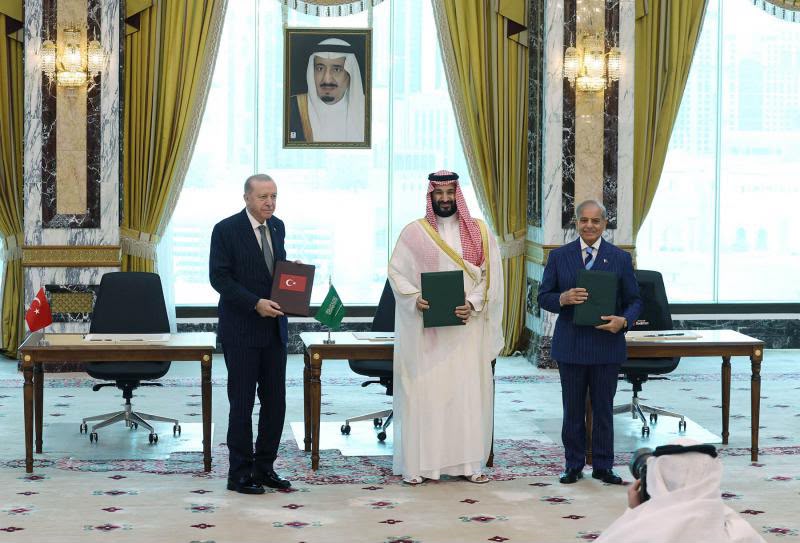

The trilateral agreement signed in Mecca on 7 August pairs a collective-defence clause with an institutional design that has still to be built: committees and a permanent secretariat announced, thresholds undefined, no command arrangements yet described. It brings a NATO member, the Muslim world’s only nuclear power and the custodian of Islam’s holiest sites under a single collective-defence clause, and the Washington Treaty does not, on its face, prohibit it. Europe’s difficulty is not that it was absent from the Gulf during this war. It is that the instruments it brought belong to a different category from the one Riyadh has now acquired.
Collective-defence commitments are rare instruments, and the reason is cost rather than sentiment: a clause of that kind moves the decision for war away from the state that suffers the attack and onto the governments obliged to answer for it. The ones that function are surrounded by machinery designed to govern when they fire, and building that machinery has historically taken longer than drafting the clause itself. At Al-Safa Palace in Mecca on Friday, Mohammed bin Salman, Recep Tayyip Erdogan and Shehbaz Sharif added one to that short list. The machinery they announced alongside it does not exist yet, which is normal: the Washington Treaty was signed in April 1949 and SHAPE did not open its doors until 1951. No EU institution had commented publicly as this went to press, and the silence is, to my mind, the most revealing European response currently available, because the ceremony measured the distance between what Europe sells its partners and what those partners have concluded they must have.
A note on the record. The treaty text has not been released by any of the three governments. What exists publicly is the joint statement issued by the Saudi Press Agency and Pakistan’s Ministry of Foreign Affairs as press release 204 of 2026, an on-record characterisation by a Turkish official, and an interview given by Foreign Minister Hakan Fidan to Anadolu on 8 August. Every description of the pact’s contents below is attributed to one of those, and a source register follows the article.
The Commitment On The Public Record
The joint statement carries one operative sentence: the agreement is intended to strengthen collective deterrence, and an armed attack on any one of the three shall be regarded as an attack against them all. It adds that the parties will enhance all aspects of defence cooperation. It does not set out what any signatory must do. Turkish accounts fill that gap, and they lead away from the NATO comparison rather than toward it.
Fidan told Anadolu that the commitment is technically identical to Article 5, then described a mechanism that is nothing of the sort: a state under attack must ask for help and specify its form, which might be intelligence, logistics, ammunition or deployed units, as Al Jazeera reported from that interview. He said no common threat had been put in writing and that no state becomes a target unless it strikes a member. He described a work programme of joint training, intelligence sharing, logistics, threat assessment, interoperability and defence-industrial collaboration, and put the preparation at two years and eight months, a timeline also carried by TASS, although other reporting describes roughly a year of formal negotiation.
The institutional design he set out is more considerable than early coverage suggested: a ministers’ committee, political and military committees bringing together foreign ministers, defence ministers and chiefs of staff, and a permanent secretariat in Saudi Arabia to oversee implementation. Turkish accounts of the text place the mutual-defence clause on the right of individual or collective self-defence under Article 51 of the UN Charter, the same legal footing the Washington Treaty uses. None of it is standing yet, and no integrated command, combined planning staff or published threshold has so far been described, an absence recorded by The New Arab. I read that as sequencing rather than hollowness, and the ground for reading it that way is the calendar: three days after signature, an alliance years in preparation has announced its organs and has not yet convened them.
What the arrangement does carry is weight. Turkey fields the Atlantic alliance’s second-largest army. Pakistan remains the only Muslim-majority state with nuclear weapons, and reporting compiled by the Atlantic Council and by Reuters places Pakistani troops, fighter aircraft, drones and an air-defence system in the kingdom under the bilateral Strategic Mutual Defence Agreement of September 2025, with the figure reported as several thousand and put at around 8,000 by The New Arab. Riyadh supplies the capital and the standing the Mecca Joint Defence Agreement rests on. Islamabad has held throughout that its 2025 undertaking extended no nuclear umbrella, and nothing published since Friday alters that position.
The Staging And What It Carries
The instrument is officially the Makkah Joint Defence Agreement, concluded at a gathering the three governments styled the Makkah Al-Mukarramah Summit for Joint Defence. Riyadh did not name it after its parties, its purpose or a capital. It named it after a place, and the Saudi Press Agency then grounded the summit in historic ties, Islamic solidarity and shared strategic interests, listing a confessional bond among the founding bases of a defence treaty. The timing was arranged to match. Sharif reached Jeddah the previous day with Field Marshal Asim Munir, performed Umrah on Friday morning, and the leaders prayed the Jumma congregation together, at Qasr Al-Safa beside the Grand Mosque on the Pakistani account and at the Grand Mosque itself in the Saudi caption. Holiest city, holiest day, army chief in frame.
Those are the facts of the day. What follows is my reading of them, and it should be taken as interpretation rather than as anything the agreement establishes. Narrow drafting alongside expansive staging looks to me like design and not tension. A treaty that names no enemy, fixes no threshold and has yet to stand up its institutions seems to me to impose, for now, less than its opening sentence implies; a photograph taken in Mecca on a Friday confers a good deal more, and it confers it immediately. On that reading Mohammed bin Salman acquires the bearing of a leader of the Muslim world without contracting to fight anyone’s war, Erdogan banks comparable standing at a moment when his quarrel with Israel is sharpening, and Sharif carries home an image no quantity of Pakistani diplomacy could have purchased. The agreement asserts none of this. It is an inference from the choreography, offered as one.
Why a NATO Member Wanted a Second Alliance
Ankara’s homeland is already covered. Article 6 of the founding treaty, as amended by the 1951 protocol on Greek and Turkish accession, extends the collective-defence clause to the territory of Turkey. But the Atlantic guarantee answers a single question: what follows if Turkey is attacked in a manner its allies agree to recognise. It says nothing about Ankara’s exposure in Syria, Libya or the eastern Mediterranean. It offers no cover against a confrontation with Israel, which sits outside the alliance. That last point is contested terrain, so it is worth marking whose judgement it is: Rich Outzen, writing for the Atlantic Council, argues that adding a nuclear power and an economic heavyweight sharpens Ankara’s deterrence against a neighbour whose leadership increasingly frames Turkey as an adversary. Turkish officials have not framed the pact that way in public.
Europe compounded the problem. Under the Council’s SAFE regulation, third-country suppliers may contribute up to 35 per cent of the value of a financed system, while selling into the instrument directly requires a bilateral security and defence agreement with the Union. Athens and Nicosia have declined to wave that through, a position documented in ELIAMEP’s analysis of Turkish participation. A state told it may supply parts but not products, and that its guarantee stops at its own frontier, will go looking for a second arrangement. In Riyadh and Islamabad it found two governments prepared to write one, and the Mecca Joint Defence Agreement is what they wrote.
What The Washington Treaty Permits
Nothing in alliance law prohibits what Erdogan signed. Article 8 of the North Atlantic Treaty requires each party to declare that its existing engagements do not clash with the treaty and to undertake “not to enter into any international engagement in conflict with this Treaty.” The test is conflict, not exclusivity. Members hold outside commitments as a matter of routine, from bilateral basing accords to European mutual-assistance duties under the EU treaties. Article 10 confines accession to European states but is silent on what members sign elsewhere. Article 4 provides for consultation whenever any ally judges its security threatened, and it is the provision to watch, since consultation is the mechanism through which allied discomfort would surface.
Ankara has addressed the point directly, through three separate voices. A Turkish official told reporters on the day of signature that the arrangement is purely defensive, is aimed at no particular country, remains open to other regional states and does not supersede existing bilateral or multilateral commitments, a formulation reported by Middle East Monitor. The presidency’s communications director repeated the point about targeting on X. And the government’s own anti-disinformation service, answering criticism of the pact, stated that the agreement does not contradict the commitments of Turkey’s existing alliances, NATO included, and that regional partnerships are not an alternative to NATO membership. That last formulation is the one that matters legally, and on the public record it is coherent. The scenarios that would test it are narrow but not fanciful: a signatory in armed dispute with an alliance member, or an invocation by Riyadh in a theatre where allied interests run the other way. Ankara’s assurance describes today’s map, and it holds only while the two circles fail to intersect.
Testing The Islamic NATO Label
The description doing the rounds, an Islamic or Sunni version of the Atlantic alliance, is three-quarters of a century old and has never survived contact with events. The Arab League’s Joint Defence and Economic Cooperation Treaty of 1950 carried a mutual-assistance clause. The Gulf Cooperation Council concluded its own defence agreement in 2000 and maintains the Peninsula Shield Force. The Islamic Military Counter Terrorism Coalition, announced in 2015 and headquartered in Riyadh, gathered more than forty member states and appointed a former Pakistani army chief as its commander. None of the three has produced a collective military response of the kind its own text contemplates, which is the record against which the Mecca Joint Defence Agreement should be read.
What distinguishes Friday’s text is the hardness of the clause and the capability behind the signatures. What it does not do is constitute a confessional bloc. The signatories decline religious framing, name no enemy, and state that a Muslim-majority Iran is not the object of the exercise. Fidan has called Egypt a natural partner and expects Cairo to sign once technical questions clear, yet Karim Elgendy and Ahmed Aboudouh of Chatham House, both speaking to Al Jazeera, judge that Egypt will demand wording protecting its American aid relationship and its peace treaty, and that Cairo prefers narrow, issue-specific arrangements to standing obligations. Qatar, Kuwait, Azerbaijan, Jordan and Syria are named in the same reporting as possibilities. What the Mecca Joint Defence Agreement describes is therefore a coalition assembling case by case, on each capital’s own arithmetic. It is not an ummah in arms, and treating it as one will produce bad forecasting.
Who Else Could Underwrite Gulf Security
Strip away the rhetoric of solidarity and the roster of Muslim-majority states able to put trained formations, air defence and combat aircraft into the Gulf at short notice, then sustain them, is very short. Egypt commands the largest Arab army but has spent a decade avoiding expeditionary obligations, having declined an earlier Saudi-led maritime arrangement for fear of inheriting other people’s wars. Jordan is professional and respected, and too small to be a guarantor. Azerbaijan is close to Ankara but has no reach into the peninsula. Indonesia, Bangladesh, Malaysia and Morocco possess manpower without strategic airlift, sustainment or political appetite. Reporting since the signing places Bahrain and Kuwait in exploratory talks with Islamabad on deeper defence ties, which indicates which direction the demand runs and why the Mecca Joint Defence Agreement took the shape it did.
That is why Pakistan carries more weight in this text than its economy would predict. It supplies the one thing Gulf capitals cannot purchase off a shelf: trained manpower at scale, a demonstrated willingness to deploy it, and the shadow cast by an arsenal that no one has formally extended and no adversary can discount. Turkey brings an industrial base and combat experience. Saudi Arabia brings money and legitimacy. Take Islamabad out and, on my reading, what remains tends toward a procurement relationship rather than a deterrent, because neither of the other two supplies deployable mass on that scale.
Whether This Makes Anyone Safer
There is a serious case that it does, and it deserves stating at full strength. Deterrence functions by making aggression difficult to price, and an attacker who must now calculate three responses instead of one faces a harder sum. A kingdom that can borrow deterrence has less reason to build its own, which is precisely the outcome European nonproliferation policy has spent decades trying to secure. Formal obligations also impose consultation on their holders, and consultation slows decisions that would otherwise be taken alone and quickly. Regional powers assuming responsibility for regional order is, in the abstract, the settlement the West has demanded for years.
The objection is that the guarantee inside the Mecca Joint Defence Agreement transmits as readily as it deters. Muhammad Faisal, quoted by Al Jazeera, locates the pact’s value in the uncertainty it creates for adversaries rather than in fixed military obligations, and Kamran Bokhari of the Middle East Policy Council calls it a strategic signal rather than an operational alliance, with integrated capacity years away.
Uncertainty deters, and it also invites probing, and the interval before the committees convene is when a pact is most exposed to being tested. The Houthi blockade of Saudi shipping, declared on 20 July and still running when the leaders met in Mecca, is the first live examination, and it arrived before the pact had a secretariat, let alone a building. Should Riyadh invoke the clause and receive a consignment of munitions, the likely consequence is that the promise is repriced downward across the region. Should the answer instead be Turkish and Pakistani forces in combat against an Iranian-aligned adversary, a bilateral fight becomes a three-state war, and European shipping, energy prices and expatriate populations sit inside the blast radius. Alliances do not manufacture peace. They defer conflict on terms fixed by the quality of their drafting, and this drafting is, for the moment, loose.
The European Offer, And Its Category
Europe’s Gulf record through this war is not one of absence. Kaja Kallas told the European Parliament’s foreign affairs committee on 17 March that she had convened a ministerial meeting with the Gulf Cooperation Council, that member states had answered calls to reinforce Gulf air defence, that more than seventy national flights had repatriated at least thirty thousand citizens, that the ASPIDES naval mission was under review for a wider role, and that Ukrainian expertise in drone interception was being matched to Gulf requirements. In the same remarks she confirmed that Cyprus, a member state of the Union, had been struck.
All of that is competent, and all of it is a catalogue of services. It is not what Riyadh went shopping for, and none of it answers the photograph, because legitimacy of that order cannot be procured or programmed. Riyadh bought a guarantee; Brussels is still selling partnerships. Europe offers cooperation frameworks in a market that has started buying obligations, and capitals that felt exposed between February and August have been learning to tell one from the other. The nine security and defence partnerships she counted in March, and those signed since, are not the same instrument as the sentence at the centre of the Mecca Joint Defence Agreement, which costs something to break.
The objection to that comparison is obvious and deserves an answer: if the Mecca clause has no institutions behind it yet, how does it differ from a European partnership that has a great deal? Not in enforceability, which neither possesses. It differs in the cost of walking away. A partnership is a programme of cooperation that either party may allow to lapse without anyone much noticing, whereas a public undertaking to treat an attack on Riyadh as an attack on Ankara cannot be abandoned quietly. Commitments of that kind bind through the price of exit rather than through command structures, which is exactly why a state acquires one before the institutions exist.
The remedy is not for the Union to extend an Article 5 to the Gulf, which it cannot do and should not attempt. It is to stop assuming that industrial access, convoy escort and dialogue formats compound into influence, because they do not. Three steps would count. Conclude the security and defence partnership with Ankara that unlocks European procurement and gives Turkey something Riyadh cannot supply. Turn integrated air and missile defence for the Gulf into a European industrial proposition with political terms attached rather than a series of national export licences. And write the Gulf states into the coming EU Middle East Strategy as principals rather than as recipients of it.
The Mecca Joint Defence Agreement will now either thicken into a structure or thin into a communiqué, and that will be settled by whether Egypt signs and how the first invocation is answered. Europe has instruments that could shape both. If it declines to use them, it will go on learning the region’s security architecture the way it learned this one, from the photographs.
ABOUT THE AUTHOR
Azfar Bukhari is a senior analyst specialising in geopolitics, public diplomacy, migration, international trade, and investment. He is a regular contributor to The European Post.