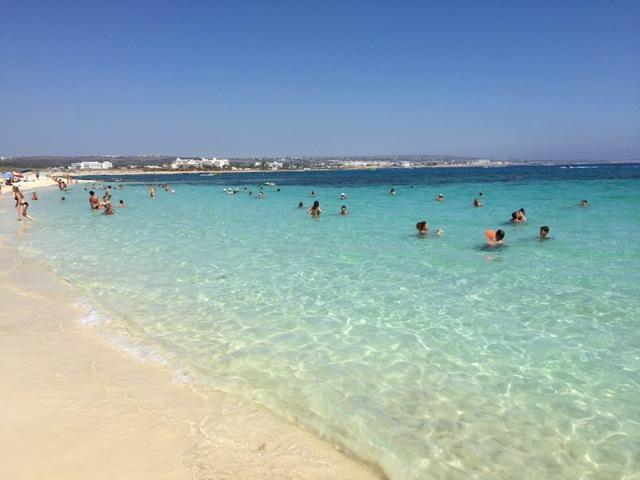
Nicosia: When families crowd Cyprus’s beaches this month, they swim in some of the cleanest water on the continent. The European Environment Agency confirmed as much in its annual assessment, which found that the vast majority of Europe’s bathing water still meets strict hygiene standards.
The agency and the European Commission examined more than 22,000 sites across the Union, plus Albania and Switzerland. Inspectors rated 85% of them excellent, the toughest grade the rules allow. A further slice cleared the minimum bar, leaving only 1.5% classed as poor.
Cyprus led the field, with every monitored site earning top marks. Greece, Bulgaria and Austria followed close behind. The results reward decades of investment in sewage treatment and tighter controls on farm run-off, the two forces that most often foul a swimming spot.
Coastal waters outperformed inland ones by a clear margin. Roughly 88% of sea sites reached excellent status, against 78% of lakes and rivers. Rivers remained the stubborn laggard, with fewer than half hitting the top grade. Their smaller volumes dilute pollution poorly, and heavy rain still flushes waste into them after storms.
Regulators are not standing still. Member states adopted updated rules on water pollutants in May, tightening limits and widening the list of substances that inspectors must track. For the first time, monitoring will reach emerging contaminants such as PFAS, microplastics and pharmaceutical residues, none of which the original 2006 directive anticipated.
The Commission frames clean water as a public health win and a tourism asset. Coastal economies from the Algarve to the Aegean lean on the promise of a safe swim, and a poor rating can empty a beach for a season. Swimmers can check any individual site on the European Environment Agency map, which updates each summer.
Campaigners want faster progress on rivers, where urban waste water and agriculture still collide. They also press for the new PFAS testing to begin quickly rather than drift through years of transition. The Commission counters that laboratories need time to standardise methods before the figures can be trusted.
The grading system dates to a 2006 directive that sorts every site into four bands, from excellent down to poor, based on repeated testing for bacteria such as E. coli and intestinal enterococci. A site slips only after several bad readings, and a single storm rarely condemns a beach on its own. That patience in the method is why a run of clean summers, rather than one lucky season, lifts a country up the table.
For now, the headline reassures. Nearly nine in ten European bathing sites offer water that meets the highest standard, and swimmers can find the local verdict before they pack the car.