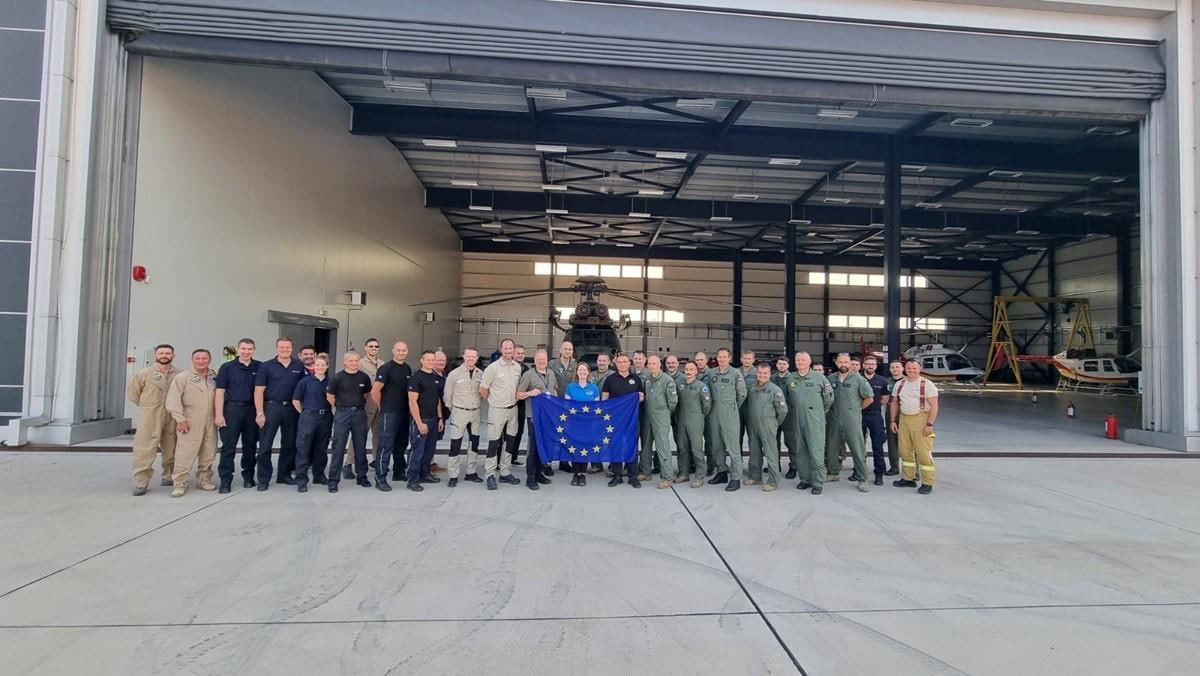
Coimbra: The crews that spent this summer waiting in central Portugal for a call that might come from anywhere in the Mediterranean went home on 15 September, when the European Union’s pre-positioning arrangement closed for the 2026 season. The arrangement is only a few years old and it has grown faster than almost any other instrument in the Union’s civil protection toolkit: from 236 firefighters drawn from six countries in its first year to 777 firefighters from fourteen this summer.
Pre-positioning is a simple idea with a demanding logic. Rather than wait for a member state to request help and then assemble a deployment, the Commission funds teams from countries that are not currently burning to sit in countries that are about to. Between 1 July and 15 September those 777 personnel were stationed across Cyprus, Greece, Italy, France, Spain and Portugal — the six states where the fire risk curve is steepest — on the understanding that response time, not headcount, is what determines whether a fire stays small.
Behind the ground crews sits the aerial reserve, and here the numbers have also moved. Twenty-two firefighting aeroplanes and five helicopters were available through the EU fleet this season to support countries under pressure. Five of those helicopters were financed directly by the Union rather than borrowed from national inventories: two based in Slovakia, two in Czechia and one in Romania, the first of which was delivered to Romania earlier in 2026. The geography is deliberate. Central European states with modest fire exposure of their own now host assets that fly south, which spreads both the cost and the industrial benefit of a capability the Mediterranean needs most.
The season tested all of it. By 24 August nine countries had activated the civil protection mechanism for wildfires. The heaviest single deployment went to France in late July, where the Union sent seven aeroplanes and four helicopters contributed by Czechia, Croatia, Germany, Portugal, Slovakia, Sweden and Türkiye — most of them drawn from the EU fleet rather than from bilateral goodwill. A second wave of mobilisations followed in mid-August as fires spread across several member states at once, which is the scenario that pooled capacity exists for and also the scenario in which pooled capacity runs out.
That is the structural question the closing date raises. A shared reserve works on the assumption that fire seasons are staggered — that the country lending aircraft in July will not need them itself until August. As the season lengthens at both ends and heat events arrive simultaneously across the basin, the assumption weakens. Nine activations in a single summer is not a system under strain in any dramatic sense, but it is a system whose margin is being measured.
The Union’s response so far has been to buy rather than borrow. The five EU-funded helicopters are the visible edge of a shift from a mechanism that coordinates national assets toward a reserve that owns some of its own, and the same logic runs through the strategic stockpiles held for medical and CBRN emergencies. Ownership is slower and more expensive than coordination. It is also the only version that survives a year in which everyone needs the same aircraft in the same week.
What is not yet resolved is who pays for the permanent version. The current fleet is assembled from a mixture of Union financing, national contributions and transitional arrangements, and the 2028-2034 budget will have to decide how much of it becomes a standing European capability with a standing European line item. Fourteen countries sent firefighters this summer, which is a good measure of political buy-in. Whether fourteen countries will vote for the invoice is a different measure, and one the next negotiation will take.