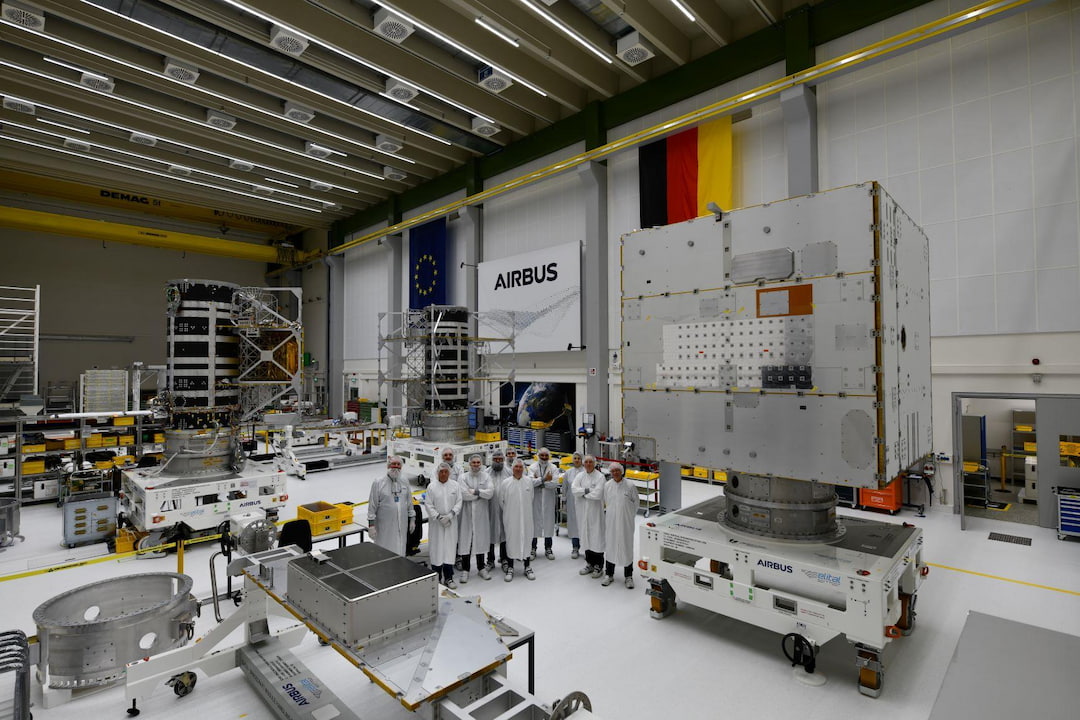
Ottobrunn: The Galileo second generation programme gained two more satellites on 27 October 2026, when the European Space Agency ordered them from Airbus. The agency acted on behalf of the EU Agency for the Space Programme, known as EUSPA, under a delegation from the European Commission. The contract builds on an existing order of six spacecraft, so the Galileo second generation order now stands at eight satellites.
Airbus announced the award from its Ottobrunn site in Germany and said the work will draw on its facilities in Backnang, Friedrichshafen, Getafe, Ottobrunn and Toulouse. The company’s release does not give a contract value, a launch date or the rocket that will carry the satellites. ESA says it is procuring launches for Galileo as a whole, but it has not tied any of them to this pair.
The Galileo second generation satellites carry the improvements that make the new fleet different from the first one. Airbus lists advanced anti-jamming and anti-spoofing capabilities to protect the signals, an enhanced atomic clock configuration, inter-satellite links, higher-strength navigation antennas and fully digital, reconfigurable payloads. Each satellite weighs more than two tonnes and is designed to operate for 15 years.
Laurent Jaffart, ESA’s Director of Resilience, Navigation and Connectivity, called the contracts an investment in Europe’s ability to navigate its own future, independently and with confidence. Alain Fauré, who heads space systems at Airbus, said the company is committed to delivering satellites that augment navigation capabilities for European security and defence as well as wider societal benefits.
The security argument for the Galileo second generation fleet has grown louder this year. Commission President Ursula von der Leyen told the International Space Summit, in a speech reported on 10 September 2026, that Galileo serves more than 4.5 billion devices worldwide and supplies timing that financial systems and electricity grids depend on. A signal that carries that much economic activity is an obvious target for interference, which explains why the Galileo second generation design puts so much weight on protection against jamming and spoofing.
The order also lands while the legal framework for space is still unsettled. The Commission proposed the EU Space Act in June 2025, and the Council has worked through compromise texts under the Danish and Cypriot Presidencies. Reporting on the May 2026 talks says member states still disagree on the scope of the text and on how to treat dual-use activities, and Commissioner Andrius Kubilius has said he hopes for agreement under the Irish Presidency in the second half of 2026. The Commission tabled a separate EUSPA regulation in April 2026, and the Irish Presidency is due to prepare the first compromise text on it.
One trade headline described the order as four satellites from Airbus and Thales. The Airbus release and a second report both say two satellites from Airbus alone, and those two sources are the ones relied on here. The sources reviewed also give no total programme cost and no date for the first launch of the new batch.
For now, the Galileo second generation fleet is a growing order book rather than a finished constellation. The next announcements on launch contracts and on the EU Space Act will show how quickly Europe turns that order book into protected navigation signals.