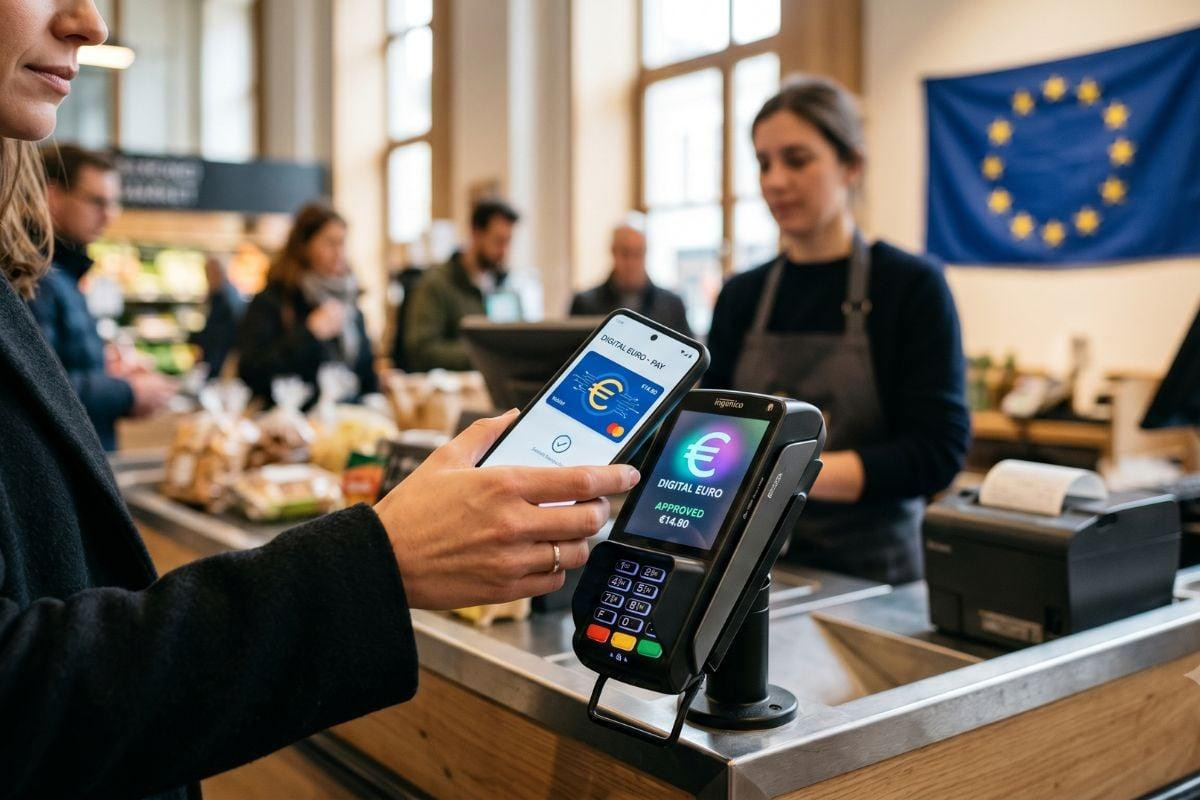
Ljubljana: After three years of technical preparation and political hesitation, the project to give Europe a public electronic currency cleared its most important legislative hurdle to date. On 23 June the European Parliament’s Economic and Monetary Affairs Committee approved the regulation establishing a digital euro by 43 votes to 14, with one abstention, and instructed negotiators to open final talks with member states without delay. The vote does not create the currency, but it ends the phase in which the initiative could have quietly died in committee.
The digital euro is conceived as a central bank money for the smartphone age, issued by the European Central Bank and usable across the euro area both online and, crucially, offline, so that a payment could clear even without a network connection. Its backers present it as a complement to cash rather than a replacement, and as an answer to a strategic vulnerability: the overwhelming share of European electronic payments now runs through a handful of non-European card networks and technology platforms. A sovereign digital means of payment, the argument goes, would give the continent a fallback it currently lacks.
That sovereignty case has grown louder as trade and geopolitical tensions have made dependence on foreign payment rails feel less like a convenience and more like an exposure. Yet the file has also attracted determined opposition. Commercial banks fear that if households can hold central bank money directly, deposits could drain out of the banking system in a crisis, which is why the regulation is expected to cap individual holdings. Privacy campaigners, meanwhile, insist that the offline mode must offer cash-like anonymity, and the degree of surveillance built into the system remains one of the most contested design questions.
The legislative path now runs through trilogue negotiations between the Parliament, the Council and the Commission. The Council adopted its own negotiating position in December, so the three institutions enter talks with broadly compatible mandates and a shared ambition to conclude the regulation before the end of the year. Officials caution that the holding limit, the compensation model for banks and merchants, and the privacy safeguards could still prove difficult to reconcile.
Even if the law is agreed in 2026, Europeans will not be tapping digital euros at the till any time soon. The ECB would still need to complete a preparation phase, and a pilot lasting roughly a year using a beta version of the system with selected merchants and payment providers, before any launch. On current expectations the currency could enter circulation around 2029. The stakes are larger than the timeline suggests: whether Europe builds its own payment infrastructure, or continues to rely on others, is a question the committee’s vote has finally forced the Union to answer.