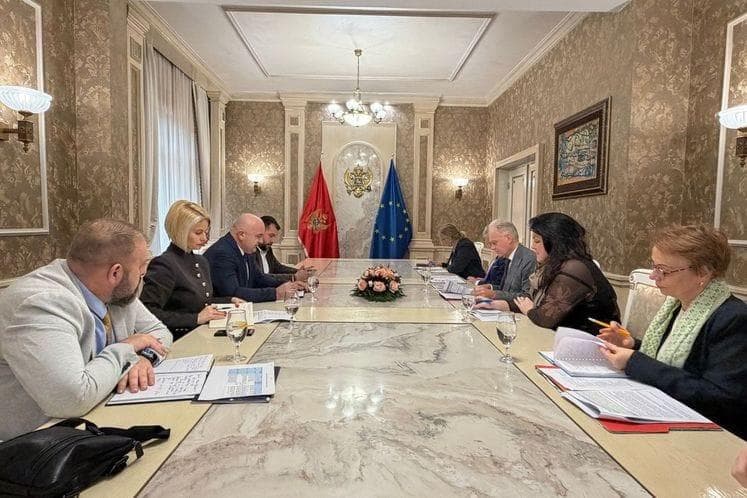
Podgorica: Negotiators in the Montenegrin capital have moved into a phase that no candidate country has reached since Croatia’s accession in 2013. On 22 April EU ambassadors in the Council approved the creation of an ad hoc working group tasked with drafting Montenegro’s accession treaty, a procedural step that in practice signals the Union accepts the country is close enough to membership to start writing the legal text of entry.
The numbers underpinning that judgement are now public. Of the thirty-three substantive chapters, nineteen are open, fourteen have been provisionally closed, and two contain no acquis for Montenegro to adopt. The remaining gaps cluster in chapters where progress is genuinely difficult: rule of law indicators under chapters 23 and 24, judicial independence, and the still-contested track record on high-level corruption cases. Yet the Commission’s November 2025 enlargement package and the January 2026 chapter closure on transport policy gave Podgorica enough political momentum to credibly target end-of-2026 for closing negotiations.
Prime Minister Milojko Spajic’s government has committed publicly to a 2028 accession date. Inside the Commission’s enlargement directorate the working assumption is more cautious, with 2029 considered the earliest realistic ratification timeline once member-state parliaments and the European Parliament have processed the treaty. Even on that calendar, Montenegro would become the twenty-eighth member state, restoring a number the Union lost when the United Kingdom departed.
Commissioner Marta Kos used a visit to Cetinje last month to underline that Montenegro is being treated as a pacesetter rather than a special case. The phrase “merit-based” appears in every official communication, and for good reason. Albania is now expected to complete negotiations between 2027 and 2029, with Cluster 5 opened in November 2025; Ukraine is on track to open its remaining three negotiating clusters before the end of 2026, contingent on alignment work largely completed last year. The risk for Podgorica is no longer being overtaken; it is being slowed by the symbolic weight of being first through the door.
The ad hoc drafting group will work on legal architecture rather than political bargaining. Its tasks include transitional arrangements for sectors where Montenegro’s economy cannot absorb the acquis on day one, derogations from environmental and agricultural rules, and the financial envelope that will govern cohesion transfers in the country’s early years of membership. Past treaties have run to several hundred pages of protocols and annexes; the Croatian template, with its complex fisheries and competition annexes, is the closest precedent.
Domestic politics in Podgorica complicate the optics. The governing coalition contains parties with sharply different views on relations with Belgrade and Moscow, and the opposition has accused Spajic of negotiating concessions on the rule-of-law chapters that will be hard to reverse. EU officials counter that the benchmark structure introduced in 2020 makes such reversals nearly impossible because closure is conditional on irreversible reforms.
The wider enlargement story is shifting in tone. After more than a decade of stalled Western Balkan integration, the institutional vocabulary in Brussels has moved from conditionality to readiness. Montenegro’s ad hoc working group is the most concrete manifestation of that shift, and the document it produces over the coming twelve months will be studied closely by every other capital in the queue.