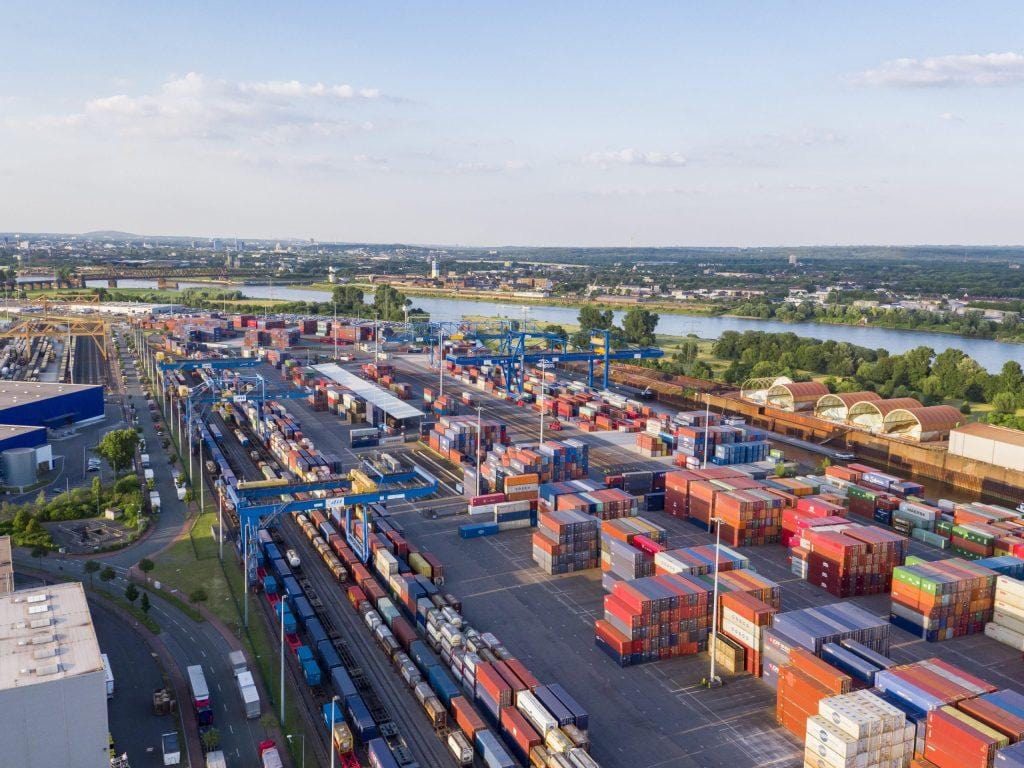
Duisburg: The inland port here handles exactly the kind of container traffic that every European climate plan assumes will eventually ride the rails. Fresh figures point the other way. Eurostat published data on 14 September showing that EU rail freight performance fell by 1.8% in 2025, sliding from 375.1 billion tonne-kilometres to 368.2 billion. It was the fourth consecutive year of decline.
The number carries weight because the Commission built its transport strategy around a pledge that rail freight would grow by 50% before 2030 and double by 2050. Four straight years of contraction push that milestone out of practical reach, and no member state has put forward a credible route back to it.
Germany still dominates the market. German operators moved 123.5 billion tonne-kilometres, a third of the EU total at 33.5%. Poland followed with 54.3 billion, or 14.7%, and France with 34.4 billion, 9.3%. Sixteen countries recorded a fall against 2024. Eight recorded a rise.
The extremes tell a sharper story than the average does. Ireland lost 35.2% of its rail freight performance, Latvia 18.8% and Estonia 17.3%. The Baltic declines follow the disappearance of eastbound transit traffic, a structural shift that no infrastructure package reverses. Greece gained 9.3%, Portugal 8.4% and France 6.6%, three networks that started from modest volumes.
Figures per inhabitant expose how uneven the single rail market remains. Luxembourg moved 10.7 tonnes per person, Austria 10.5 and Lithuania 8.5. Ireland managed 0.03 tonnes, Greece 0.06 and Spain 0.5. A framework that treats these as one market asks Dublin and Vienna to solve entirely different problems with the same instruments.
Operators name the same obstacles they named a decade ago. Cross-border trains swap locomotives and drivers at national frontiers. Signalling systems differ. Track access charges vary by orders of magnitude. The European Rail Traffic Management System, meant to harmonise signalling, advances slowly because infrastructure managers pay for trackside equipment while operators pay for onboard units, and neither side wants to spend first.
Road freight moved the other way. Eurostat recorded a 0.9% rise in road tonne-kilometres for the same year. Modal shift, the organising idea behind two decades of EU transport law, is running in reverse.
The Commission holds tools it has not pressed hard. Corridor bodies created under the rail freight corridors regulation can steer capacity allocation, and most of them exercise that power cautiously. The revised TEN-T regulation sets 2030 and 2040 deadlines for core network standards, including 740-metre trains and 22.5-tonne axle loads, yet delivery rests on national investment budgets now competing with defence and energy claims.
A counterargument deserves a hearing. Rail freight volumes track industrial output, and European manufacturing shrank through much of 2025, so part of the fall reflects the economy rather than the policy. Road freight nevertheless rose in the same period, which suggests rail lost share rather than simply losing cargo.
Eurostat counts only main railway undertakings, those carrying at least 200 million tonne-kilometres or 500 000 tonnes a year, so smaller operators sit outside the total. Cyprus and Malta run no railways at all. Neither caveat bends the trend line.
The real test arrives when the Commission measures its mobility strategy against the 2030 milestones. On this data it must explain either how a 50% increase happens inside four years or why the target no longer governs. The Eurostat release and the underlying transport database hand ministers the numbers to argue over.