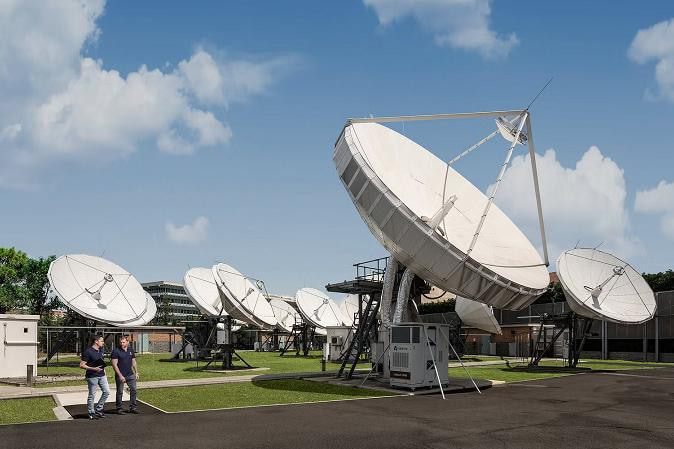
Cologne: Europe’s bid to control its own secure communications took a concrete turn this summer as Germany broke ground on a hub that will steer the bloc’s government satellite services. The facility marks another step toward sovereign satellites, spacecraft that European states own, command and trust without leaning on foreign operators.
The site anchors GOVSATCOM, the pooled service that lets governments share secure satellite capacity for missions that cannot rely on the open market. Since January the programme has run on eight satellites contributed by five member states, and the Cologne hub gives it a physical command backbone alongside a second planned facility.
GOVSATCOM bridges toward a far larger ambition. The EU is building IRIS2, a multi-orbit constellation of roughly 290 satellites that will deliver resilient, encrypted connectivity for defence, border control, crisis response and remote regions. The Commission wants first services before the decade closes and full coverage by 2030.
The logic is strategic as much as technical. War on the continent’s edge, the jamming of satellite signals and dependence on a handful of commercial mega-constellations convinced European capitals that connectivity is now a security asset. A government that cannot guarantee its own links cannot guarantee its own operations.
The European Union Agency for the Space Programme will manage service delivery, while the European Space Agency handles development and deployment. That split hands the space agency a growing operational role, and lawmakers have moved to put it on a permanent footing as its remit stretches deeper into defence.
Money and management remain the hard part. IRIS2 pairs public funds with a private consortium, and past flagship programmes have taught planners that ambitious constellations slip and overrun. Delivering hundreds of satellites across three orbits on schedule will test both the budget and the governance.
Industry sees opportunity. Manufacturers, launch providers and ground-segment firms across the member states stand to win work, and officials argue that the investment seeds a competitive European space sector rather than simply buying capability abroad. Smaller suppliers, long squeezed out of a market dominated by a few primes, hope the constellation spreads contracts more widely across the bloc.
Security agencies watch just as closely. Encrypted, jam-resistant links matter most to the armies, border guards and disaster teams that operate where commercial networks fail, and each of those users wants guarantees written into the design rather than promised after launch.
For now the story sits in poured concrete near the Rhine rather than in orbit. Yet the Cologne hub signals intent. Europe means to speak to its own satellites, on its own terms, and to build the ground beneath the constellation before the spacecraft ever fly.