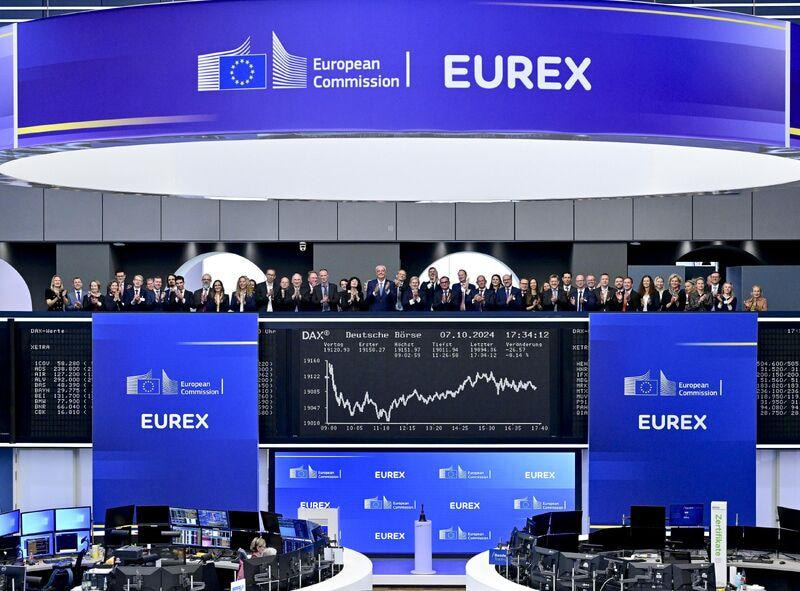
Frankfurt: The European Commission raised €8 billion on 11 November 2026 in its tenth syndicated EU bond issuance of the year, and investors placed orders worth more than €152 billion across the two tranches. The deal shows that demand for EU debt remains deep even as yields sit well above the levels of the early recovery-fund years.
The EU bond issuance tapped two existing lines rather than opening new ones. A €4 billion tap of the five-year EU-Bond maturing on 13 October 2031 carried a 2.875% coupon and priced at 97.560, for a re-offer yield of 3.423%. Orders exceeded €71 billion, about 17.8 times the amount on offer.
The long tranche attracted even stronger interest. A €4 billion tap of the 20-year bond maturing on 12 October 2046, with a 4% coupon, priced at 96.124 for a yield of 4.293%. The order book topped €81 billion, roughly 20.2 times covered. BNP Paribas, Commerzbank, Deutsche Bank, JP Morgan and Nomura acted as joint lead managers.
Pricing places the EU between the strongest sovereign issuers and the larger euro area borrowers. The five-year bond paid 34.9 basis points over the German Bund due in October 2031 but 57.4 basis points less than the French OAT due in May 2031. The 20-year bond priced 69.9 basis points over the comparable Bund and 82.2 basis points under the French equivalent.
That middle position matters for the debate about the place of the EU in sovereign bond markets. The Commission now prices new deals against its own EU-Bond curve, a sign of growing liquidity, and steady EU bond issuance strengthens its case that index providers and central banks should treat EU paper more like a sovereign benchmark. A tighter spread to Bunds would cut the cost of every euro the Union borrows.
This EU bond issuance forms part of an €80 billion funding target for the second half of 2026. The Commission plans to raise the remaining €12 billion through EU-Bond auctions on 23 November and 7 December, followed by a related non-competitive offer.
Total outstanding EU debt stands at about €874.67 billion, according to the Commission. That figure includes €53.41 billion of short-term EU-Bills and €86.24 billion of NextGenerationEU green bonds. The stock finances the recovery programme, macro-financial assistance to Ukraine and other EU lending instruments.
Higher yields carry a budget cost. Coupons of 2.875% and 4% sit far above the near-zero rates the Commission paid when NextGenerationEU borrowing began in 2021, and the European Court of Auditors has already warned that interest costs for the current budget period far exceed early estimates. Each new round of EU bond issuance at current levels adds to the interest bill that the 2028 to 2034 framework must cover.
For bond investors in Frankfurt and beyond, the latest EU bond issuance confirms that the Union can still raise large sums quickly at stable spreads. Whether that strength turns into lower borrowing costs will depend on decisions by member states on new own resources and on how long the Commission remains a regular issuer once recovery borrowing ends.