Klaipėda: The push to translate the EU’s Military Mobility 2.0 action plan into actual infrastructure has shifted from white-paper rhetoric to engineering specs in a handful of named corridors, and the Lithuanian port of Klaipėda is one of the test cases watched most closely. The next package — the corridor map and the synchronisation between SAFE disbursements and dual-use upgrades — is the political deliverable that the Commission has been promising since the Joint White Paper for European Defence Readiness 2030 was published in March 2025. The work has been technical rather than headline-grabbing, but the next twelve months will determine whether the framework moves from a coordination plan into hard concrete and steel.
The Lithuanian port example illustrates what corridor upgrade actually means at the dossier level. The site handles ro-ro and break-bulk traffic that on a contested scenario would carry armoured formations into Lithuania and onward across the Suwałki gap. The relevant engineering changes — higher axle-load limits on the approach roads, quay-wall reinforcement to take tracked-vehicle loadings, staging nodes at the rail-port interface and corresponding crane and rail-siding capacity — sit across at least four national jurisdictions and an EU funding stack that has historically not been built for defence-tagged spending. The Commission has been working with Lithuania, Poland, the Czech Republic and Germany on aligning the SAFE disbursement timeline with the construction milestones already in the TEN-T core network corridors.
The architecture has been deliberately built to layer onto existing instruments rather than create a new one. Cohesion funds, Connecting Europe Facility transport money and the new SAFE financing window each carry rules of eligibility that have to be reconciled. The Council Working Party on Transport and the Political and Security Committee have been holding parallel meetings on the same project pipeline since late 2025, with the explicit objective of preventing the dual-use upgrades from getting trapped in procurement bottlenecks. By 2026, the first SAFE disbursements are expected to align with corridor milestones; the test of the framework is whether they do.
EU-NATO coordination is the layer that often goes underreported in the file. The cross-border movement permission regime — the rules under which a military convoy from the North Sea ports moves through Germany, the Netherlands, Poland and Lithuania without administrative re-permitting at each border — is jointly owned with NATO’s military mobility task force. The Council pledges of 2025 set a target of forty-eight-hour cross-border permission timelines for routine movements. The current average, according to internal assessments, has moved into the two-to-three-day range from the pre-2022 five-to-seven-day baseline, but the variance across corridors remains high. The harder cases are not the well-rehearsed northern and Baltic routes but the southern and south-eastern flank, where infrastructure investment and permission architecture are both thinner.
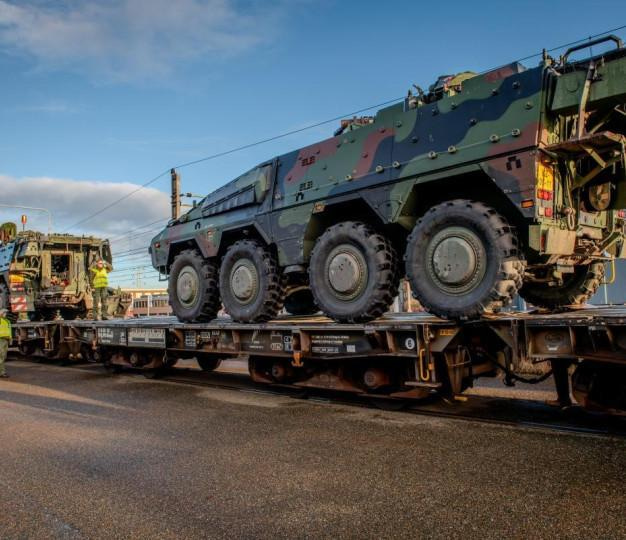
A quieter dossier sits underneath all of this — the rolling stock and lifting capacity that any corridor depends on. Specialised railway flat cars, heavy-equipment transporters and amphibious ferry capacity are not items that EU procurement frameworks have traditionally tracked. The European Defence Agency has been running a joint capability requirement exercise to put numbers on the gap, and the result is expected to feed into the next round of European Defence Fund calls. Whether SAFE can fund that hardware alongside infrastructure, or whether it sits more naturally under the EDF, is still being worked out.
For the eastern-flank nodes, the next test is whether the corridor map the Commission is due to publish later this year names the right priority sections and whether the SAFE money actually arrives against them. The political consensus on military mobility is now broader than it has been at any point since 2018. What the framework now needs is a hard set of in-corridor delivery dates rather than another round of strategy papers.