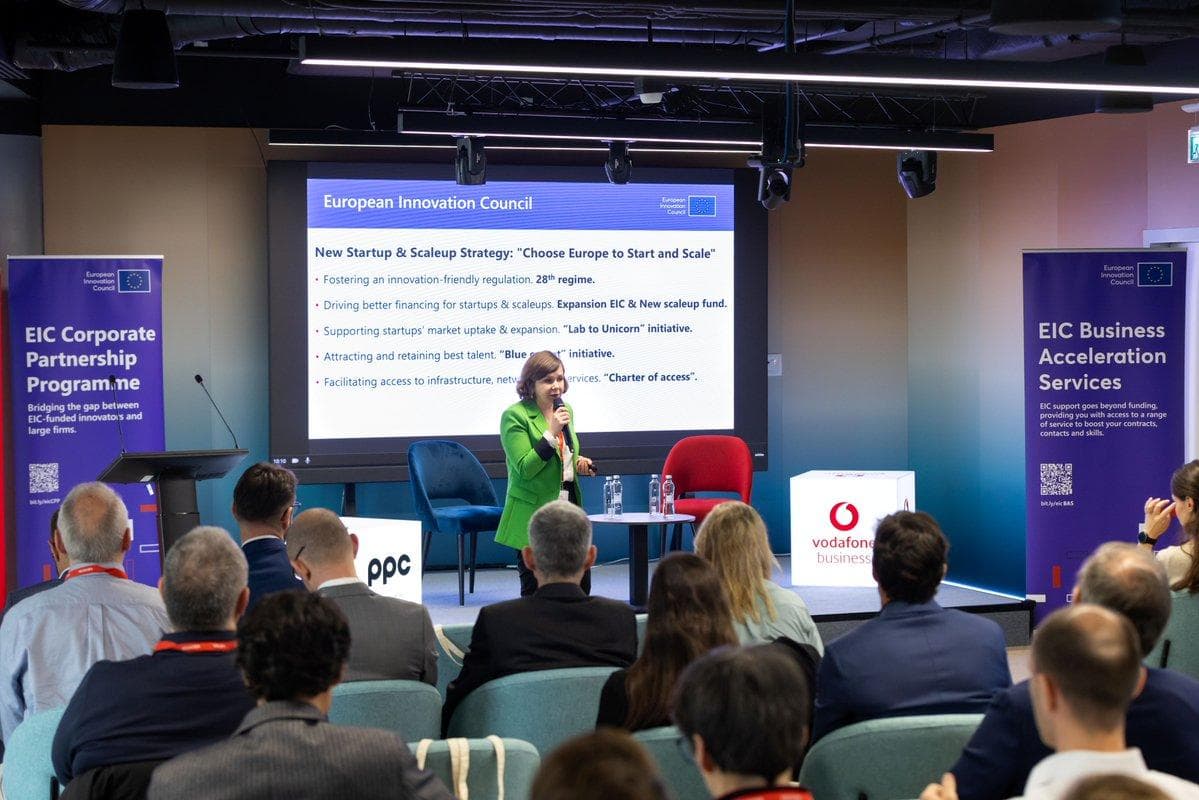
Eindhoven: Europe has never struggled to produce clever engineers or promising patents. Where it has repeatedly stumbled is in the stretch between a working prototype and a company big enough to matter, the so-called valley of death where capital dries up and founders drift toward American investors. The European Innovation Council’s flagship scheme exists to throw a bridge across that gap, and its latest figures show both the ambition and the limits of the effort.
In its most recent evaluation round the Council selected sixty-one start-ups and small firms for support, drawn from a larger pool that reached the interview stage. The proposed funding totalled around four hundred and sixty-seven million euro, and the striking detail is the structure of the money. Roughly eighty-five per cent of the winners are receiving blended finance, a combination of an outright grant of up to two and a half million euro and an equity investment, ranging from half a million to ten million, made directly through the Council’s own fund. In effect the Union is taking stakes in deep-tech companies the way a venture capitalist would.
That equity arm is what sets the instrument apart from the grant programmes Europe has run for decades. Grants are comfortable; they ask nothing back and carry no risk for the recipient. Equity is different. It signals that the public purse is prepared to share in both the danger and the upside of unproven technology, from quantum hardware to novel materials to medical devices that need years and deep pockets before they reach a market. For founders, a cheque that does not have to be repaid but also does not dilute them into irrelevance can be the difference between staying in Europe and decamping to California.
The scheme is also trying to fix its own reputation for sluggishness. From 2026 the application process has been streamlined, with full proposals cut from fifty pages to twenty and evaluations promised every two months instead of twice a year. Founders have long complained that the speed of public money bears no relation to the speed of a start-up’s cash burn, and the reforms are an admission that a grant arriving a year too late is worthless. The overall budget for the year runs to several hundred million euro, split between open calls and targeted challenges in areas the Union has decided are strategic.
Whether it is enough is the open question. Set against the sums American and Chinese investors pour into frontier technology, the Council’s firepower looks modest, and a few hundred million spread across dozens of companies will not by itself close the innovation gap that haunts every competitiveness report out of Brussels. Sceptics argue the state makes a poor stock-picker and that the real fix lies in deeper private capital markets, not public equity stakes.
Yet for the firms that make the cut, the abstraction of industrial policy becomes a concrete lifeline. A scale-up scheme launched earlier in the year has already backed a handful of companies trying to grow past the awkward middle stage where European money traditionally vanishes. The bet behind it all is simple: that a continent which keeps inventing the future can also learn, finally, to finance it.