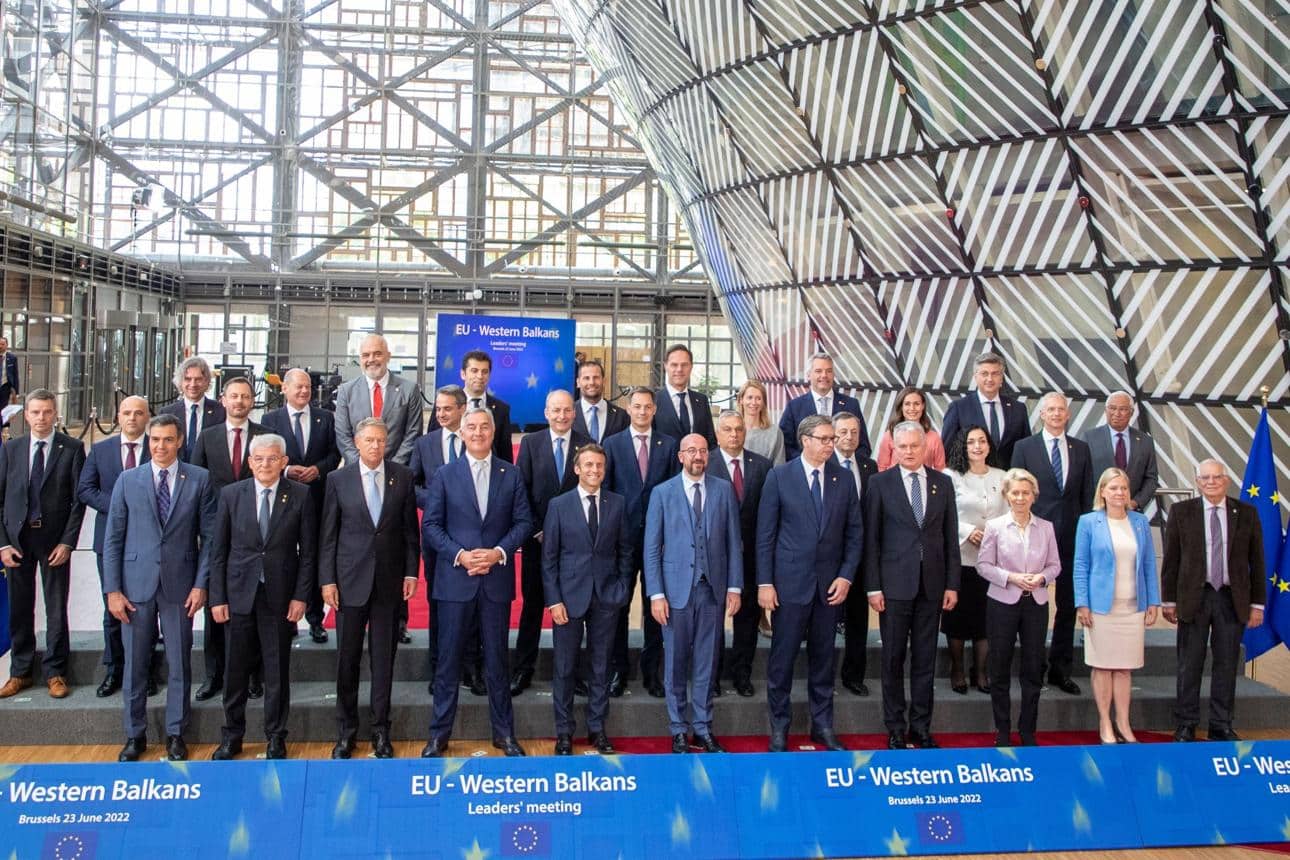
Tivat: The choreography of the EU-Western Balkans summit held in this Montenegrin coastal town on 5 June was familiar to anyone who has watched enlargement diplomacy over the past two decades. Warm words, a photograph of regional leaders flanked by the powerful, and a renewed promise that membership is, this time, genuinely within reach. What was new was the vehicle. A Franco-German proposal for “gradual integration” that Chancellor Friedrich Merz and President Emmanuel Macron pressed in the days around the meeting would reward candidates that meet specific reform benchmarks with phased access to the single market and observer seats in EU institutions, rather than making them wait for the all-or-nothing moment of full accession.
On its face this is a sensible answer to a real problem. The classic enlargement model asks candidate states to undertake wrenching reforms for a reward that may be a decade or more away, with no partial credit along the route. Voters in the Balkans, watching successive governments exhaust themselves on judicial overhauls and anti-corruption drives without visible payoff, have grown cynical. Gradual integration tries to shorten the feedback loop. Hit a target on the rule of law, and a slice of the single market opens. Align your foreign policy with Brussels, and you earn a voice, if not yet a vote, in the rooms where decisions are made.
The geopolitical urgency behind the rebrand is genuine. Macron framed the region bluntly as the place where Europe’s independence is at stake in terms of energy, security and migration routes. A decade of Russian and Chinese courtship in the Western Balkans, layered over the unresolved Serbia-Kosovo dispute and Bosnia’s internal paralysis, has convinced even enlargement sceptics in Paris and Berlin that the cost of leaving the region in limbo now exceeds the cost of bringing it in. Montenegro, which the bloc’s leaders suggest could join as early as 2028, has become the proof of concept, with Albania close behind.
Yet gradual integration carries risks that the summit’s warm choreography tends to obscure. The first is that phased access hardens into a permanent waiting room. If candidates can be given the economic benefits of membership without the political cost of admitting them, the incentive for existing members to complete the final, difficult step weakens. A country enjoying single-market access but holding no vote has the obligations of membership without its protections, an arrangement that can curdle into resentment rather than gratitude. The European Economic Area offers a cautionary precedent of rule-takers without rule-makers.
The second risk is that benchmarks become a tool for managing pace rather than measuring progress. Member states that quietly oppose enlargement, whether over agricultural budgets, free movement or bilateral disputes, can find in a granular list of conditions an inexhaustible supply of reasons to delay. Bulgaria’s long blockade of North Macedonia over questions of language and history is the warning here. Gradual integration multiplies the number of gates at which a single capital can object.
There is also the matter of differentiation within the group. Treating the six as a bloc flatters the laggards and frustrates the leaders. Montenegro and Albania have earned a faster track. Serbia, hedging between Brussels and Moscow, and Bosnia, hobbled by its own constitution, have not. A scheme that advances them in lockstep risks either dragging the frontrunners back or rewarding the reluctant. The Franco-German design at least gestures at merit-based progression, but the politics of the European Council rarely tolerate winners and losers being named so plainly.
For all that, the Tivat summit marks a real shift in tone. After years in which enlargement was a rhetorical commitment honoured mostly in communiques, the largest member states are now treating it as a strategic necessity. Whether gradual integration becomes a genuine on-ramp or an elaborate parking structure will depend on a detail the summit left unresolved: what, precisely, a candidate must do to move from observer to member, and whether Europe has the will to let them through the final door.