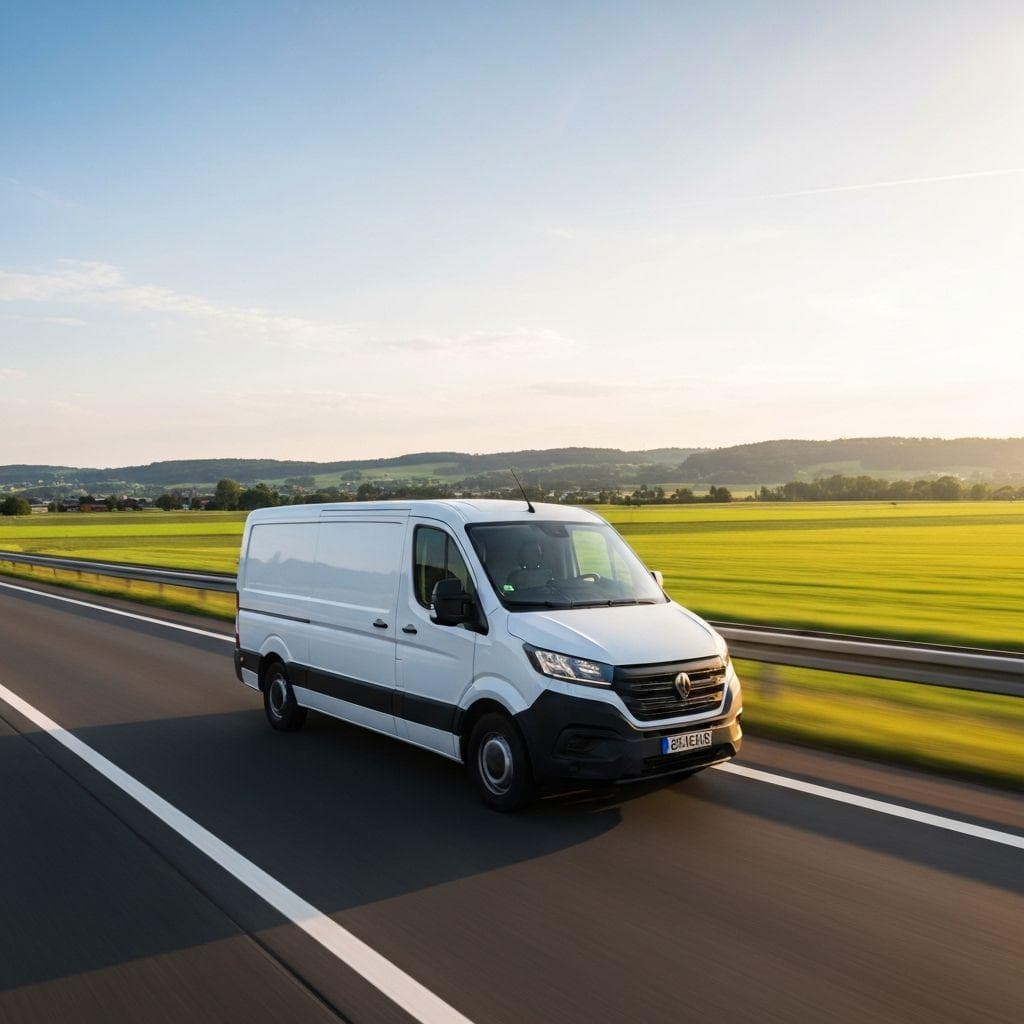
Duisburg: The light vans that criss-cross Europe’s motorways carrying parcels and pallets have long occupied a regulatory blind spot, big enough to run serious international haulage, small enough to escape the rules that govern lorries. From 1 July that gap has closed. Vehicles between 2.5 and 3.5 tonnes used for the international carriage of goods, or for cabotage inside another member state, now fall under the EU’s rules on driving times, rest periods, tachographs and the posting of drivers.
The change is the final tranche of the Mobility Package agreed in 2020, whose provisions have phased in over several years. For the operators affected, the practical demands are concrete. Drivers of these lighter vehicles must now respect a maximum daily driving time of nine hours, extendable to ten on no more than two days a week, and take a break of at least forty-five minutes after four and a half hours at the wheel. The vehicles themselves must carry a smart tachograph, the tamper-resistant device that records movement and rest automatically and can be read at the roadside by enforcement officers.
Until now those obligations applied only above 3.5 tonnes, and the difference had real consequences. A parcel firm could field a fleet of sub-3.5-tonne vans on long cross-border runs without logging hours or fitting recording equipment, undercutting operators who ran heavier trucks and bore the compliance cost. The van segment grew rapidly in the age of e-commerce, and with it grew concern about fatigued drivers and uneven competition. Extending the rulebook is meant to level that field and to fold a fast-expanding slice of road freight into the same safety and social framework as the rest of the sector.
Enforcement is the part operators will feel first. Fitting an approved smart tachograph is neither quick nor cheap, and firms that ran on the old model of light, unregulated vans must now retrofit vehicles, retrain drivers on rest rules, and build the administrative machinery to store and produce records. Smaller couriers, in particular, face a jump in overhead. The posting-of-drivers dimension adds another layer, bringing these journeys within rules on minimum pay and conditions when a driver works temporarily in another member state.
The measure does not stand alone. It arrives alongside a broader modernisation of road rules, including a revised driving-licence Directive that introduces a digital licence carried in a phone wallet and a two-year probationary period for novice drivers, and fresh rules to smooth cross-border rail capacity. Together they sketch a Union trying to make road transport safer and more uniform while nudging it toward digital enforcement.
For the freight buyers who rely on van networks, the effect will be felt in schedules and rates. Journeys that once ran on tight, lightly-regulated timings must now be planned around mandatory breaks and capped hours, and the cost of compliance will filter into prices. Trade bodies have broadly accepted the logic of closing the loophole while warning of a bumpy transition for the smallest firms. The direction, though, is settled: the humble delivery van has grown up in the eyes of the regulators, and the rules of the road now treat it accordingly.