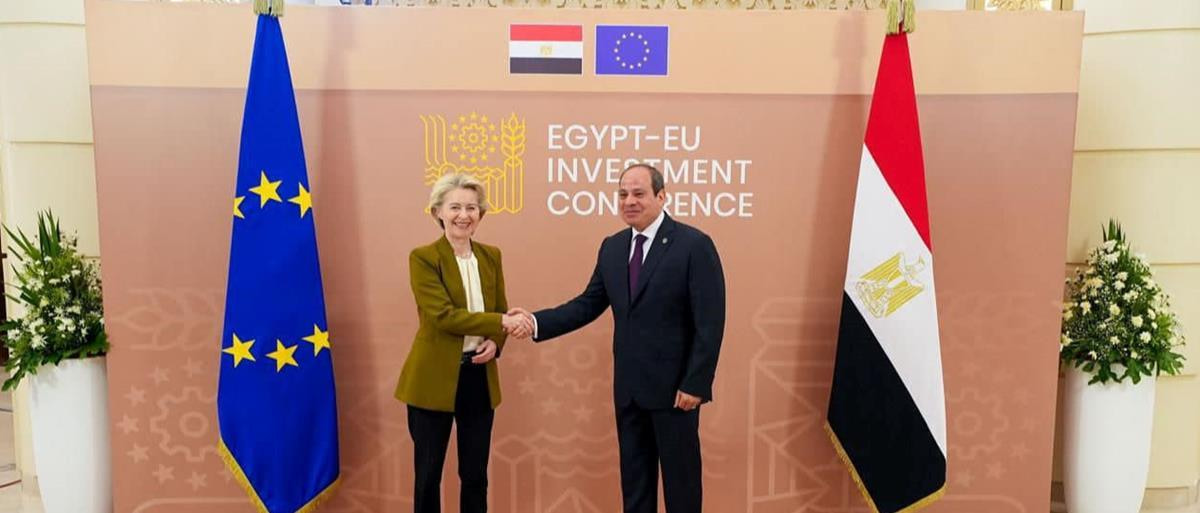
Cairo: The European Commission moved EUR 1.5 billion to Egypt at the end of July, and the size of the payment matters less than what it certifies. This was the second of three instalments under a EUR 4 billion macro-financial assistance operation the Commission proposed in March 2024 and the Parliament and Council adopted in June 2025. Money of this kind does not arrive because a partner needs it. It arrives because an assessment concluded the conditions were met.
The tally now reads EUR 3.5 billion since the strategic partnership was signed, counting a EUR 1 billion short-term operation in December 2024 and a first EUR 1 billion tranche in January 2026. One instalment of EUR 1.5 billion remains outstanding, and that residual is the entire mechanism of leverage. The EU delegation in Cairo set out the reform list attached to the release: public financial management, the investment climate, competition policy, governance of state-owned enterprises, social protection, and water and electricity market reform.
That list deserves attention because it names the one thing Egyptian economic policy has struggled with for a decade. State-owned and military-linked enterprises compete with private firms on terms private firms cannot match, and every serious analysis of Egypt’s growth model returns to that asymmetry. Writing governance of those entities into a disbursement condition is more pointed than the usual language about macroeconomic resilience. Whether the reform survives contact with the institutions it touches is a separate question, and one the next assessment will have to answer.
Macro-financial assistance is a balance-of-payments instrument, not a development grant, and it works alongside an International Monetary Fund programme rather than in place of one. Egypt’s external position has improved since the currency float and the Gulf investment surge, but the debt service profile still consumes a punishing share of revenue. European money reduces the cost of rolling that debt over. It does not reduce the stock.
The political conditions in the memorandum of understanding are where the argument sits. Members of the European Parliament have pressed repeatedly on human rights and detention practices, and the Commission’s position is that the conditions were assessed and satisfied. Critics of the programme read the same disbursement as evidence that the Union values migration cooperation and Mediterranean stability far above the political benchmarks it writes down. Defenders answer that tranching creates real friction, that an unconditional transfer would have been simpler to arrange, and that withholding money from a country of 110 million people punishes the population before it moves the government.
Both readings survive the evidence, which is itself the problem. Conditionality that is never visibly enforced becomes a schedule rather than a test. The final EUR 1.5 billion is the only remaining moment at which the Union can demonstrate the difference, and it will fall due against a broader package worth EUR 7.4 billion for 2024 to 2027 in grants, loans and guarantees.
Egypt sits at the junction of three files Europe cannot solve elsewhere: migration across the central Mediterranean, gas and electricity interconnection, and the diplomacy of a region where European influence has thinned. A partner that stabilises its currency and pays its import bills serves all three. That is the calculation behind the transfer, and it is a defensible one. It is also the reason the last tranche will probably be released on time, whatever the assessment finds, unless the Commission decides that the credibility of its own conditions is worth more than the goodwill the money buys.