Nagoya: The machine-tool and component firms clustered across Aichi prefecture sell into European factories that cannot easily replace them, and they buy inputs from a Chinese supply chain that Brussels and Tokyo both now describe as a vulnerability. That single sentence explains why economic security has crept to the centre of the European relationship with Japan. It does not explain why the relationship still lacks an instrument to manage it.
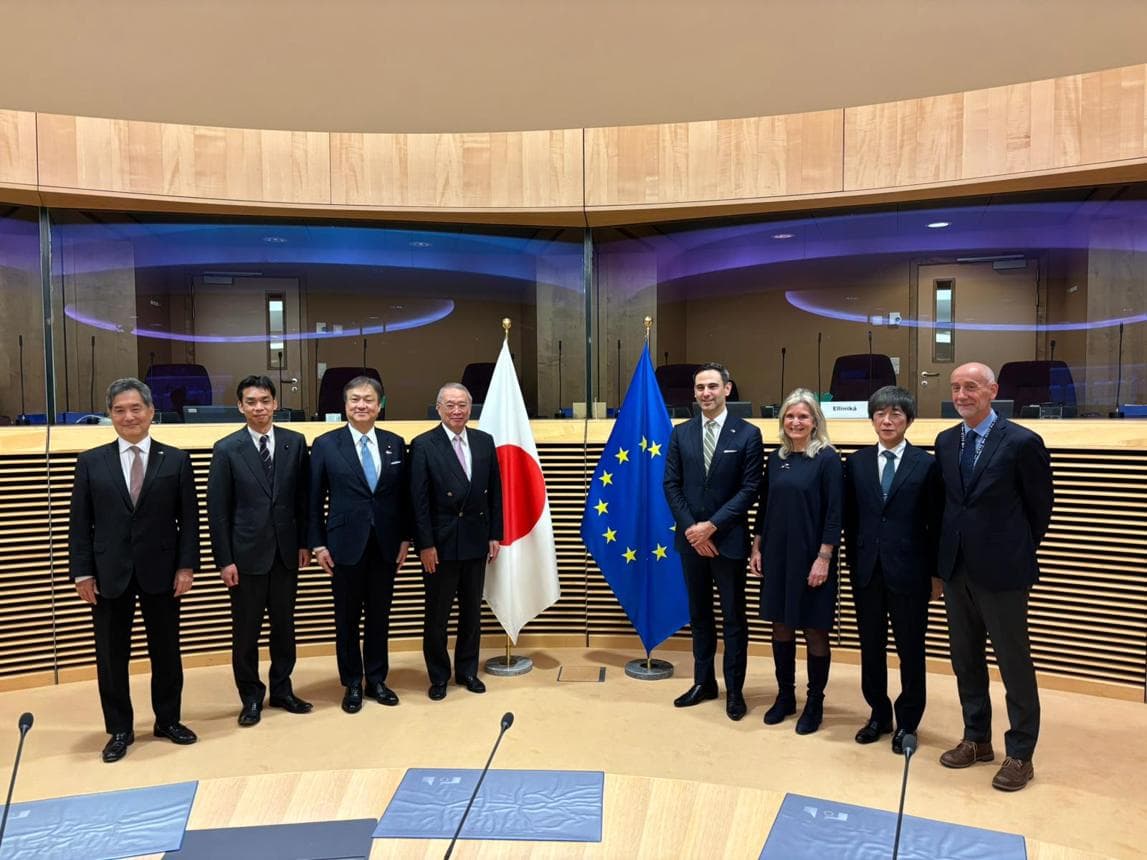
Officials met in Brussels on 7 May 2026 for the seventh High-Level Economic Dialogue, convened for the first time in what both sides called a reinforced format. They agreed to deepen work on trade, industrial policy and economic security, welcomed matchmaking sessions that paired Japanese firms with strategic projects under the Critical Raw Materials Act, and said they would explore backing further joint critical mineral ventures. The communique read well. It committed almost nothing.
Count the instruments that already govern this partnership. An Economic Partnership Agreement has run since 2019. A Strategic Partnership Agreement handles political cooperation. A Security and Defence Partnership arrived in late 2024. A Green Alliance, a Digital Partnership and a connectivity partnership sit alongside them. Japan is, by institutional density, Europe’s most heavily documented Asian relationship. Yet no single text tells a Japanese trade ministry official whom to telephone in Brussels when a supplier in Guangdong stops shipping.
Analysts have named the gap. Researchers at ISPI and at Institut Montaigne argue that the accords advance overlapping goals without a framework that ranks them, and that the partnership needs a roadmap covering supply-chain resilience, technology standards and crisis response. The diagnosis holds. The prescription usually stops before the hard part, which is deciding who acts first when a shortage hits and what each side owes the other.
The vacuum already produces visible consequences. In April 2026 Japan signed a rare earths recycling arrangement with France, a bilateral deal between Tokyo and a single member state rather than with the Union. Berlin and Rome pursue their own industrial conversations in parallel. Each agreement makes sense on its own terms and each one shaves a little leverage off the collective position, because Beijing negotiates with whichever European capital offers the softest terms.
A serious roadmap would look nothing like the communiques. It would name a small number of joint projects with financing attached, set a standards agenda with deadlines rather than intentions, and write a consultation clause with an actual trigger, so that an export restriction imposed on one partner starts a clock rather than a conversation. Both administrations know how to draft such a text. Neither wants to volunteer the first concession that makes it binding.
The obstacle is structural rather than diplomatic. Trade policy belongs to the Commission, industrial policy largely to member states, and security to capitals that guard it jealously. Japan faces a milder version of the same fragmentation across its own ministries. A crisis instrument requires someone to hold the pen during the crisis, and neither side has decided who that is.
The reinforced format marked a real step, and it recognised the problem. Recognition is where this relationship has been stuck for three years. The next dialogue will show whether Europe and Japan can convert an unusually thick file of agreements into something that functions on the day it is needed.