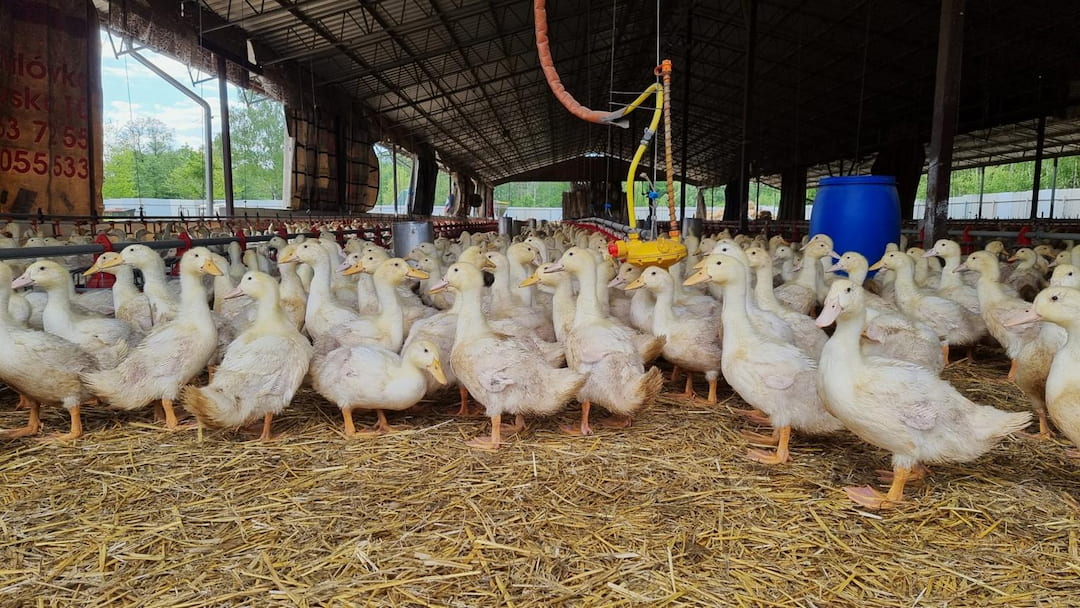
Kaposvár: Hungary’s waterfowl belt supplies a bird that most European shoppers never think about, and it has become the newest test of whether Brussels can defend a market it says it wants to protect.
The European Commission opened an anti-dumping investigation into Chinese Pekin duck imports in July 2026, after five European producers argued that subsidised pricing had taken volume they could not win back. The complaint points at familiar machinery. Provincial authorities fund regional feed clusters, they underwrite processing capacity, and the national five-year plan adopted in March 2026 treats poultry protein as a strategic output rather than an ordinary commodity.
Duck is a small file. That is exactly why it repays attention. Trade defence cases work as a stress test of administrative capacity, and Europe now opens them faster than it resources them. Biodiesel, tinplate and construction machinery sit in the same queue. Five member states, France, Spain and the Netherlands among them, sent the Commission a joint paper this year asking for more investigations, a firmer line in Geneva, and more staff in the enforcement directorate. The third request explains the first two.
Beijing answers on different counters. It has taxed European pork since September 2025, it has set dairy duties reaching 43 percent, and it signals fresh probes whenever Brussels tightens an instrument. The rhythm has become predictable. Europe acts on an industrial input, China responds on a farm product, and the political cost lands on rural constituencies that took no part in the original dispute.
The asymmetry favours Beijing. European agricultural exports concentrate in a handful of member states, so retaliation splits the Council within days. Chinese industrial goods run through every member state’s supply chain, so restricting them splits the Council too. Whoever absorbs the internal argument longer wins the exchange, and China does not need to publish a vote count.
Brussels has tried to shift the contest onto rules. In February 2026 it asked the World Trade Organization to establish a panel over Chinese courts setting global royalty rates for European high-tech patents, a case that reaches much further than any duty on poultry. The Commission set out its reasoning when it requested the panel. It is separately examining whether construction materials shipped from Balkan suppliers carry Chinese glass fibre that already sits under duty, an inquiry Euronews reported in late July.
That second line of work says something uncomfortable. Trade defence assumes goods arrive by the route printed on the paperwork. Transhipment breaks the assumption, and every circumvention case consumes investigators who could otherwise open a fresh file. Enforcement capacity, not political will, has become the binding constraint.
The duck case will probably end in provisional duties within nine months, and producers in Hungary, France and Poland will book a modest gain. The larger question outlives the outcome. Europe has assembled an impressive set of trade instruments and has not decided how many it can run at the same time. Until it answers that, each case it opens carries a quiet wager that the next one can wait.