August 9, 2026
LATEST
Japan Becomes Europe’s Closest Security Partner in AsiaCan Europe’s New Zealand Deal Anchor It in the Pacific?Chip Research Binds Europe and South Korea CloserMinimum Prices Replace Tariffs in Europe’s China Car DealBrussels and Beijing Keep Talking While the Trade Gap WidensKorean Weapons and EU Loans Now Bankroll Europe’s RearmamentNew EU Gas Market Rules Take Effect With Consumer SafeguardsDeforestation Regulation Holds Its December Deadline Despite CutsDigital Omnibus Delays Europe’s High-Risk AI Deadline to 2027Europe’s Schools Confront a Widening Basic Skills GapRule of Law Report Finds Progress but Trust Still LagsIRIS2 Gains 66 Satellites as Brussels Signs the Rollout DealNature Restoration Plans Come Due as Member States Race a DeadlineECB Rates Hold at 2.25 Percent as Frankfurt Waits on the DataEU Budget Talks Turn to Cohesion as Ireland Takes OverWildfire Response Stretches Europe’s Emergency Fleet ThinCan Europe’s Quantum Plan Match Its Big Ambitions?Armenia Edges West as Moscow’s Grip Slips AwayEurope Inherits the World’s Aid Bill It Cannot Fully PayAir Passenger Rights Get Their First Overhaul in Two DecadesJapan Becomes Europe’s Closest Security Partner in AsiaCan Europe’s New Zealand Deal Anchor It in the Pacific?Chip Research Binds Europe and South Korea CloserMinimum Prices Replace Tariffs in Europe’s China Car DealBrussels and Beijing Keep Talking While the Trade Gap WidensKorean Weapons and EU Loans Now Bankroll Europe’s RearmamentNew EU Gas Market Rules Take Effect With Consumer SafeguardsDeforestation Regulation Holds Its December Deadline Despite CutsDigital Omnibus Delays Europe’s High-Risk AI Deadline to 2027Europe’s Schools Confront a Widening Basic Skills GapRule of Law Report Finds Progress but Trust Still LagsIRIS2 Gains 66 Satellites as Brussels Signs the Rollout DealNature Restoration Plans Come Due as Member States Race a DeadlineECB Rates Hold at 2.25 Percent as Frankfurt Waits on the DataEU Budget Talks Turn to Cohesion as Ireland Takes OverWildfire Response Stretches Europe’s Emergency Fleet ThinCan Europe’s Quantum Plan Match Its Big Ambitions?Armenia Edges West as Moscow’s Grip Slips AwayEurope Inherits the World’s Aid Bill It Cannot Fully PayAir Passenger Rights Get Their First Overhaul in Two Decades
August 9, 2026
LATEST
Japan Becomes Europe’s Closest Security Partner in AsiaCan Europe’s New Zealand Deal Anchor It in the Pacific?Chip Research Binds Europe and South Korea CloserMinimum Prices Replace Tariffs in Europe’s China Car DealBrussels and Beijing Keep Talking While the Trade Gap WidensKorean Weapons and EU Loans Now Bankroll Europe’s RearmamentNew EU Gas Market Rules Take Effect With Consumer SafeguardsDeforestation Regulation Holds Its December Deadline Despite CutsDigital Omnibus Delays Europe’s High-Risk AI Deadline to 2027Europe’s Schools Confront a Widening Basic Skills GapRule of Law Report Finds Progress but Trust Still LagsIRIS2 Gains 66 Satellites as Brussels Signs the Rollout DealNature Restoration Plans Come Due as Member States Race a DeadlineECB Rates Hold at 2.25 Percent as Frankfurt Waits on the DataEU Budget Talks Turn to Cohesion as Ireland Takes OverWildfire Response Stretches Europe’s Emergency Fleet ThinCan Europe’s Quantum Plan Match Its Big Ambitions?Armenia Edges West as Moscow’s Grip Slips AwayEurope Inherits the World’s Aid Bill It Cannot Fully PayAir Passenger Rights Get Their First Overhaul in Two DecadesJapan Becomes Europe’s Closest Security Partner in AsiaCan Europe’s New Zealand Deal Anchor It in the Pacific?Chip Research Binds Europe and South Korea CloserMinimum Prices Replace Tariffs in Europe’s China Car DealBrussels and Beijing Keep Talking While the Trade Gap WidensKorean Weapons and EU Loans Now Bankroll Europe’s RearmamentNew EU Gas Market Rules Take Effect With Consumer SafeguardsDeforestation Regulation Holds Its December Deadline Despite CutsDigital Omnibus Delays Europe’s High-Risk AI Deadline to 2027Europe’s Schools Confront a Widening Basic Skills GapRule of Law Report Finds Progress but Trust Still LagsIRIS2 Gains 66 Satellites as Brussels Signs the Rollout DealNature Restoration Plans Come Due as Member States Race a DeadlineECB Rates Hold at 2.25 Percent as Frankfurt Waits on the DataEU Budget Talks Turn to Cohesion as Ireland Takes OverWildfire Response Stretches Europe’s Emergency Fleet ThinCan Europe’s Quantum Plan Match Its Big Ambitions?Armenia Edges West as Moscow’s Grip Slips AwayEurope Inherits the World’s Aid Bill It Cannot Fully PayAir Passenger Rights Get Their First Overhaul in Two Decades

Osaka Cements EU Japan Quantum Compact Through New Q-Neko Cycle

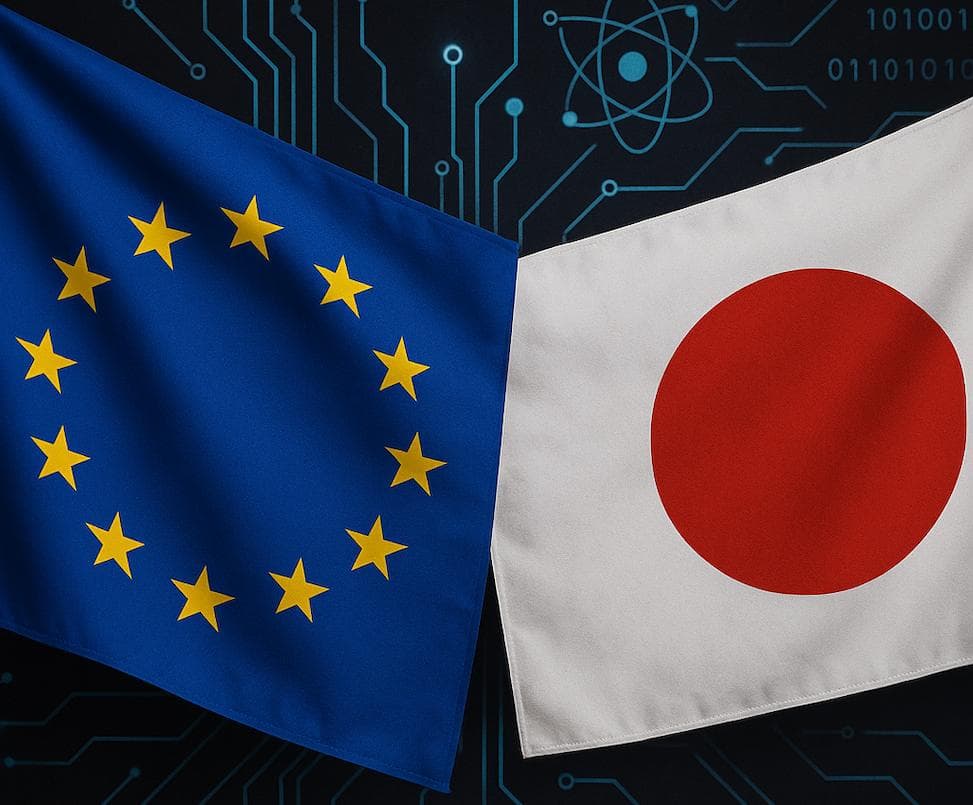
Osaka: The fourth meeting of the EU–Japan Digital Partnership Council, held in Brussels earlier this month, has reset the bilateral technology agenda around a triad of files — quantum, semiconductors and data governance — that together signal a sharper convergence on what European and Japanese officials now openly describe as economic-security technology. The clearest deliverable was the next cycle of the joint Q-Neko quantum research programme, which links flagship European laboratories with their Japanese counterparts in Osaka, Tsukuba and across the Kanto research belt around a shared roadmap for quantum communication networks, error-correction algorithms, and middleware standards that can bridge superconducting and photonic hardware platforms.

Q-Neko’s significance is methodological as much as technical. Earlier transcontinental quantum collaborations have been bilateral in name but compartmentalised in practice, with researchers running parallel tracks rather than integrated experiments. The new cycle compresses that. It assigns lab pairs to specific milestones, ties funding to joint deliverables, and channels supplemental allocations through Horizon Europe’s lump-sum mechanism on the EU side and Japan’s Moonshot programme on the Japanese side. That alignment of disbursement architecture is the unglamorous detail that determines whether transnational quantum projects produce shared papers or shared products. Q-Neko’s revised governance structure suggests Brussels and Tokyo now want the latter.

The wider Digital Partnership architecture is moving in parallel. The agreed Data Strategy Working Group will be tasked with interoperability between the EU’s emerging data spaces and Japan’s Data Free Flow with Trust framework, which has been the institutional vehicle for Tokyo’s preferred multilateral data agenda since the 2019 G20 summit hosted in this city. A practical convergence here would matter for industries operating across both regulatory perimeters, including pharmaceuticals, mobility, finance and increasingly AI model developers training on cross-jurisdictional datasets. The technical work will not be quick. EU and Japanese data protection authorities have produced an adequacy decision that already underpins routine commercial transfers, but the harder layer — interoperable data spaces with standardised metadata, identity proofs and governance audit trails — remains incomplete.

Quantum and data are joined by a renewed semiconductor track. The Council reaffirmed cooperation on advanced node materials, equipment supply, and the difficult coordination problem of subsidy and chip-act design. Japan’s revived chip industrial policy and the EU Chips Act’s revised funding envelope create overlapping pressure points where bilateral coordination can avoid duplicative bidding wars for the same investors. There is a particular focus on legacy and analogue chips, where neither bloc commands market leadership and where Chinese growing share has become a strategic vulnerability for both supply chains.

Officials briefing on the outcome were measured. The bilateral relationship has built up considerable institutional ballast — the 2018 Strategic Partnership Agreement, the Economic Partnership Agreement, the digital partnership, defence-industrial dialogue and now AI governance work — and the marginal political effort required to add another working group has fallen. The harder question is whether the institutional plumbing produces lasting joint capabilities. Three indicators will tell. First, whether Q-Neko’s first-cycle results convert into co-developed components that European and Japanese vendors can sell into third-country markets. Second, whether the data working group can deliver a concrete sectoral interoperability use case before the next Digital Partnership Council, scheduled for the Japanese capital in 2027. Third, whether the AI transparency cooperation produces a measurable convergence in how the two systems treat content-moderation accountability, an area where the EU’s Digital Services Act and Japan’s lighter-touch self-regulatory model still diverge.

For Brussels, the broader strategic logic is unchanged. Japan is the densest concentration of capabilities outside the United States in a set of technology domains the EU treats as foundational, and its political alignment on economic-security instruments has been the most reliable of any major partner east of Suez. The Q-Neko upgrade — small, technical and unflashy — fits exactly that profile, and is precisely the kind of disciplined cooperation that will compound over the coming years.