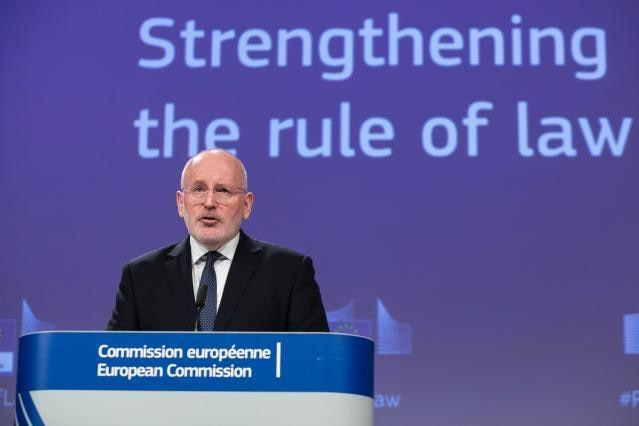
Vilnius: The European Commission’s defence agenda is converging, slowly but visibly, around the geography that has always made the bloc nervous. Speaking at an Eastern Flank security forum in mid-May, Defence Commissioner Andrius Kubilius framed the next phase of the EU’s defence build-up as a question less of ambition than of execution, pointing to the approval of eight national investment plans drawing on the €150 billion loan envelope agreed earlier in the year. Belgium, Bulgaria, Denmark, Spain, Croatia, Cyprus, Portugal and Romania now have green-lit programmes worth roughly €38 billion between them — enough, on paper, to reshape procurement pipelines that have spent two decades atrophying.
The political logic is straightforward. Member states want predictable spending, defence primes want long-cycle contracts, and the Commission wants something that looks more like a single market for armoured vehicles, drones and air-defence systems than the patchwork that European armies have lived with since the end of the Cold War. The €150 billion SAFE instrument is meant to subsidise exactly that convergence by lowering the cost of cross-border joint procurement. What Kubilius’s appearance underscored is how heavily early uptake skews toward states with either direct exposure to Russia or significant industrial slack to absorb.
Layered on top of SAFE is the European Defence Fund’s 2026 work programme, adopted late last year, which ring-fences €1 billion for collaborative research and development. The European Defence Industry Programme adds another €1.5 billion across 2026 and 2027, with €300 million earmarked for the Ukraine Support Instrument. None of these figures alone rivals what NATO’s larger members spend annually on their own armed forces. Their importance lies in the rules they encode: priority for consortia spanning multiple member states, preference for European-made components, and a slow nudge away from the off-the-shelf American purchases that have dominated post-2022 capability rebuilds.
Critics in the European Parliament have asked whether the new spending will produce strategic depth or simply distribute money along familiar industrial lines. The answer probably depends on whether Eastern members continue to set the tempo. Vilnius, Warsaw and Bucharest have been willing to commit faster, and to specify what they want in concrete categories — counter-drone kit, long-range fires, layered air defence — rather than abstract capability targets. That specificity is what gives industry the visibility it needs to invest in new lines.
There are caveats. SAFE loans must still be repaid; the political consensus around defence spending could fray once interest payments begin to compete with social budgets. Germany’s absence from the first wave of approved plans is conspicuous, even if Berlin’s own Sondervermögen continues to plough ahead independently. France remains uneasy about any framework that dilutes its national champions. And the Commission’s appetite for further common borrowing — whether for a follow-on defence vehicle or for the wider competitiveness package — is untested in the new political cycle.
Still, the trajectory has shifted. A bloc that spent decades treating defence as residual is now writing multi-year programmes, codifying procurement preferences, and putting hard numbers behind a phrase — defence union — that until recently was mostly rhetorical. The Eastern flank is where the rhetoric is being tested first.