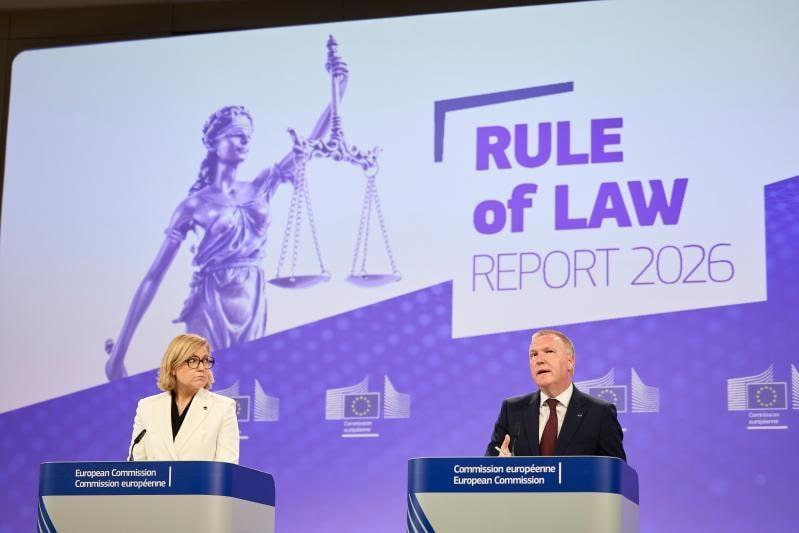
Seven annual editions in, the exercise has produced a number that its authors treat as progress and its critics treat as an indictment. The Commission’s law report on the rule of law, published on 17 July 2026, found that member states had followed up 47 percent of the recommendations issued a year earlier, either fully or partially, with at least limited progress on a further 23 percent.
Read one way, that means roughly seven in ten recommendations moved. Read another, it means a majority were not completed, and the instrument has no mechanism to make them so. Both readings are accurate, which is the central awkwardness of the whole cycle.
The report covers all twenty-seven member states and, since the format widened, four candidate countries: Albania, Montenegro, North Macedonia and Serbia. It assesses each against four pillars, namely the justice system, the anti-corruption framework, media pluralism, and the institutional checks and balances that sit around them. Country chapters and the accompanying communication are collected on the Commission’s publications portal.
Extending the same grid to candidate countries was a quiet structural change with real consequences. Enlargement negotiations already run through fundamentals chapters that examine judicial independence and corruption, and applying the internal methodology to applicants means Belgrade and Tirana now answer the same questionnaire as Warsaw and Madrid. That removes an old rhetorical defence, namely that candidates face standards the existing membership never met.
The recommendations themselves bind nobody. They carry no deadline, no penalty and no automatic escalation, and the Commission has repeatedly declined to link non-compliance to the budget conditionality regulation, which requires a demonstrable risk to the Union’s financial interests rather than a general democratic backslide. Article 7 proceedings sit even further away, requiring a political appetite in the Council that has never quite materialised.
Press freedom organisations made that criticism before the report even landed. The European Federation of Journalists argued in June that the annual cycle had settled into a box-ticking exercise, cataloguing problems that member states then decline to fix. The complaint is not that the diagnosis is wrong. It is that a diagnosis repeated seven times without a prescription starts to look like an alibi.
The defence is more persuasive than it first appears. Naming a problem in an official document creates a citable reference for domestic litigants, opposition parties, national bar associations and journalists who need something more authoritative than their own assertion. Several judicial reforms across central Europe moved after their absence was recorded in successive editions, and Balkan Insight’s reading of this year’s chapters described marked but uneven improvement across the region. Soft instruments work slowly and mostly through third parties, which makes their effects hard to attribute and easy to dismiss.
The harder question concerns what happens when a government simply waits. A capital that ignores a recommendation faces a paragraph noting that it ignored the recommendation. Repeat that across an electoral term and the report documents its own irrelevance in that country while continuing to shape behaviour in the twenty-six others, which may be the most honest description of what the instrument actually does.
Next year’s edition will land in the middle of budget negotiations for the post-2027 framework, and several member states have argued for tighter links between the annual findings and the money that flows from Brussels institutions. Whether that link ever gets drafted is a question for finance ministers rather than justice commissioners, and it will decide whether the eighth report reads as an assessment or as an audit.