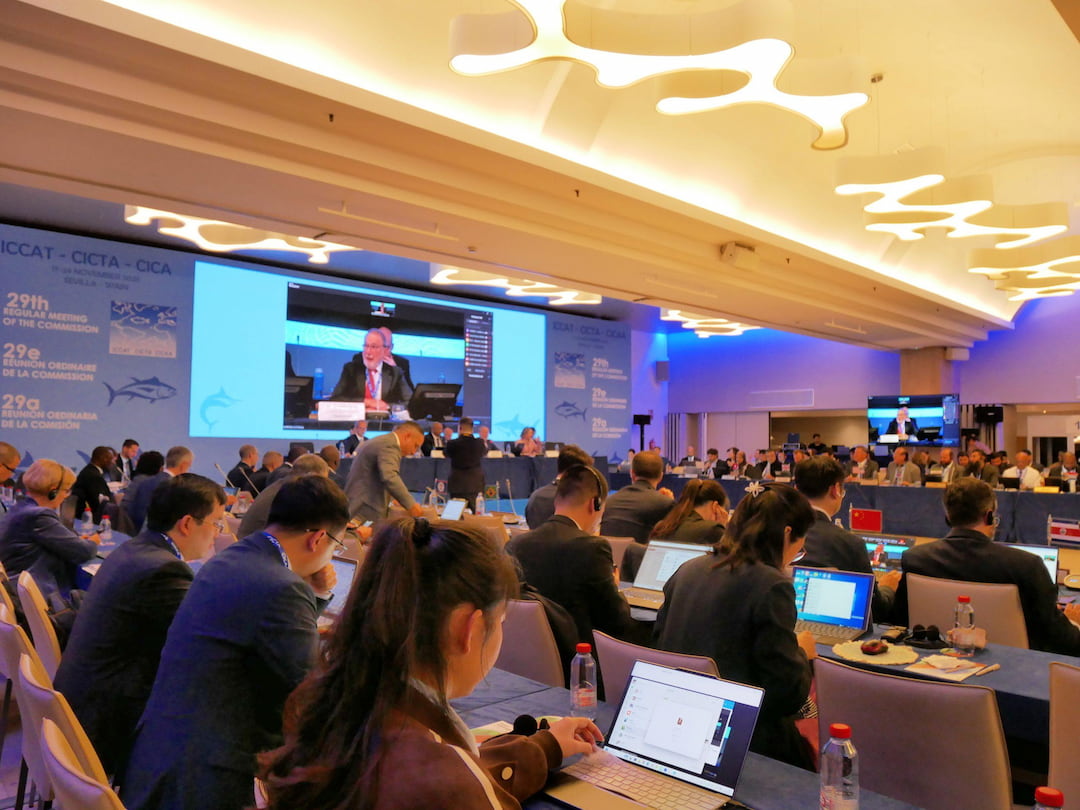
Brussels: EU fisheries ministers will prepare the ground for the EU position at the ICCAT annual meeting when they gather for the Agriculture and Fisheries Council on 26 and 27 October 2026. The Council forward look for 19 October to 1 November 2026 lists the tuna item alongside political talks on Baltic Sea fishing opportunities for 2027.
The International Commission for the Conservation of Atlantic Tunas sets catch limits for tuna and tuna-like species across the Atlantic and adjacent seas. The EU negotiates as a single bloc, so the ministers’ guidance shapes what the Commission can accept when delegations bargain late into the final night. Capitals with large tuna fleets, notably in the Mediterranean, follow the preparation closely.
Last year’s result gives the ministers a benchmark. At the November 2025 session, which ran from 17 to 24 November, negotiators agreed a three-year total allowable catch for bluefin tuna of 48,403 tonnes per year, as the Commission summary of the 2025 ICCAT outcome explains. The EU share of Eastern Atlantic and Mediterranean bluefin rose by 3,661 tonnes to 25,164 tonnes per year, an increase of 17%.
The Commission presented that outcome as proof that the 2007 multiannual recovery plan worked. At the next ICCAT annual meeting, Brussels will want to defend the gain, because bluefin quotas decide the income of coastal fleets and the supply of local ports. Any ministerial signal on sustainability limits will therefore carry weight in the next round.
Not every EU proposal succeeded in 2025. ICCAT rejected the EU request to raise the bigeye tuna allowable catch to match scientific advice, even though the bloc argued the science supported the move. Delegates did agree to cut catches of southern shortfin mako sharks after an EU proposal aimed at faster recovery of the species.
Yellowfin tuna now looms at the ICCAT annual meeting as the next hard dossier. ICCAT agreed to start a process to discuss how the yellowfin allowable catch is allocated, because members have been overshooting current limits. That process could pit distant-water fleets against coastal states, and the EU must decide how far to push for stricter discipline.
Ministers on 26 and 27 October will not fix numbers, but they will signal priorities for bluefin, bigeye, yellowfin and shark conservation. The Commission can then enter the ICCAT annual meeting with a mandate that reflects both stock science and the economic pressure on Mediterranean and Atlantic fleets. Fishers, scientists and campaigners will compare that mandate against the final deal once the meeting closes.
The outcome of the ICCAT annual meeting will matter well beyond the tuna trade. A strong EU performance would reinforce the argument that science-based management delivers results, while a weaker one would hand ammunition to critics of the common fisheries approach. The ministers’ preparation next week is the first test of which story Brussels expects to tell.