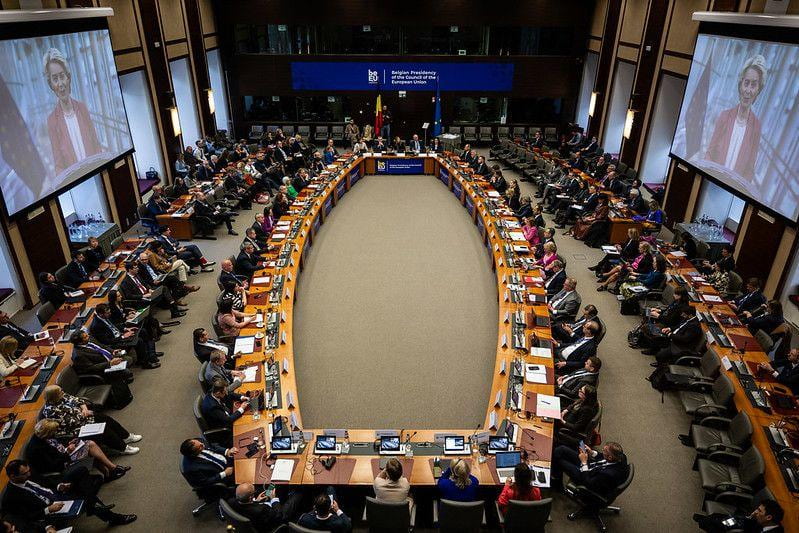
Brussels: The European Union’s single market repair job now runs on a countdown, and the countdown ends in 2027. Parliament, Council and Commission signed a joint roadmap on 24 April 2026 committing all three to dismantle the bloc’s worst internal trade barriers before the current mandate runs out.
The document, branded One Europe, One Market, lists 42 actions across five pillars. Negotiators grouped them under regulatory simplification, deeper market integration, trade policy, cheaper energy, and faster digital and artificial intelligence adoption. Leaders launched the agenda at the March 2026 European Council and told officials to deliver where possible during 2026 and everywhere else by the end of 2027.
Inside that package sits the sharper deadline. The institutions singled out the ten most damaging obstacles, which Brussels has taken to calling the terrible ten, and promised concrete progress on them by March 2027 at the latest. They cover services, digital activity, capital markets, energy and cross-border company operations, which is to say the areas where the single market has failed for thirty years.
Ursula von der Leyen first floated a single market roadmap to 2028 in September 2025. What arrived is tighter in time and looser in numbers. The Commission’s roadmap page sets out actions and dates but stops short of quantified targets for how much of a barrier each action removes.
That gap matters because the single market’s problems are measured in effective tariff equivalents, not in legislative counts. Economists routinely put the internal friction on services trade far above anything the bloc tolerates at its external border. Passing 42 files without moving that number would count as activity rather than progress.
Member states are the obstacle and the solution at once. Most of the terrible ten exist because national governments layer their own authorisation regimes, insurance requirements and labour formalities on top of European rules. The Commission can propose and litigate, but only capitals can repeal.
Business groups have pushed hardest on services and professional mobility, where a company operating in three countries still files three sets of paperwork. Energy and telecoms integration attracts the same complaint from a different direction, since fragmented national markets keep costs above what a continental market would deliver.
The Commission tracks the underlying picture in its 2026 Annual Single Market and Competitiveness Report, which feeds the roadmap’s monitoring. That reporting cycle becomes the honest test. If the 2027 edition describes the same barriers in the same language, the roadmap will have failed regardless of how many files cleared trilogue.
There is also a sequencing risk. Several roadmap actions depend on legislation nobody has tabled yet, and a proposal published in late 2026 has almost no chance of completing ordinary legislative procedure before end-2027. Officials know this, which is why the March 2027 checkpoint on the terrible ten carries more weight than the headline date.
Digital ambitions add another strand. The institutions committed to upgrading existing artificial intelligence factories into gigafactories from June 2026, tying industrial infrastructure to the single market agenda. Whether that belongs in a barrier-removal roadmap is debatable, and critics read it as a sign the package absorbed every competitiveness idea in circulation.
Supporters answer that breadth is the point. Previous single market strategies died quietly because nobody owned them. This one carries signatures from all three institutions, a fixed expiry, and an annual report that will say plainly whether the barriers came down.