August 9, 2026
LATEST
New EU Gas Market Rules Take Effect With Consumer SafeguardsDeforestation Regulation Holds Its December Deadline Despite CutsDigital Omnibus Delays Europe’s High-Risk AI Deadline to 2027Europe’s Schools Confront a Widening Basic Skills GapRule of Law Report Finds Progress but Trust Still LagsIRIS2 Gains 66 Satellites as Brussels Signs the Rollout DealNature Restoration Plans Come Due as Member States Race a DeadlineECB Rates Hold at 2.25 Percent as Frankfurt Waits on the DataEU Budget Talks Turn to Cohesion as Ireland Takes OverWildfire Response Stretches Europe’s Emergency Fleet ThinCan Europe’s Quantum Plan Match Its Big Ambitions?Armenia Edges West as Moscow’s Grip Slips AwayEurope Inherits the World’s Aid Bill It Cannot Fully PayAir Passenger Rights Get Their First Overhaul in Two DecadesErasmus Opens a 5 Billion Euro Round for Skills and MobilityCeuta Crisis Pushes the EU Toward Faster Migrant ReturnsBulky Parcels Face a Packaging Crackdown From August 12Can Europe Build Its Drone Wall Before 2030 Arrives?Indonesia’s Trade Deal With Europe Nears Its Final SignatureEurope Leans on Beijing to Keep Climate Talks Alive Before AntalyaNew EU Gas Market Rules Take Effect With Consumer SafeguardsDeforestation Regulation Holds Its December Deadline Despite CutsDigital Omnibus Delays Europe’s High-Risk AI Deadline to 2027Europe’s Schools Confront a Widening Basic Skills GapRule of Law Report Finds Progress but Trust Still LagsIRIS2 Gains 66 Satellites as Brussels Signs the Rollout DealNature Restoration Plans Come Due as Member States Race a DeadlineECB Rates Hold at 2.25 Percent as Frankfurt Waits on the DataEU Budget Talks Turn to Cohesion as Ireland Takes OverWildfire Response Stretches Europe’s Emergency Fleet ThinCan Europe’s Quantum Plan Match Its Big Ambitions?Armenia Edges West as Moscow’s Grip Slips AwayEurope Inherits the World’s Aid Bill It Cannot Fully PayAir Passenger Rights Get Their First Overhaul in Two DecadesErasmus Opens a 5 Billion Euro Round for Skills and MobilityCeuta Crisis Pushes the EU Toward Faster Migrant ReturnsBulky Parcels Face a Packaging Crackdown From August 12Can Europe Build Its Drone Wall Before 2030 Arrives?Indonesia’s Trade Deal With Europe Nears Its Final SignatureEurope Leans on Beijing to Keep Climate Talks Alive Before Antalya
August 9, 2026
LATEST
New EU Gas Market Rules Take Effect With Consumer SafeguardsDeforestation Regulation Holds Its December Deadline Despite CutsDigital Omnibus Delays Europe’s High-Risk AI Deadline to 2027Europe’s Schools Confront a Widening Basic Skills GapRule of Law Report Finds Progress but Trust Still LagsIRIS2 Gains 66 Satellites as Brussels Signs the Rollout DealNature Restoration Plans Come Due as Member States Race a DeadlineECB Rates Hold at 2.25 Percent as Frankfurt Waits on the DataEU Budget Talks Turn to Cohesion as Ireland Takes OverWildfire Response Stretches Europe’s Emergency Fleet ThinCan Europe’s Quantum Plan Match Its Big Ambitions?Armenia Edges West as Moscow’s Grip Slips AwayEurope Inherits the World’s Aid Bill It Cannot Fully PayAir Passenger Rights Get Their First Overhaul in Two DecadesErasmus Opens a 5 Billion Euro Round for Skills and MobilityCeuta Crisis Pushes the EU Toward Faster Migrant ReturnsBulky Parcels Face a Packaging Crackdown From August 12Can Europe Build Its Drone Wall Before 2030 Arrives?Indonesia’s Trade Deal With Europe Nears Its Final SignatureEurope Leans on Beijing to Keep Climate Talks Alive Before AntalyaNew EU Gas Market Rules Take Effect With Consumer SafeguardsDeforestation Regulation Holds Its December Deadline Despite CutsDigital Omnibus Delays Europe’s High-Risk AI Deadline to 2027Europe’s Schools Confront a Widening Basic Skills GapRule of Law Report Finds Progress but Trust Still LagsIRIS2 Gains 66 Satellites as Brussels Signs the Rollout DealNature Restoration Plans Come Due as Member States Race a DeadlineECB Rates Hold at 2.25 Percent as Frankfurt Waits on the DataEU Budget Talks Turn to Cohesion as Ireland Takes OverWildfire Response Stretches Europe’s Emergency Fleet ThinCan Europe’s Quantum Plan Match Its Big Ambitions?Armenia Edges West as Moscow’s Grip Slips AwayEurope Inherits the World’s Aid Bill It Cannot Fully PayAir Passenger Rights Get Their First Overhaul in Two DecadesErasmus Opens a 5 Billion Euro Round for Skills and MobilityCeuta Crisis Pushes the EU Toward Faster Migrant ReturnsBulky Parcels Face a Packaging Crackdown From August 12Can Europe Build Its Drone Wall Before 2030 Arrives?Indonesia’s Trade Deal With Europe Nears Its Final SignatureEurope Leans on Beijing to Keep Climate Talks Alive Before Antalya

Behind Europe’s India Pact Lies a Quiet Bet Against Beijing

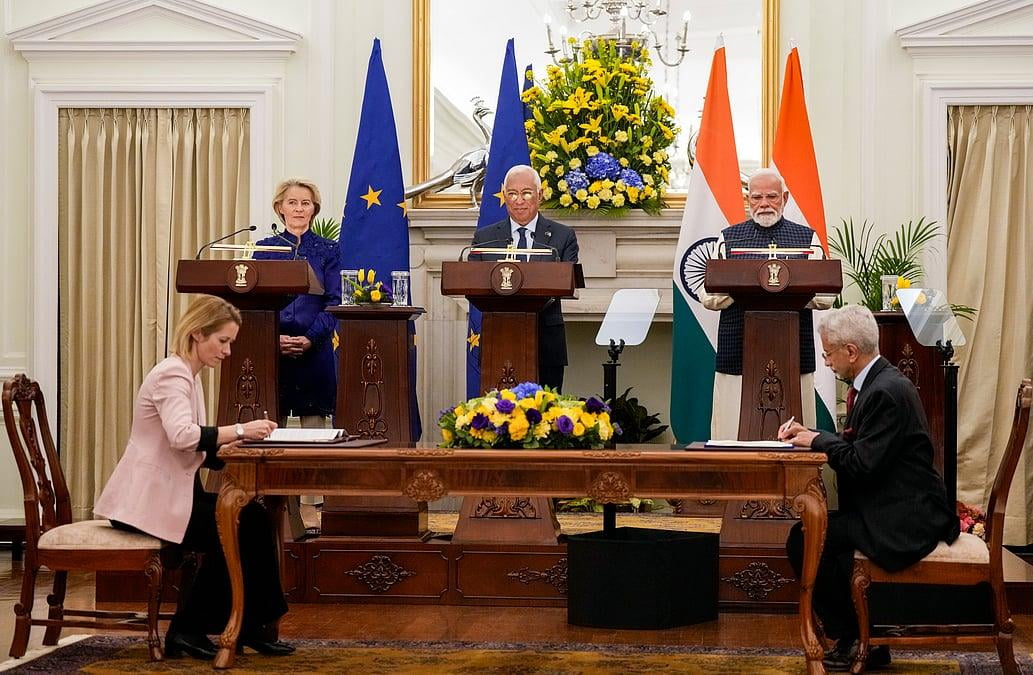
New Delhi: When the European Union and India concluded their free trade agreement in January 2026, both sides reached for superlatives, calling it the largest deal either had ever struck and the mother of all trade agreements. The tariff schedules matter, but they are not the reason two partners who circled each other for nearly two decades suddenly found the will to close. The real driver is geopolitical, and it is spelled out most clearly in the clauses that have nothing to do with tariffs.

Alongside the commercial text sit a security and defence partnership and a mobility and migration agreement. The first commits the two to cooperate on maritime security, counterterrorism, cyberdefence and, tellingly, defence procurement. The second opens legal pathways for Indian students and skilled workers into a Europe facing a demographic squeeze. Neither belongs in a conventional trade deal. Together they describe something closer to a strategic alignment, dressed for the occasion in the language of commerce.

The context is impossible to miss. Europe spent the past three years learning how dangerous it is to depend on a single supplier, whether for Russian gas or Chinese processed minerals and manufactured goods. India offers a hedge: a market of 1.4 billion people, a manufacturing base courting the firms leaving China, and a government that shares few of Brussels’ values but a good deal of its unease about Beijing’s reach across the Indian Ocean. For New Delhi, the calculation is mirror-image. Access to European capital and technology, and a partner that is not Washington, helps it diversify away from an American relationship that has grown erratic.

None of this makes the partnership easy. India guards its policy autonomy fiercely, has refused to join Western sanctions on Russia, and continues to buy discounted Russian crude at scale. European negotiators who hoped the deal would pull Delhi closer to their line on Ukraine will be disappointed; India’s foreign policy is transactional by design and unapologetic about it. The mobility chapter, meanwhile, will collide with the same anti-immigration politics that is reshaping elections across the continent. A promise of more Indian workers is easy to sign in a summit hall and hard to defend in a national campaign.

Yet the direction of travel is clear enough. Brussels has quietly concluded that its twenty-first-century security cannot be built in Europe alone, and that the Indo-Pacific is where the balance of the century will be set. Binding India into European supply chains, defence industries and mobility schemes is a way of buying influence in a region where the Union has little hard power to project. It is diplomacy by economic entanglement, the only kind Brussels does well.

Whether the bet pays off depends on execution, and on ratification, which will test the patience of twenty-seven parliaments. But the ambition marks a shift worth naming. For years Europe treated India as a difficult market and a reluctant partner. It now treats Delhi as indispensable. The word that goes unspoken in every communique, the reason the deal finally closed, is China.