Astana: For three decades the shortest commercial answer to the question of how goods move between China and Europe ran straight through Russia. The war in Ukraine made that answer politically toxic, and a corridor that planners had long sketched on maps but rarely funded suddenly became Europe’s most serious bet on an alternative. The Trans-Caspian route, the so-called Middle Corridor, threads cargo across Kazakhstan, over the Caspian Sea, through Azerbaijan and Georgia and onward to European markets, and it is now absorbing real money rather than rhetoric.
The momentum is measurable. Freight volumes along the corridor have quadrupled since 2022, and the European institutions backing it believe the traffic could triple again before 2030 if the infrastructure keeps pace. At its best the route delivers cargo in under fifteen days, competitive with the northern path and free of the sanctions risk that now shadows anything touching Russian territory. A high-level meeting of corridor states scheduled for late June is meant to convert that interest into committed eastbound volume, the flow of European goods heading the other way that would make the route commercially whole rather than a one-directional escape valve.
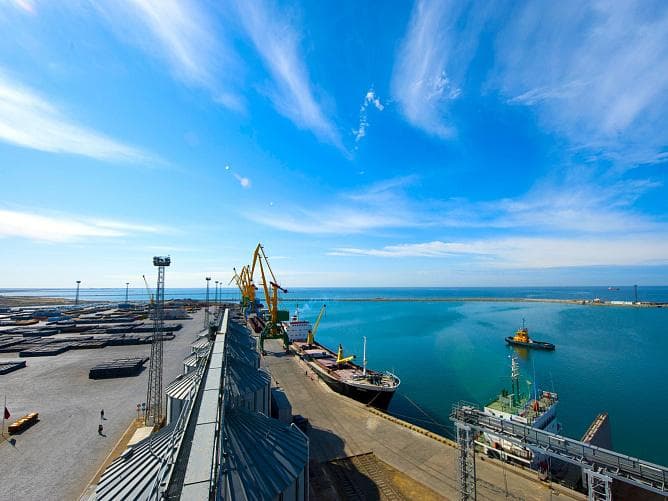
Brussels has moved from study to spending. The European Union is contributing just over ten million euros within a larger development-bank loan to modernise Kazakhstan’s Aktau port on the Caspian, adding berths, energy-efficient cranes and container capacity at a chokepoint that has long throttled throughput. A separate investment bank loan of a hundred and fifty million euros, underwritten by an EU guarantee, will rehabilitate the Kazakh roads that feed the corridor. A trans-Caspian fibre-optic cable between Azerbaijan and Kazakhstan is meant to digitise the paperwork that slows physical cargo. These are unglamorous projects, and that is precisely the point, because corridors fail at the berth and the border crossing rather than on the strategy paper.
The strategic logic is plain enough that even sceptics concede it. A functioning Middle Corridor reduces Europe’s dependence on Russian transit and, more subtly, on Chinese-controlled logistics, giving the continent a route it part-owns and part-governs. It pulls Central Asian states, long treated as Moscow’s backyard, into a westward orbit at the very moment those governments are looking to diversify their own dependencies. For Kazakhstan and its neighbours the corridor is leverage, a way to be courted by several great powers at once rather than captured by one.
Yet the obstacles are stubborn and well documented. Governance along the route is uneven, infrastructure gaps persist at almost every link, and the Caspian itself is shrinking as the climate warms, raising hard questions about the depth its ports will hold in a decade. Georgia, a critical western terminus, has slashed funding for its planned deep-water port at Anaklia even as existing capacity nears exhaustion, a reminder that political drift in any single transit state can throttle the whole chain. The corridor is only as strong as its weakest crossing, and there are many crossings.
The honest verdict is that the Middle Corridor is no longer a fantasy and not yet a guarantee. It will not replace the sea lanes that carry the bulk of Eurasian trade, and it cannot match Russia’s northern route on raw capacity. What it offers Europe is optionality, a hedge worth buying precisely because the alternatives have become unreliable. Whether the investments now flowing translate into the eastbound volumes the route needs will be decided not in the summits but in the ports, where European ambition meets the unforgiving logistics of moving a container from a rail car onto a ship and across a thinning sea.