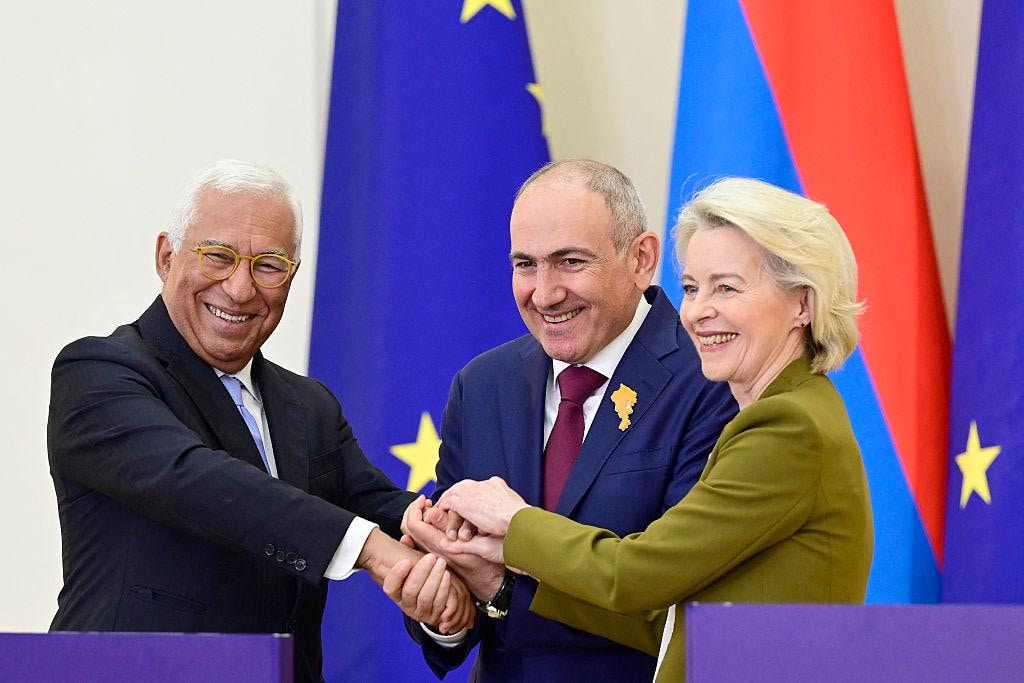
Chișinău: When António Costa and Ursula von der Leyen sat down with Maia Sandu in Brussels on 22 June, the choreography was familiar: a joint declaration, warm language about a shared European future, and a fresh envelope of money. Yet beneath the ceremony, the second EU-Moldova summit marked something more consequential than its modest billing suggested. For the first time, the Union treated a country of fewer than three million people as a genuine security partner on its eastern flank rather than a recipient to be managed at arm’s length.
The numbers tell part of the story. The Moldova Growth Plan now commits up to €1.9 billion between 2025 and 2027, of which €504 million has already been released. Brussels added an €11 million package against hybrid attacks, €17 million for border infrastructure, and signalled a further €120 million tied specifically to Moldova’s security needs this year. Stripped of the bureaucratic packaging, this is the EU paying to harden a state that sits directly in Russia’s line of fire.
What makes Moldova different from the usual candidate is how exposed it is. The country opened negotiations on the ‘fundamentals’ cluster on 15 June, the technical heart of accession, but the more telling shift has been in energy. Four years ago Chișinău bought its gas exclusively from Russia; today it does not, a break no Moldovan government had dared make in three decades. That single decision did more to blunt Moscow’s leverage than any communiqué, and it explains why the Kremlin has poured resources into disinformation, financed proxies, and tried to buy elections outright.
Here lies the uncomfortable question the summit did not answer. Money and market access are necessary, but they are not a security guarantee. Moldova is not a NATO member, its breakaway Transnistria region still hosts Russian troops, and membership remains years away even on an optimistic timetable. The Union has learned, painfully, in Ukraine that economic integration without hard deterrence can invite rather than deter aggression. The €120 million on offer buys resilience, not defence.
Defenders of the cautious approach argue that this is precisely the point. Overt military commitments would hand Moscow a propaganda gift and risk dragging the Union into a confrontation it is not ready to fight. Better, they say, to bind Moldova into European payment systems through the Single Euro Payments Area, mobile-roaming rules, and cultural programmes such as Creative Europe, knitting the country into the everyday fabric of the Union until membership becomes irreversible in practice before it is so in law. There is logic in that incrementalism; it is how Moldova quietly escaped its energy trap.
The risk is that gradualism moves slower than the threat. Sandu’s pro-European majority is real but not unshakable, and every delay gives Russian-backed forces another election cycle to exploit. The summit’s true test will not be the size of its cheques but whether Brussels can compress its own timelines, opening further negotiating clusters quickly and showing that the European project rewards the brave. Moldova took the hardest steps largely alone. Whether the Union matches that courage with speed, rather than ceremony, is the measure that matters now.