August 9, 2026
LATEST
Pension Savings Rules Get a Reset as the EU Scraps the 1% CapMedicine Shortages Move to the Heart of Europe’s Pharma ResetJapan Becomes Europe’s Closest Security Partner in AsiaCan Europe’s New Zealand Deal Anchor It in the Pacific?Chip Research Binds Europe and South Korea CloserMinimum Prices Replace Tariffs in Europe’s China Car DealBrussels and Beijing Keep Talking While the Trade Gap WidensKorean Weapons and EU Loans Now Bankroll Europe’s RearmamentNew EU Gas Market Rules Take Effect With Consumer SafeguardsDeforestation Regulation Holds Its December Deadline Despite CutsDigital Omnibus Delays Europe’s High-Risk AI Deadline to 2027Europe’s Schools Confront a Widening Basic Skills GapRule of Law Report Finds Progress but Trust Still LagsIRIS2 Gains 66 Satellites as Brussels Signs the Rollout DealNature Restoration Plans Come Due as Member States Race a DeadlineECB Rates Hold at 2.25 Percent as Frankfurt Waits on the DataEU Budget Talks Turn to Cohesion as Ireland Takes OverWildfire Response Stretches Europe’s Emergency Fleet ThinCan Europe’s Quantum Plan Match Its Big Ambitions?Armenia Edges West as Moscow’s Grip Slips AwayPension Savings Rules Get a Reset as the EU Scraps the 1% CapMedicine Shortages Move to the Heart of Europe’s Pharma ResetJapan Becomes Europe’s Closest Security Partner in AsiaCan Europe’s New Zealand Deal Anchor It in the Pacific?Chip Research Binds Europe and South Korea CloserMinimum Prices Replace Tariffs in Europe’s China Car DealBrussels and Beijing Keep Talking While the Trade Gap WidensKorean Weapons and EU Loans Now Bankroll Europe’s RearmamentNew EU Gas Market Rules Take Effect With Consumer SafeguardsDeforestation Regulation Holds Its December Deadline Despite CutsDigital Omnibus Delays Europe’s High-Risk AI Deadline to 2027Europe’s Schools Confront a Widening Basic Skills GapRule of Law Report Finds Progress but Trust Still LagsIRIS2 Gains 66 Satellites as Brussels Signs the Rollout DealNature Restoration Plans Come Due as Member States Race a DeadlineECB Rates Hold at 2.25 Percent as Frankfurt Waits on the DataEU Budget Talks Turn to Cohesion as Ireland Takes OverWildfire Response Stretches Europe’s Emergency Fleet ThinCan Europe’s Quantum Plan Match Its Big Ambitions?Armenia Edges West as Moscow’s Grip Slips Away
August 9, 2026
LATEST
Pension Savings Rules Get a Reset as the EU Scraps the 1% CapMedicine Shortages Move to the Heart of Europe’s Pharma ResetJapan Becomes Europe’s Closest Security Partner in AsiaCan Europe’s New Zealand Deal Anchor It in the Pacific?Chip Research Binds Europe and South Korea CloserMinimum Prices Replace Tariffs in Europe’s China Car DealBrussels and Beijing Keep Talking While the Trade Gap WidensKorean Weapons and EU Loans Now Bankroll Europe’s RearmamentNew EU Gas Market Rules Take Effect With Consumer SafeguardsDeforestation Regulation Holds Its December Deadline Despite CutsDigital Omnibus Delays Europe’s High-Risk AI Deadline to 2027Europe’s Schools Confront a Widening Basic Skills GapRule of Law Report Finds Progress but Trust Still LagsIRIS2 Gains 66 Satellites as Brussels Signs the Rollout DealNature Restoration Plans Come Due as Member States Race a DeadlineECB Rates Hold at 2.25 Percent as Frankfurt Waits on the DataEU Budget Talks Turn to Cohesion as Ireland Takes OverWildfire Response Stretches Europe’s Emergency Fleet ThinCan Europe’s Quantum Plan Match Its Big Ambitions?Armenia Edges West as Moscow’s Grip Slips AwayPension Savings Rules Get a Reset as the EU Scraps the 1% CapMedicine Shortages Move to the Heart of Europe’s Pharma ResetJapan Becomes Europe’s Closest Security Partner in AsiaCan Europe’s New Zealand Deal Anchor It in the Pacific?Chip Research Binds Europe and South Korea CloserMinimum Prices Replace Tariffs in Europe’s China Car DealBrussels and Beijing Keep Talking While the Trade Gap WidensKorean Weapons and EU Loans Now Bankroll Europe’s RearmamentNew EU Gas Market Rules Take Effect With Consumer SafeguardsDeforestation Regulation Holds Its December Deadline Despite CutsDigital Omnibus Delays Europe’s High-Risk AI Deadline to 2027Europe’s Schools Confront a Widening Basic Skills GapRule of Law Report Finds Progress but Trust Still LagsIRIS2 Gains 66 Satellites as Brussels Signs the Rollout DealNature Restoration Plans Come Due as Member States Race a DeadlineECB Rates Hold at 2.25 Percent as Frankfurt Waits on the DataEU Budget Talks Turn to Cohesion as Ireland Takes OverWildfire Response Stretches Europe’s Emergency Fleet ThinCan Europe’s Quantum Plan Match Its Big Ambitions?Armenia Edges West as Moscow’s Grip Slips Away

South Korea And Europe Quietly Turn A Defence Pact Into Action

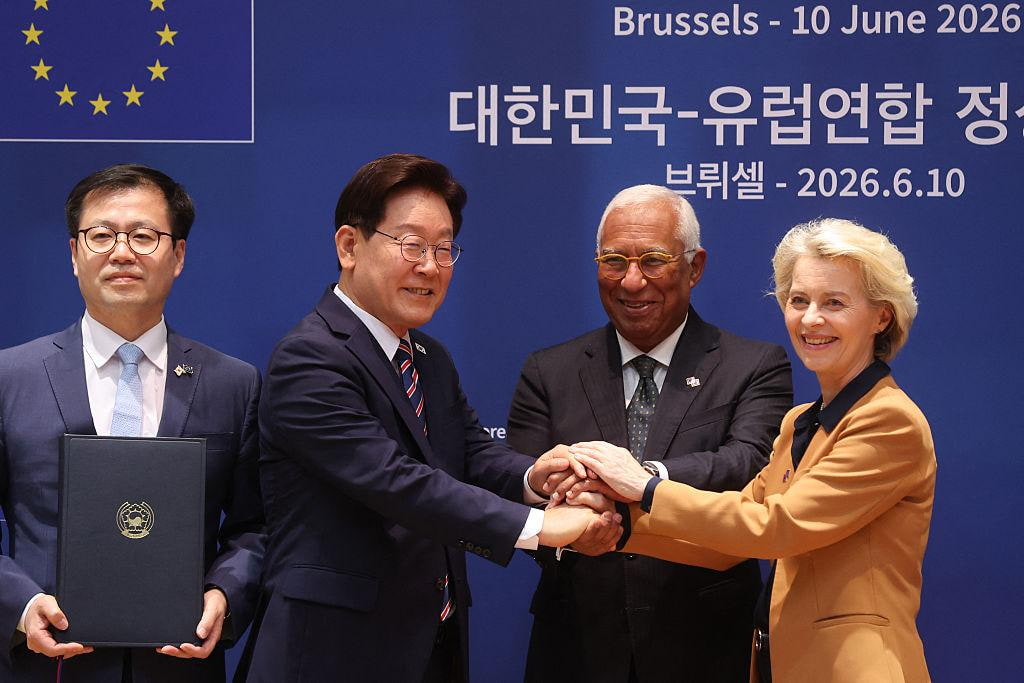
Seoul: When the second EU–Republic of Korea Security and Defence Dialogue wrapped up in the South Korean capital in May, it produced little of the drama that usually accompanies a summit. There were no troops, no basing rights, no headline arms order. Yet the quiet upgrade of that dialogue to managing-director level, confirmed again when leaders met in Brussels on 10 June, tells a more revealing story than any single contract would. Europe and one of Asia’s most capable middle powers are slowly converting a political declaration into working machinery.

The Security and Defence Partnership the two sides signed in November 2024 was, like most such documents, long on ambition and short on obligation. What has changed in eighteen months is the texture of the cooperation. The two governments have agreed to move towards negotiating a Security of Information Agreement, the unglamorous legal plumbing that allows classified material to be shared without leaking. Without it, talk of joint work on cyber defence, maritime security or space remains aspirational. With it, intelligence services and defence ministries can actually exchange the sensitive assessments that real coordination requires.

That focus on procedure rather than spectacle is deliberate, and it reflects how Brussels has learned to operate in the Indo-Pacific. The European Union is not a military alliance and cannot pretend to be one. It cannot offer Seoul a mutual-defence guarantee, and it has no intention of stationing forces in the region. What it can offer is a dense web of practical arrangements on the threats that increasingly bleed across continents: cyber intrusions, foreign information manipulation, sanctions evasion, and the maritime chokepoints through which European trade flows.

The logic runs in both directions, which is why the partnership has momentum. South Korea watches North Korean shells and missiles being tested in Ukraine and understands that European and Asian security are no longer separate files. Europe, in turn, has discovered that Seoul is not merely a diplomatic partner but an industrial one. Korean defence firms have become the suppliers of choice for European states rearming in a hurry, from Polish howitzers and tanks to the assembly facilities now rising on Romanian soil. The political partnership and the commercial reality are reinforcing each other, even if officials prefer to keep the two conversations in separate rooms.

There are limits worth naming. The European Union speaks for twenty-seven capitals that do not share an identical reading of China, and Seoul must manage a relationship with Beijing that is far more exposed than anything Brussels faces. Neither side wants the partnership read in Beijing as containment, and both have been careful to frame it around resilience rather than rivalry. That caution is sensible, but it also caps how far the cooperation can go. A Security of Information Agreement is a meaningful step; it is not an alliance.

What the past months demonstrate is a particular European theory of influence. Lacking hard power in Asia, the Union builds partnerships out of standards, information-sharing and industrial ties, and lets those accumulate into something durable. It is slower than a treaty and less satisfying than a summit photograph, but it is also harder to reverse. The test now is whether the information agreement actually gets negotiated rather than merely promised, and whether the next dialogue produces concrete joint exercises in cyber or maritime domains. If it does, the EU–Korea partnership will have quietly become one of the more functional relationships Brussels maintains east of Suez, precisely because it was never oversold.