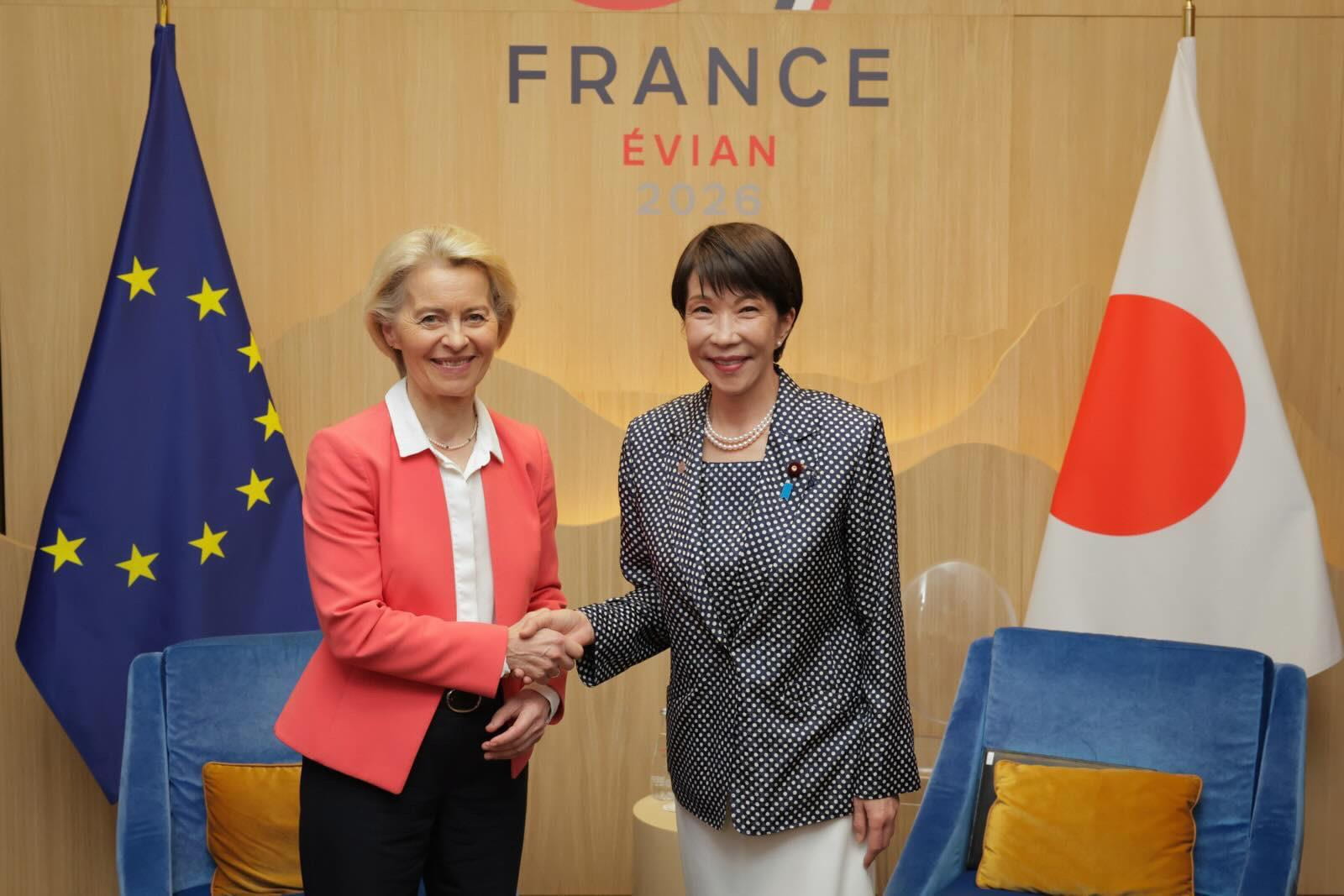
Tokyo: EU-Japan economic security cooperation now carries both ambition and friction, as the June 2026 meeting between Prime Minister Sanae Takaichi and Commission President Ursula von der Leyen made clear. The two leaders met for about twenty minutes on the sidelines of the G7 summit in Évian, France, and covered supply chains, trade, defence industry cooperation and research.
Takaichi proposed closer work on advanced technology and on making supply chains for essential goods, including critical minerals, more resilient. Von der Leyen described Japan as a dependable partner. That exchange shows why EU-Japan economic security has become a priority for both capitals: each depends on China for key inputs, and each wants to reduce that exposure without closing its own market.
The conversation was not entirely comfortable. According to the Japanese summary, Takaichi raised concerns about European tariffs on Japanese steel products and about the Industrial Accelerator Act, and she asked Brussels to respond appropriately. Von der Leyen answered that Chinese overcapacity is the root cause of the problem and promised to keep sharing information about the measures. The exchange illustrates a recurring tension, because defensive tools designed against one country can catch allies.
Research cooperation offers a more positive track for EU-Japan economic security. The two sides noted an agreement in principle on Japan’s participation in Horizon Europe, the Union’s research funding framework, and Takaichi said she wants to sign it as soon as possible. Association would give Japanese researchers access to European programmes and give European teams a closer link to Japanese laboratories in fields such as quantum technology and semiconductors.
Defence industry cooperation also featured in the EU-Japan economic security agenda. Japan and the Union already run a security and defence partnership, and both want their arms industries to cooperate more closely as Russia’s war against Ukraine continues. The leaders exchanged views on Ukraine, on the Indo-Pacific including China, and on North Korea’s nuclear and missile programmes and the abductions issue.
No new agreement was signed, and the Japanese readout mentions no new summit date. That restraint is a reminder that the partnership works mainly through practical coordination rather than headline treaties. The Economic Partnership Agreement already removes most tariffs, so the next gains depend on regulation, standards and shared screening of investment and exports.
For EU-Japan economic security, the lesson is that allies need advance notice when trade defence measures evolve. Consultation before decisions, not explanations afterwards, would reduce irritation. If both sides sign the Horizon Europe association and coordinate on critical minerals, EU-Japan economic security could become a model for how like-minded partners manage shared risks.