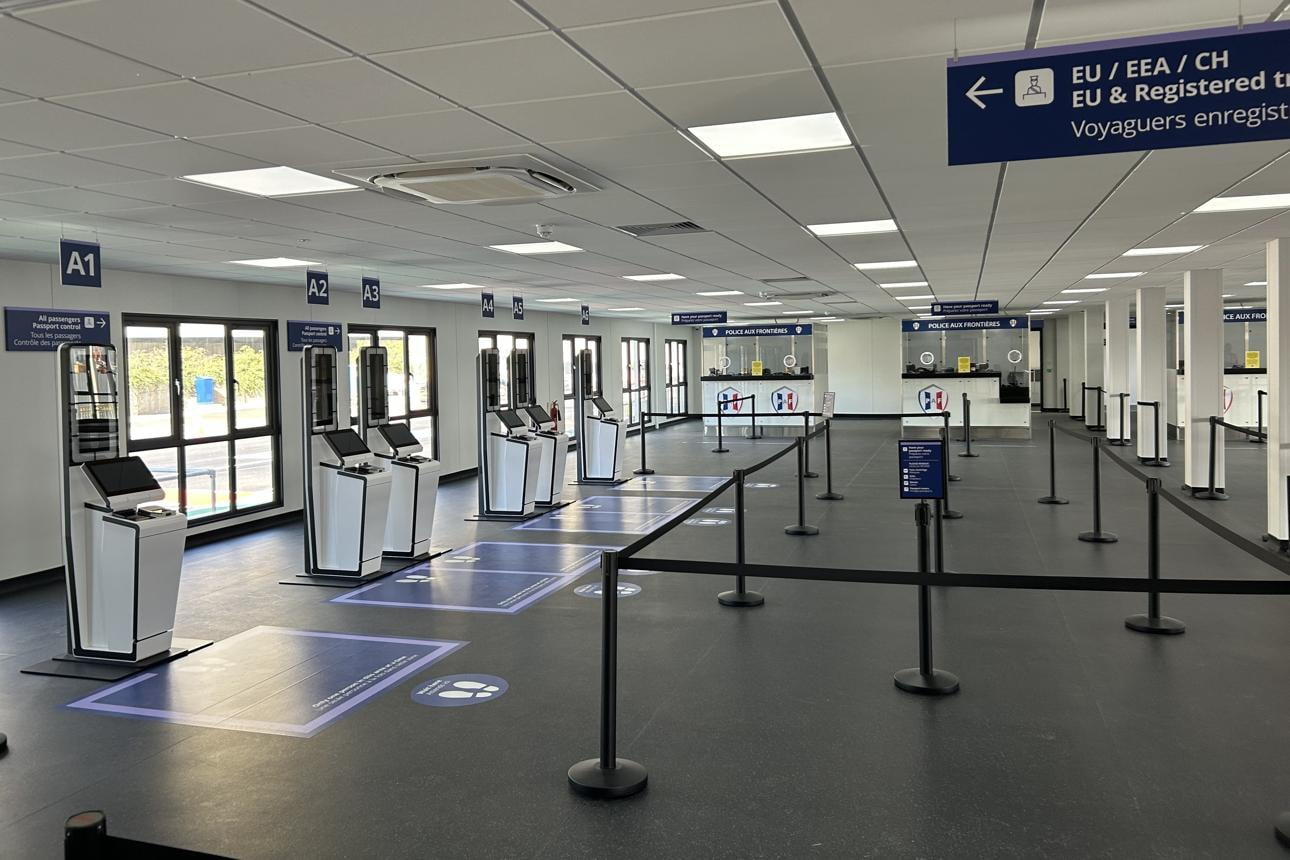
Dover: The French police booths inside the port of Dover are a good place to watch European law meet European staffing levels, because for the past fortnight the two have not agreed. Since 6 September 2026 the Entry/Exit System has been required to run in full at every external Schengen crossing, without the congestion escape hatch that had covered the first months of operation. At Dover, and at a long list of other crossings, it has not.
The escape hatch was never meant to last. Regulation (EU) 2025/1534, adopted in July 2025, allowed the system to be introduced in stages rather than switched on everywhere at once, and it attached a set of dates to that indulgence. Article 7(3) let a national authority suspend biometric registration at an individual crossing point for up to six hours where exceptional traffic produced excessive waiting times. Article 7(4) added sixty automatic days where fewer than four in five of the files created during the phased period actually contained biometric data. Article 8(2)(c) set the outer limit at 330 days after operations began. Operations began on 12 October 2025. The arithmetic ran out on 6 September.
What remains is a regulation with no soft edges. The Entry/Exit System itself rests on Regulation (EU) 2017/2226, which records entries, exits and refusals for third-country nationals on short stays, captures facial images and, for the visa-exempt, fingerprints, and replaces the passport stamp with an electronic file. Regulations bind in their entirety and apply directly. Yet reporting in mid-September, led by The Guardian on 14 September, identified nine participating states — France, Belgium, the Netherlands, Germany, Greece, Malta, Portugal, Italy and Switzerland — where biometric processing remains partial, restricted or absent at particular crossings.
The word “nationwide” is where most of the commentary goes wrong. Biometric capture is reportedly running at the Eurostar terminal in Brussels, at the port of Antwerp, at Frankfurt Airport and at Schiphol. The gaps are crossing-specific, and they concentrate where physical space, booth numbers and shift rosters were hardest to expand. Switzerland belongs in the list for a different reason: it is bound not through the treaty machinery that applies to member states but through its association with the development of the Schengen acquis, which produces the same obligation by a different route.
Two legal instruments survive for the genuinely difficult day, and they are narrower than the one that lapsed. Article 21 of the 2017 regulation covers technical impossibility: data go first to the national interface, then to local electronic storage, and only in the last resort to a manual record without biometrics, with a physical stamp in the passport. Article 9 of the Schengen Borders Code permits certain checks to be relaxed where exceptional and unforeseen traffic exhausts all available staff, facilities and organisation — but it does not suspend the obligation to enter the data. Congestion, understaffing and a broken server are three different things in law, and only one of them now excuses an incomplete file.
The Commission’s posture has been cooperative rather than punitive. Its midday briefing on 1 September acknowledged that some crossing points need further operational adjustment, offered technical help and pointed to possible Frontex support. It has not extended the expired articles, and it has not said that infringement proceedings are off the table. Discretion over whether to open, continue or close such a procedure sits with the Commission, and the Court of Justice confirmed in Tecno*37 in October 2024 that closing one establishes nothing about the legality of the conduct that prompted it.
For the traveller, the practical effect is procedural rather than substantive. A missing fingerprint does not extend the ninety days available in any hundred and eighty, and an incomplete registration creates no entitlement. It does create the possibility of an inaccurate record, which is why Article 52 gives third-country nationals a route to correction through any member state’s competent authority, with a forty-five-day deadline for a reply. Uneven borders produce uneven files. The right to fix them is the only part of this that has not been running late.