Noordwijk: The money arrived before the rulebook did. That, in one line, is the state of European space policy after a September that produced a large budget figure and no agreement on the regulation meant to govern what the money builds.
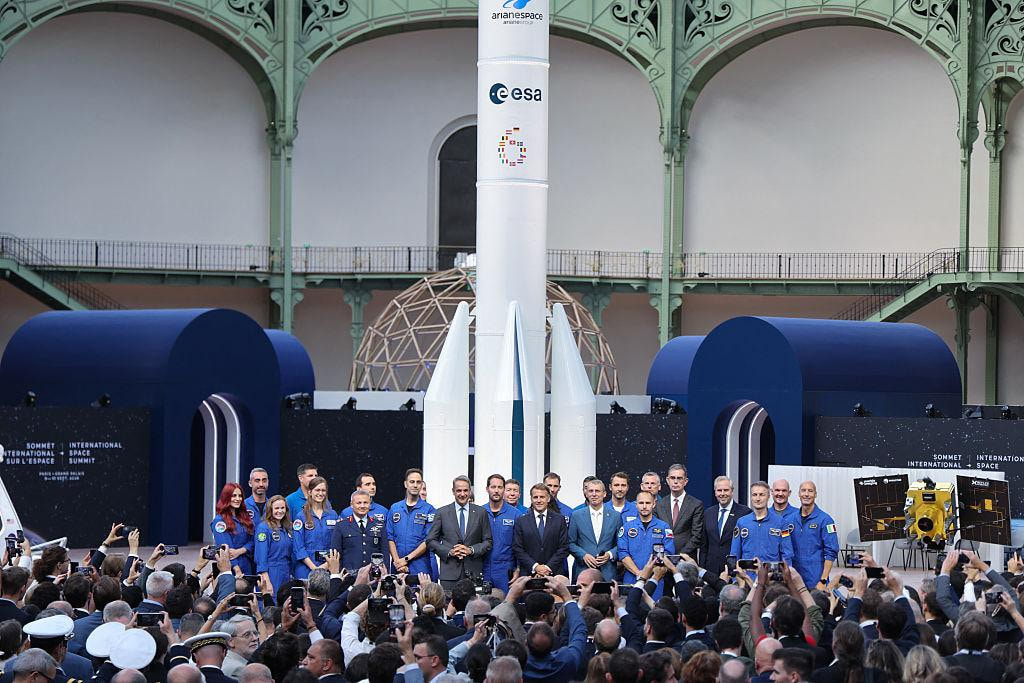
Speaking at the International Space Summit in Paris on 10 September, Commission President Ursula von der Leyen set out four priorities: reinforcing IRIS², building a competitive European space market, strengthening the space ecosystem, and reinforcing European space governance. Alongside Commissioner Andrius Kubilius she pointed to a proposed combined defence, security and space envelope of 131 billion euro for 2028 to 2034, described as roughly five times current EU-level funding, and to a European Space Shield among the capabilities it would support.
The framing was explicitly strategic. Security on Earth, she argued, increasingly depends on security in space, and the choices made now will shape Europe’s position there for decades. It is a diagnosis few in the sector dispute. Where opinion divides is on the instrument.
The EU Space Act, proposed as a regulation on the safety, resilience and sustainability of space activities, remains in the ordinary legislative procedure with both Parliament and Council. A Presidency compromise text circulated earlier this year was received as an improvement, reducing complexity and simplifying obligations, but member states recorded that several issues remain open and require further work. That formulation, in Council language, describes a file that is progressing and not close to done.
The persistent tension runs between the Act’s two purposes. One is to create a single regulatory environment replacing the patchwork of national space laws, so that an operator licensed in one member state is not navigating a different regime in the next. Every part of the sector supports that. The other is to impose common requirements on safety, debris mitigation and cybersecurity, which entails compliance obligations that fall unevenly. A large integrator absorbs them within existing quality systems. A twelve-person satellite start-up experiences them as a cost that arrives before the first revenue does.
The Commission’s answer is proportionality: a clear, transparent regulatory environment that avoids unnecessary burdens on European companies, particularly small and medium enterprises and start-ups. The principle is agreed. The thresholds are not, and thresholds are where a proportionality clause either works or becomes decorative.
A second unresolved question concerns who supervises. The proposal would give the EU Agency for the Space Programme a central role in administering a Union Register of Space Objects and in supporting compliance oversight, with the Commission authorising operators of Union-owned assets on the basis of the agency’s technical assessments. That is a substantial expansion of a body created principally to run service delivery for Galileo and EGNOS. The Commission has separately proposed a standalone founding act for the agency, which would put it on a permanent mandate rather than one rewritten at each seven-year budget cycle.
Both files therefore depend on each other. The Space Act assumes a regulator with capacity the agency does not yet have; the founding act builds that capacity for a supervisory role the Space Act has not yet finally defined. Neither is blocked by the other, and neither can be completed in isolation.
The budget envelope, meanwhile, is a proposal within a multiannual financial framework that member states have not adopted. Europe’s space sector ends September with a clearer picture of what Brussels intends and no more certainty than it had in August about the rules it will operate under, or the sum it will operate on.