Kaub: The 2026 weather extremes have turned critical infrastructure climate risk from a modelling exercise into a daily operating problem, according to Briefing 22/2026 from the European Environment Agency, published on 3 November. The agency reviews drought, heat and storm events this year and concludes that failures in one network quickly cascade into energy, transport, telecoms and water.
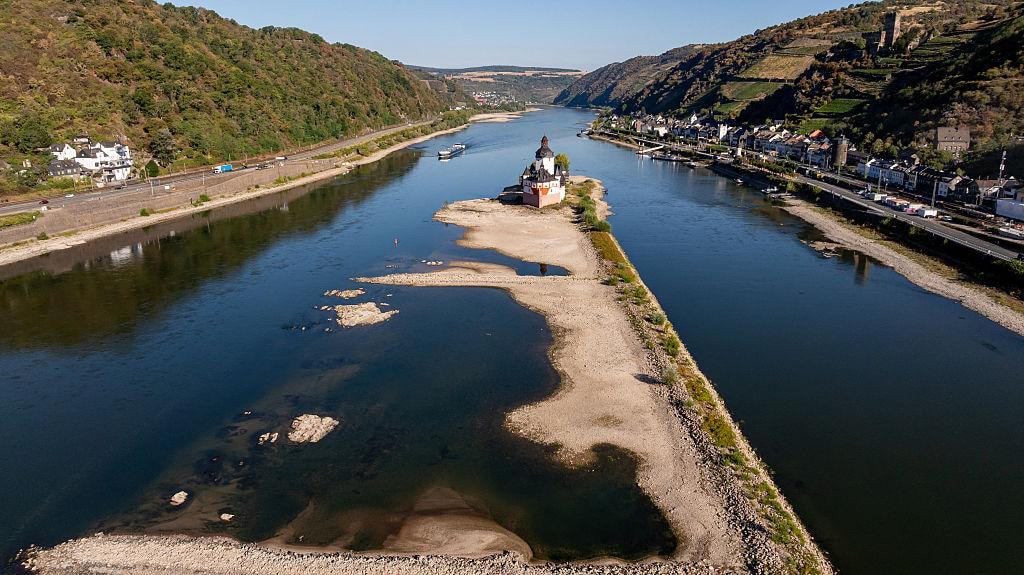
The Rhine offers the starkest case. At Kaub, the water level fell below 10 centimetres on 14 August 2026, well under the previous record of about 25 centimetres set in 2018. Barge freight from Rotterdam to Karlsruhe rose from about 45 euros per tonne to between 150 and 155 euros by 31 July, and replacing a single barge can take up to 150 trucks. Water levels this low turn critical infrastructure climate risk into a freight cost problem for manufacturers.
Drought reached far beyond the river. About half of EU and UK territory was affected by late July, and the Danube at Baziaș carried 1,650 cubic metres per second, roughly a third of the July average. Romania’s Cernavodă nuclear plant shut Unit 1 on 27 July and Unit 2 on 13 August, and Romania declared a state of emergency on 31 July. The briefing also records that peak power demand rose by up to 25 percent in some countries during heatwaves.
Storm Kristin tested the electricity grid in a different way. From 28 January 2026, winds of about 200 kilometres per hour hit Portugal, brought down 61 very high voltage pylons and cut 774 kilometres of lines, about 7 percent of the transmission grid. More than one million customers lost power. A Portuguese estimate cited by the EEA put total economic damage at 5.3 billion euros, and only 26 percent of it was insured. The Portuguese case shows that critical infrastructure climate risk also covers winter storms, not only summer drought.
The EEA puts the wider economic cost in context. It says the climate impact on EU GDP in 2026 was at least around 1 percent, and that energy accounts for about 23 percent, or roughly 2 billion euros a year, of drought-related losses based on Joint Research Centre estimates. Its reference scenario from the 2024 European Climate Risk Assessment expects annual damage to critical infrastructure to climb from 9.3 billion euros in the 2020s to 19.6 billion in the 2050s. Those numbers explain why critical infrastructure climate risk is now a budget question as well as an engineering one.
The agency’s message to governments is blunt. As the briefing puts it, resilience cannot be secured only by repairing damaged assets. It recommends planning for the future climate, systemic assessments across sectors, regular stress tests, cross-sector alternatives, better coordination and a mix of incremental and transformational adaptation.
For energy planners, the practical lesson is that critical infrastructure climate risk now sits inside every investment decision, from nuclear cooling water to grid design and inland shipping. The 2026 evidence shows that the cost of waiting is already visible in freight prices, blackouts and national budgets.