August 29, 2026
LATEST
Data Rules Agreed With Seoul Now Wait on Parliament’s ConsentChina Listed Fourteen European Firms and November Ends the TruceWhy Australia’s Finished Trade Deal Still Has No Signature DateLate Application Leaves Tokyo Outside the Defence Loan QueueCyber Resilience Rules Give Makers 24 Hours From SeptemberWinter Stocks Test Europe’s New Gas Storage Flexibility RulesInnovation Theory Meets Merger Control in a New Commission StudyMercosur Tariffs Fell in May and the Court Has Not Ruled YetBilaterals III Now Turns on Which Referendum Switzerland PicksDark Patterns Face the EU Digital Fairness ActFifteen Chapters Stand Between Montenegro and 2028Who Blinks First in the FP10 Research Budget FightCustoms Reform Landed in March and Its Data Hub Opens in 2028Victims Rights Gain an EU Helpline and Capitals Have Two YearsIreland Must Move the EU Budget Box Before the October SummitFertiliser Prices Sit 71 Percent Above Their 2024 Average LevelState Aid Exemptions Face a Rewrite With Four Months to SpareIrregular Crossings Fell 37 Percent and Spain Is the ExceptionSpring Growth Went to Ireland and Skipped Belgium EntirelyEurope’s Drought Pushed Four Great Rivers to Record LowsData Rules Agreed With Seoul Now Wait on Parliament’s ConsentChina Listed Fourteen European Firms and November Ends the TruceWhy Australia’s Finished Trade Deal Still Has No Signature DateLate Application Leaves Tokyo Outside the Defence Loan QueueCyber Resilience Rules Give Makers 24 Hours From SeptemberWinter Stocks Test Europe’s New Gas Storage Flexibility RulesInnovation Theory Meets Merger Control in a New Commission StudyMercosur Tariffs Fell in May and the Court Has Not Ruled YetBilaterals III Now Turns on Which Referendum Switzerland PicksDark Patterns Face the EU Digital Fairness ActFifteen Chapters Stand Between Montenegro and 2028Who Blinks First in the FP10 Research Budget FightCustoms Reform Landed in March and Its Data Hub Opens in 2028Victims Rights Gain an EU Helpline and Capitals Have Two YearsIreland Must Move the EU Budget Box Before the October SummitFertiliser Prices Sit 71 Percent Above Their 2024 Average LevelState Aid Exemptions Face a Rewrite With Four Months to SpareIrregular Crossings Fell 37 Percent and Spain Is the ExceptionSpring Growth Went to Ireland and Skipped Belgium EntirelyEurope’s Drought Pushed Four Great Rivers to Record Lows
August 29, 2026
LATEST
Data Rules Agreed With Seoul Now Wait on Parliament’s ConsentChina Listed Fourteen European Firms and November Ends the TruceWhy Australia’s Finished Trade Deal Still Has No Signature DateLate Application Leaves Tokyo Outside the Defence Loan QueueCyber Resilience Rules Give Makers 24 Hours From SeptemberWinter Stocks Test Europe’s New Gas Storage Flexibility RulesInnovation Theory Meets Merger Control in a New Commission StudyMercosur Tariffs Fell in May and the Court Has Not Ruled YetBilaterals III Now Turns on Which Referendum Switzerland PicksDark Patterns Face the EU Digital Fairness ActFifteen Chapters Stand Between Montenegro and 2028Who Blinks First in the FP10 Research Budget FightCustoms Reform Landed in March and Its Data Hub Opens in 2028Victims Rights Gain an EU Helpline and Capitals Have Two YearsIreland Must Move the EU Budget Box Before the October SummitFertiliser Prices Sit 71 Percent Above Their 2024 Average LevelState Aid Exemptions Face a Rewrite With Four Months to SpareIrregular Crossings Fell 37 Percent and Spain Is the ExceptionSpring Growth Went to Ireland and Skipped Belgium EntirelyEurope’s Drought Pushed Four Great Rivers to Record LowsData Rules Agreed With Seoul Now Wait on Parliament’s ConsentChina Listed Fourteen European Firms and November Ends the TruceWhy Australia’s Finished Trade Deal Still Has No Signature DateLate Application Leaves Tokyo Outside the Defence Loan QueueCyber Resilience Rules Give Makers 24 Hours From SeptemberWinter Stocks Test Europe’s New Gas Storage Flexibility RulesInnovation Theory Meets Merger Control in a New Commission StudyMercosur Tariffs Fell in May and the Court Has Not Ruled YetBilaterals III Now Turns on Which Referendum Switzerland PicksDark Patterns Face the EU Digital Fairness ActFifteen Chapters Stand Between Montenegro and 2028Who Blinks First in the FP10 Research Budget FightCustoms Reform Landed in March and Its Data Hub Opens in 2028Victims Rights Gain an EU Helpline and Capitals Have Two YearsIreland Must Move the EU Budget Box Before the October SummitFertiliser Prices Sit 71 Percent Above Their 2024 Average LevelState Aid Exemptions Face a Rewrite With Four Months to SpareIrregular Crossings Fell 37 Percent and Spain Is the ExceptionSpring Growth Went to Ireland and Skipped Belgium EntirelyEurope’s Drought Pushed Four Great Rivers to Record Lows

Serbia Burned for Two Weeks Before Europe’s Helicopters Arrived

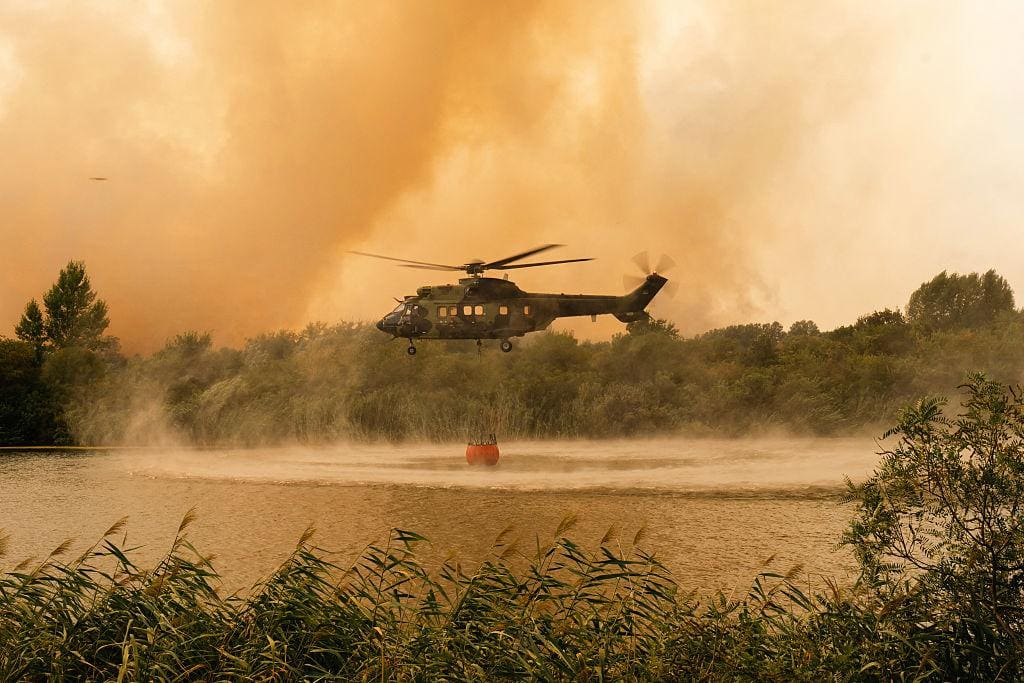
Vršac: The fires in the Deliblato Sands had been running for a fortnight before four helicopters from the rescEU fleet lifted off from bases in Czechia, Romania and Slovakia. Serbia asked for European help on Friday 21 August. The aircraft moved within hours, alongside ground crews from Germany and Romania and a liaison officer sent to sit beside Serbian commanders. By then more than 3,500 hectares of one of the country’s most valued nature reserves had burned.

That gap between the first flame and the first foreign helicopter is the part worth studying. Copernicus satellite mapping was switched on for the area on 8 August, a full thirteen days before the mechanism request. Serbia therefore knew the scale of the problem long before it asked. The delay was not European. It sat with a national authority weighing whether its own crews could still hold the line, and that calculation is one every civil protection ministry in the region makes each summer.

The rescEU fleet exists precisely because those calculations often run late. The reserve holds 22 aeroplanes and five helicopters, funded from the EU budget and stationed across eleven member states plus North Macedonia. Slovakia and Czechia each host two of the five helicopters, Romania the fifth. Nine countries have pulled on the mechanism for wildfires this summer alone, which tells you the reserve is no longer an emergency backstop but a routine part of the fire season.

Routine use creates its own problem. A reserve sized for occasional catastrophe cannot serve as everyone’s second fire brigade. When Portugal, France and Spain all called in July, the fleet stretched. When Serbia called in August, the helicopters that answered came from three countries at once, which works only because none of those three was burning that week. Commissioner Hadja Lahbib framed the deployment as proof that Europe stands together, and it is. It is also proof that solidarity currently depends on fires politely taking turns.

Serbia’s case adds a second wrinkle. Belgrade participates in the mechanism as a partner outside the Union, so its access rests on the same rules that cover member states but its own capacity build-up draws on different money. The Commission published a wildfire strategy in March that pushed prevention, land management and earlier detection rather than more aircraft. Deliblato Sands shows why. Strong winds and terrain that ground vehicles cannot reach turned a manageable fire into a two-week emergency, and no helicopter fleet fixes terrain.

The harder question for the next budget cycle is whether member states will fund permanent national capacity or keep leaning on a shared reserve that costs them nothing directly. Governments face an obvious incentive to underinvest at home when Brussels pays for the fallback. Officials in the emergency response coordination centre understand this well and have pressed capitals to treat rescEU as a top-up rather than a substitute.

For now the helicopters remain over the reserve, and the Serbian authorities have not signalled when they expect to release them. Whatever the outcome, the record will show that European aircraft reached the fire on day fourteen, and that nobody in the chain treats that as a scandal.