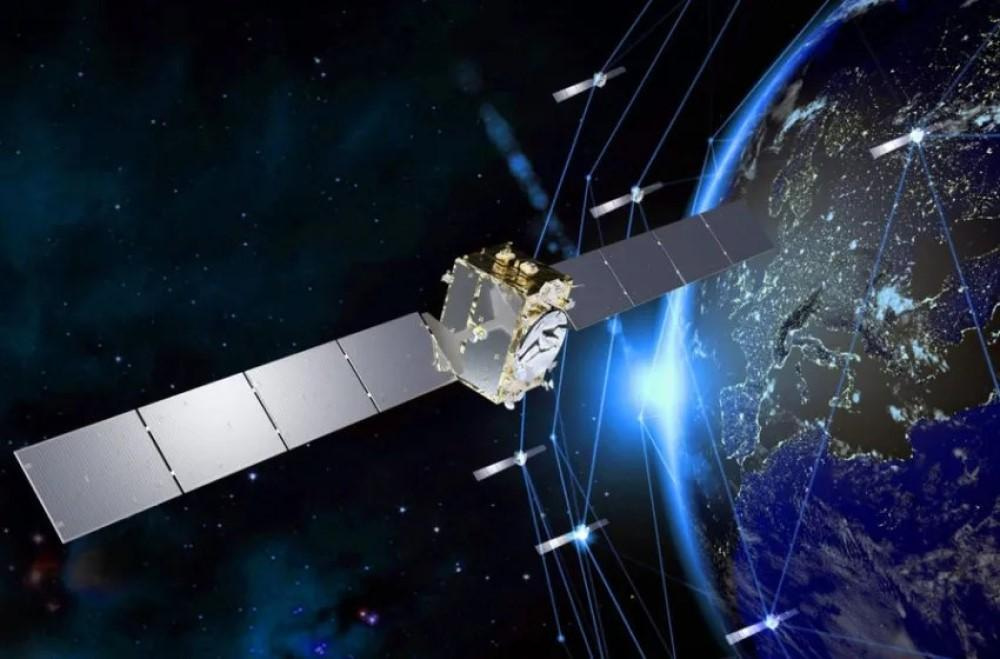
Cologne: Europe’s most ambitious space project since Galileo has cleared a decisive hurdle. SpaceRISE, the consortium of satellite operators Eutelsat, Hispasat and SES, has signed the concession agreement to design, build and run IRIS², the European Union’s planned constellation for secure government and commercial communications.
The signature turns years of planning into a binding commitment. Under the public-private partnership, the consortium takes on much of the risk and cost of assembling a satellite network of roughly 290 spacecraft, spread across low and medium Earth orbit, in exchange for the right to sell surplus capacity to commercial customers. The Union keeps sovereign control of the secure channels its governments and armies will rely on.
Brussels frames the constellation as a matter of independence rather than prestige. Europe currently leans on satellite links it does not own, a dependence that looks riskier with every geopolitical tremor. A sovereign network gives member states encrypted communications that no outside power can switch off, monitor or hold hostage during a crisis.
The system also aims to plug the continent’s connectivity gaps. Remote regions, islands and maritime routes that fibre never reached would gain high-speed broadband, and civil-protection teams could stay linked when storms or earthquakes flatten ground networks. The constellation should enter full service around 2030.
The ground is already moving. Germany broke ground in June on a GOVSATCOM hub in Cologne, one of two facilities that will anchor the programme that bridges today’s national satellites to tomorrow’s full constellation. The EU space agency EUSPA declared the GOVSATCOM service operational in January, stitching together eight satellites from five member states as a first working layer.
Money and management remain the hard part. The project has faced sharp questions over its budget, with earlier cost estimates climbing well beyond the initial public envelope and forcing the consortium to shoulder a larger commercial stake. Critics in the European Parliament have warned that a project spanning a decade and three private operators could drift over time and over budget unless the Commission holds a firm line.
Supporters counter that the alternative is worse. A Europe without its own secure constellation would keep renting capacity from foreign providers whose priorities may not align with the bloc’s, a vulnerability laid bare every time a conflict disrupts global communications. The strategic logic, they argue, justifies the spend.
The consortium now faces the engineering marathon. Building, launching and operating hundreds of satellites on a fixed timetable will test Europe’s fragmented space industry, which must coordinate manufacturers, launch providers and ground stations across many borders and national interests.
For now, the signature stands as the moment the project stopped being a proposal and became a programme with a builder, a budget and a deadline. Whether Europe can hold all three together over the coming years will decide whether the network becomes the backbone of the continent’s digital sovereignty or another cautionary tale of ambition outrunning delivery.